In 1827, Scottish botanist Robert Brown peered through his microscope at tiny pollen grains of Clarkia pulchella suspended in water. To his astonishment, he observed minute particulate matter darting continuously in rapid, erratic zig-zags through the fluid. Brown verified that these particles were not living organisms, but the physical origin of this perpetual jitter remained a mystery for nearly eight decades. In his miraculous year of 1905, Albert Einstein recognized that Brownian motion was the definitive smoking gun of the atomic hypothesis. By connecting the macroscopic viscous friction of a fluid with the microscopic stochastic collisions of atoms, Einstein and later Paul Langevin formulated the Fluctuation-Dissipation Theorem: one of the deepest pillars of non-equilibrium physics.
Einstein’s Random Walk & Mean Square Displacement
Einstein approached Brownian motion from the perspective of diffusion. Let $rho(x, t)$ be the probability density of finding a Brownian particle at position $x$ at time $t$. In a time interval $tau$, each particle undergoes random displacements $Delta$ governed by an even probability distribution $phi(Delta) = phi(-Delta)$. Expanding $rho(x, t + tau)$ in a Taylor series:
$$rho(x, t) + tau frac{partial rho}{partial t} = int_{-infty}^{infty} left[ rho(x, t) – Delta frac{partial rho}{partial x} + frac{Delta^2}{2} frac{partial^2 rho}{partial x^2} right] phi(Delta) , dDelta$$
Because $int phi , dDelta = 1$ and the mean displacement vanishes ($int Delta phi , dDelta = 0$), the first derivative disappears, leaving the classical diffusion equation:
$$frac{partial rho}{partial t} = D frac{partial^2 rho}{partial x^2}, quad D = frac{langle Delta^2 rangle}{2tau}$$
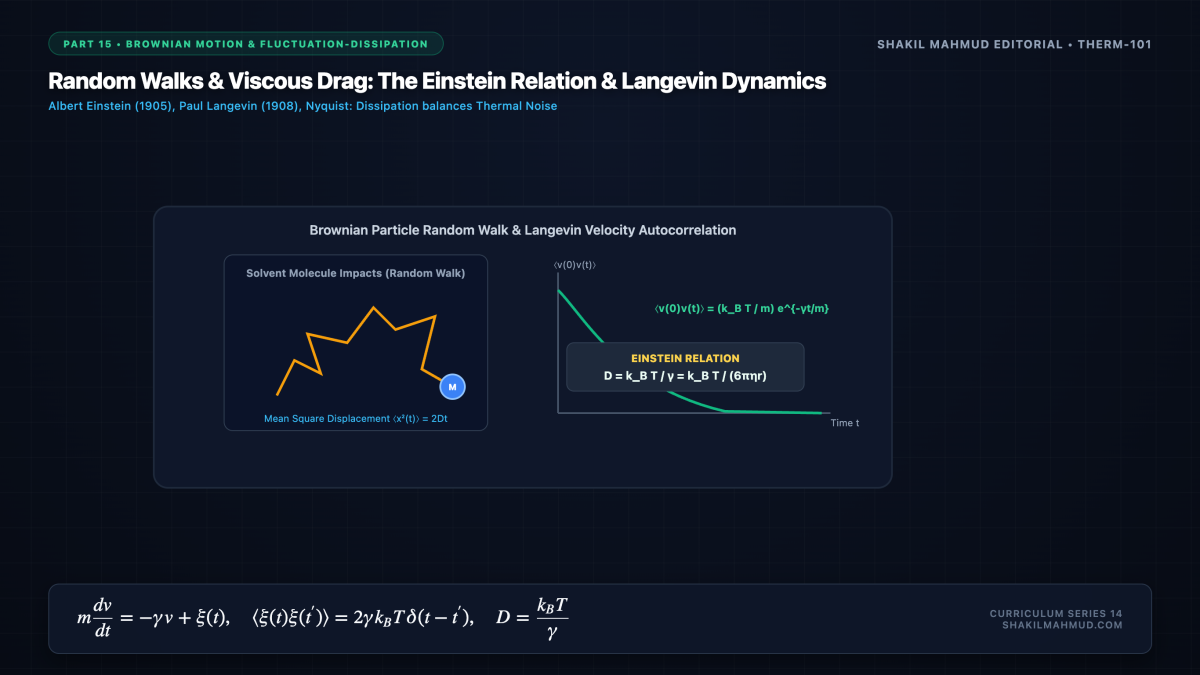
The solution for a particle starting at the origin is a spreading Gaussian. Crucially, the mean square displacement grows strictly linear with time, rather than quadratically as in ballistic motion:
$$langle x^2(t) rangle = 2 D t$$
The Einstein Relation: Duality of Noise and Drag
To connect the diffusion coefficient $D$ with microscopic thermal motion, Einstein considered a suspension of particles in dynamic equilibrium under gravity. Downward drift velocity $v_{text{drift}} = mu F = F / gamma$ (where $gamma$ is the Stokes friction coefficient) creates an downward convective flux $J_{text{drift}} = rho F / gamma$. At equilibrium, this is exactly counterbalanced by the upward Fickian diffusive flux $J_{text{diff}} = -D frac{partial rho}{partial x}$:
$$-D frac{partial rho}{partial x} + rho frac{F}{gamma} = 0 implies rho(x) propto expleft( frac{F x}{gamma D} right)$$
Comparing this directly with the Boltzmann barometric distribution $rho(x) propto exp(-mgx / k_B T) = exp(Fx / k_B T)$ yields the celebrated Einstein Relation:
$$D = frac{k_B T}{gamma} = frac{R T}{N_A (6pi eta r)}$$
where $eta$ is fluid viscosity, $r$ is particle radius, and $N_A$ is Avogadro’s number. By measuring the macroscopic diffusion of microscopic beads, French experimentalist Jean Perrin extracted $N_A approx 6.8 times 10^{23}$ in 1908, demolishing the energeticists and securing the 1926 Nobel Prize. Atoms were undeniably real.
Langevin Dynamics & Stochastic Differential Equations
In 1908, Paul Langevin introduced an alternative, dynamic formulation that gave birth to the mathematics of stochastic processes. Langevin applied Newton’s Second Law to a Brownian particle of mass $m$, splitting the total environmental force into two distinct physical components:
$$m frac{dv}{dt} = -gamma v + xi(t)$$
- Viscous Drag ($-gamma v$): A deterministic dissipative drag resisting motion, representing the average friction of the surrounding solvent.
- Stochastic Force ($xi(t)$): A rapidly fluctuating, zero-mean Gaussian random noise representing the relentless, uncorrelated bombardment of individual solvent molecules:
$$langle xi(t) rangle = 0, quad langle xi(t) xi(t’) rangle = 2 B , delta(t – t’)$$
Integrating the formal solution for velocity $v(t) = v_0 e^{-gamma t / m} + frac{1}{m} int_0^t e^{-gamma(t – s)/m} xi(s) , ds$ and taking the ensemble average of the kinetic energy $frac{1}{2} m langle v^2 rangle$ as $t to infty$, the Equipartition Theorem ($frac{1}{2} m langle v^2 rangle = frac{1}{2} k_B T$) mandates that the noise strength $B$ is uniquely determined:
$$B = gamma k_B T implies langle xi(t) xi(t’) rangle = 2 gamma k_B T , delta(t – t’)$$
The Fluctuation-Dissipation Theorem
This result is the simplest manifestation of the Fluctuation-Dissipation Theorem (generalized by Callen, Welton, and Kubo). The frictional coefficient $gamma$ measures energy dissipation (how quickly kinetic energy is drained into thermal heat). The noise correlation $B$ measures statistical fluctuations (the thermal kicks delivered by the bath). The theorem proves that these are not separate physical phenomena: dissipation cannot exist without fluctuations, and fluctuations cannot exist without dissipation. They are the two inseparable faces of thermal contact.