In 1867, James Clerk Maxwell conceived a miniature intellectual creature that would torment physicists for over a century. Imagine a vessel divided into two chambers, $A$ and $B$, separated by a partition with a microscopic, frictionless door. Sitting at the door is an intelligent entity—a “Demon”—who observes individual molecules approaching. When a fast, hot molecule approaches from $A$, the Demon opens the door to let it into $B$; when a slow, cold molecule approaches from $B$, the Demon lets it into $A$. Over time, without performing any mechanical work, chamber $B$ heats up while chamber $A$ cools down, driving heat backwards against temperature gradients and violating the Second Law of Thermodynamics. The resolution of this paradox took 115 years, forging an unbreakable bridge between physics and information theory: Information is Physical.
Szilard’s One-Molecule Heat Engine (1929)
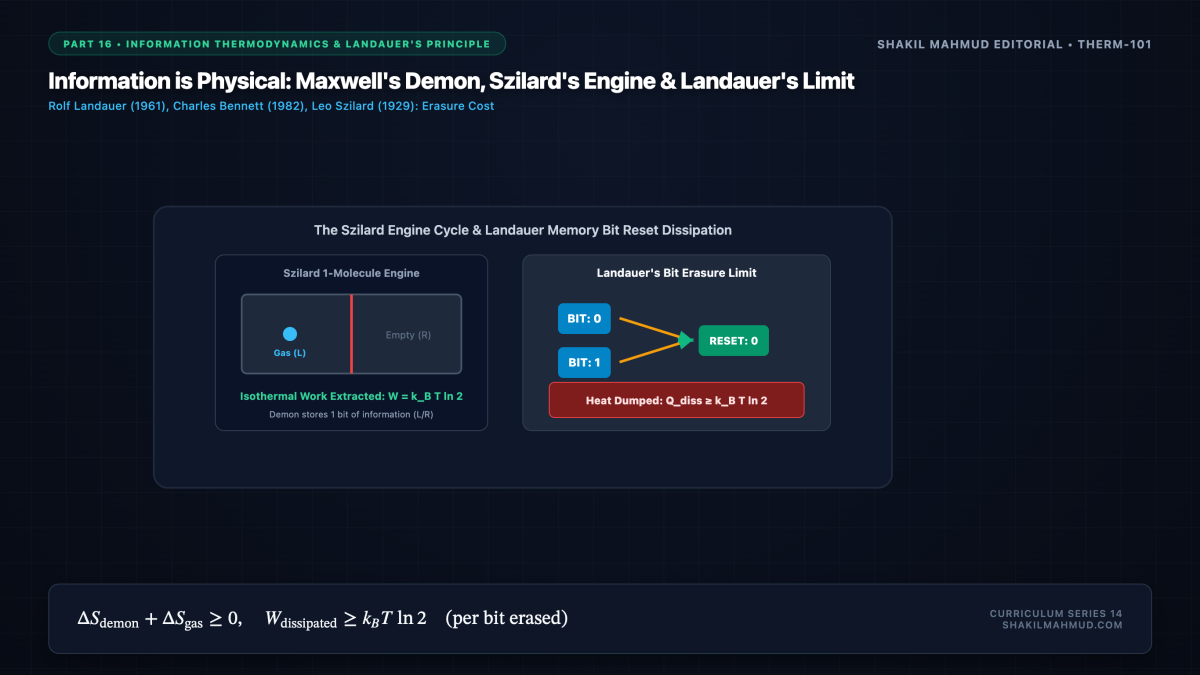
In 1929, Hungarian-American physicist Leo Szilard stripped Maxwell’s thought experiment down to its barest logical minimum. Consider a cylinder of volume $V$ in contact with a thermal bath at temperature $T$, containing a single gas molecule. The Szilard engine executes four cycles:
- Partition Insertion: A frictionless partition is slid into the exact midpoint of the cylinder, dividing it into two chambers of volume $V/2$.
- Measurement: An intelligent agent observes which side contains the molecule. The outcome is binary: Left ($L$) or Right ($R$). The agent acquires 1 bit of information.
- Isothermal Work Extraction: If the molecule is in the left chamber, a piston is attached from the right. The single molecule collides repeatedly with the piston, expanding isothermally back to full volume $V$. The work extracted from the heat bath is:
$$W = int_{V/2}^V P , dV = int_{V/2}^V frac{k_B T}{V’} dV’ = k_B T ln 2$$ - Reset: The partition is removed, returning the engine to its initial state.
The engine converted heat $Q = k_B T ln 2$ completely into mechanical work $W$ from a single reservoir with $100%$ efficiency, apparently violating Kelvin’s statement of the Second Law. Szilard deduced that to prevent this violation, the acquisition of 1 bit of information must generate an entropy increase of at least $Delta S ge k_B ln 2$.
The Measurement Myth & Landauer’s Breakthrough (1961)
For decades, physicists like Leon Brillouin and Dennis Gabor believed that the thermodynamic cost was paid during the measurement step—arguing that scattering photons off the molecule to determine its position dissipated energy. But in 1961, IBM research fellow Rolf Landauer made a revolutionary discovery: measurement can, in principle, be performed completely reversibly with zero thermodynamic dissipation!
Landauer realized that the thermodynamic bill comes not during measurement, but during the necessary step of memory erasure. A computational agent operating in a cycle must record the binary measurement ($L$ or $R$) in physical memory. At the end of the cycle, before the next measurement can be taken, this physical register must be reset to a standard baseline state (say, $0$):
$${0, 1} xrightarrow{text{Reset}} 0$$
This operation is logically irreversible: two distinct input states are mapped into a single output state. In physical phase space, this compresses the computational degrees of freedom from two possible states into one, reducing the information entropy of the memory by $Delta S_{text{memory}} = -k_B ln 2$. Because total entropy cannot decrease, this missing entropy must be dumped into the thermal environment as heat:
$$Q_{text{dissipated}} ge k_B T ln 2$$
Landauer’s Principle: Any logically irreversible manipulation of information, such as the erasure of a bit or the merging of two computational paths, must dissipate a minimum thermodynamic work of $W_{text{diss}} = k_B T ln 2$ as heat into the environment.
Bennett’s Exorcism of Maxwell’s Demon (1982)
In 1982, Charles Bennett of IBM applied Landauer’s principle to fully resolve Maxwell’s paradox. The Demon can measure the molecule without energetic cost. It can extract work $W = k_B T ln 2$ from the gas. But the Demon’s brain or computer is a physical system. As it operates, its memory fills with information. To complete a thermodynamic cycle, the Demon must erase its memory registers to prevent infinite memory accumulation.
The erasure of each bit dissipated precisely $Q = k_B T ln 2$ of heat back into the environment, perfectly canceling the extracted work and rescuing the Second Law of Thermodynamics:
$$Delta S_{text{total}} = Delta S_{text{gas}} + Delta S_{text{bath}} + Delta S_{text{demon}} ge 0$$
At room temperature ($T = 300 , text{K}$), the Landauer limit is tiny: $k_B T ln 2 approx 2.87 times 10^{-21} , text{Joules}$. Today’s silicon microprocessors dissipate roughly $1000 times$ more energy per bit flip due to resistive losses, but modern nanoscale computing is rapidly approaching Landauer’s physical frontier. Landauer’s famous dictum proved true: information is not a disembodied abstraction; information is physical.




