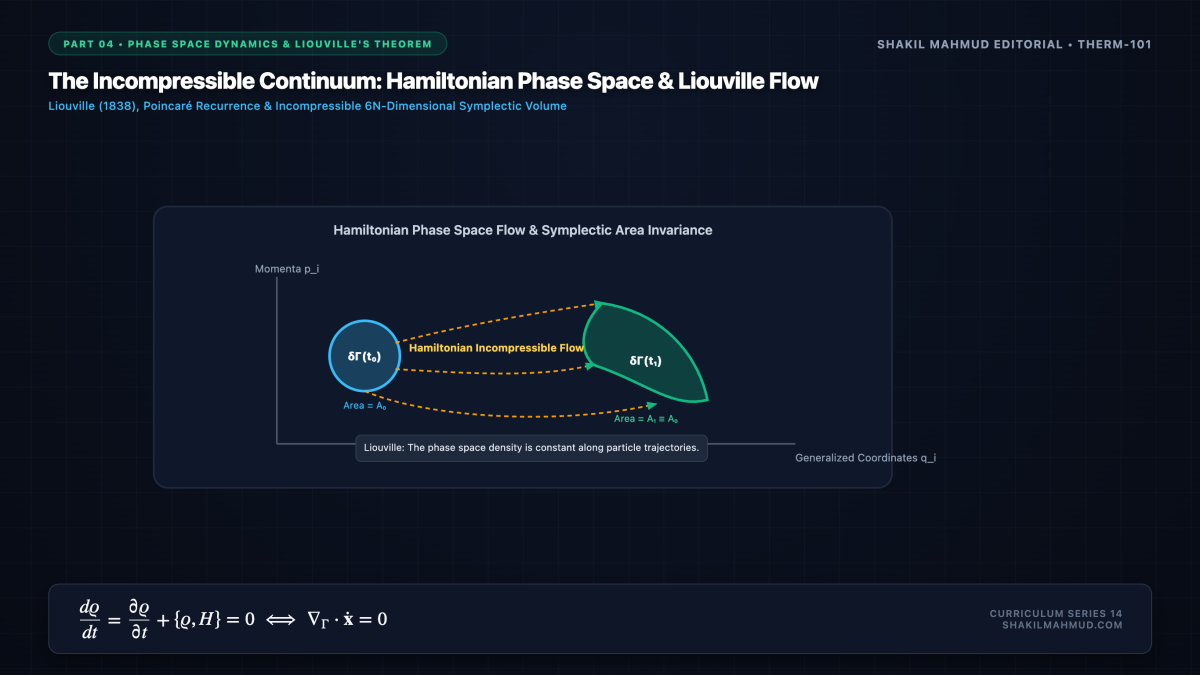
In a macroscopic glass of water, there are roughly $10^{24}$ individual molecules. To track each particle deterministically using classical mechanics would require solving $6 times 10^{24}$ simultaneous, coupled differential equations—a calculation that exceeds the memory and computational capacity of the entire observable universe. Yet thermodynamics describes this same glass of water using just three numbers: temperature, pressure, and volume. How does this miraculous reduction of complexity occur? In the mid-nineteenth century, French mathematician Joseph Liouville uncovered a profound geometric theorem of Hamiltonian mechanics that would become the conceptual bedrock of statistical physics: the incompressibility of phase space flow.
Hamiltonian Mechanics & The 6N-Dimensional Phase Space
In analytical mechanics, a system of $N$ particles is described by $3N$ generalized coordinates $mathbf{q} = (q_1, dots, q_{3N})$ and $3N$ conjugate momenta $mathbf{p} = (p_1, dots, p_{3N})$. Together, they constitute a point in a $6N$-dimensional manifold called phase space ($Gamma = mathbb{R}^{6N}$):
$$mathbf{x} = (mathbf{q}, mathbf{p}) = (q_1, dots, q_{3N}, p_1, dots, p_{3N}) in Gamma$$
The time evolution of the entire microscopic universe is governed by a single scalar function, the Hamiltonian $H(mathbf{q}, mathbf{p}, t)$, through Hamilton’s canonical equations:
$$dot{q}_i = frac{partial H}{partial p_i}, quad dot{p}_i = -frac{partial H}{partial q_i} quad (i = 1, dots, 3N)$$
A single point in phase space specifies the exact microstate of the system. As time advances, this representative point traces out a one-dimensional trajectory in $Gamma$. Because our experimental measurements can never pinpoint $10^{24}$ coordinates with infinite precision, J. Willard Gibbs proposed shifting our focus from single trajectories to a statistical ensemble: a fictitious collection of infinitely many mental copies of the system, distributed according to a probability density function $rho(mathbf{q}, mathbf{p}, t)$.
Liouville’s Theorem: The Symplectic Fluid
The probability of finding the system in an infinitesimal volume element $dGamma = d^{3N}q , d^{3N}p$ is given by $dP = rho(mathbf{q}, mathbf{p}, t) , dGamma$. Because probability is strictly conserved—no systems in the ensemble are created or destroyed—the probability density must satisfy a continuity equation in phase space, identically analogous to the mass continuity of a fluid:
$$frac{partial rho}{partial t} + nabla_{Gamma} cdot (rho dot{mathbf{x}}) = 0$$
Expanding the divergence operator across coordinates and momenta:
$$nabla_{Gamma} cdot (rho dot{mathbf{x}}) = sum_{i=1}^{3N} left[ frac{partial}{partial q_i}(rho dot{q}_i) + frac{partial}{partial p_i}(rho dot{p}_i) right] = sum_{i=1}^{3N} left( dot{q}_i frac{partial rho}{partial q_i} + dot{p}_i frac{partial rho}{partial p_i} right) + rho sum_{i=1}^{3N} left( frac{partial dot{q}_i}{partial q_i} + frac{partial dot{p}_i}{partial p_i} right)$$
Now comes the stroke of mathematical genius. Using Hamilton’s equations, we evaluate the velocity divergence:
$$frac{partial dot{q}_i}{partial q_i} + frac{partial dot{p}_i}{partial p_i} = frac{partial}{partial q_i}left(frac{partial H}{partial p_i}right) + frac{partial}{partial p_i}left(-frac{partial H}{partial q_i}right) = frac{partial^2 H}{partial q_i partial p_i} – frac{partial^2 H}{partial p_i partial q_i} equiv 0$$
Because mixed partial derivatives commute, the divergence of the Hamiltonian velocity field vanishes identically everywhere in phase space: $nabla_{Gamma} cdot dot{mathbf{x}} = 0$. Consequently, the continuity equation simplifies to the total convective derivative:
$$frac{drho}{dt} = frac{partial rho}{partial t} + sum_{i=1}^{3N} left( frac{partial rho}{partial q_i} dot{q}_i + frac{partial rho}{partial p_i} dot{p}_i right) = frac{partial rho}{partial t} + {rho, H} = 0$$
This is Liouville’s Theorem. It states that the phase space density along the trajectory of any moving system is invariant in time. Viewed geometrically, the ensemble moves through $6N$-dimensional phase space exactly like an incompressible fluid. If an initial droplet of microstates has volume $delta Gamma_0$, its shape may stretch, twist, and bifurcate into extraordinarily intricate filaments under chaotic dynamics, but its total volume is preserved with absolute mathematical perfection: $int_{delta Gamma_t} dGamma = int_{delta Gamma_0} dGamma$.
Poincaré Recurrence & The Paradox of Equilibrium
In 1890, Henri Poincaré established a staggering corollary to Liouville’s theorem for bounded Hamiltonian systems. If a system is confined to a finite energy surface (so that the total accessible phase space volume $Omega(E) < infty$), any initial state will, almost surely, return arbitrarily close to its initial configuration after a finite time: the Poincaré Recurrence Time.
This theorem ignited a philosophical firestorm known as the reversibility paradox. If phase space volume is strictly conserved and every particle trajectory is mathematically bound to recur, how can entropy increase? How can a drop of ink dissolve irreversibly in water? The answer lies in the distinction between coarse-grained and fine-grained information. While the fine-grained Liouville volume is invariant, chaotic trajectories stretch it into microscopic filaments that uniformly penetrate every crevice of the accessible energy shell. To any macroscopic observer with finite measurement resolution, the ink has irreversibly reached uniform equilibrium.




