In classical statistical mechanics, uncertainty is purely epistemic: a billiard ball possesses a definite position and momentum, and our ignorance is merely an artifact of having $10^{23}$ coordinates. In the quantum realm, however, uncertainty is ontological. A microscopic system can reside in a coherent linear superposition of states, yet when interacting with a macroscopic thermal environment, quantum phase interference dissolves into classical probabilities. In 1927, Hungarian polymath John von Neumann and Soviet physicist Lev Landau independently formulated the mathematical language of quantum statistical mechanics: the Density Matrix Formalism.
Pure States versus Statistical Mixed States
In standard quantum mechanics, an isolated system is described by a state vector $|psirangle$ living in a complex Hilbert space $mathcal{H}$. Such a state is termed pure. The expectation value of an observable represented by Hermitian operator $hat{A}$ is given by $langle hat{A} rangle = langle psi | hat{A} | psi rangle$. In a thermal system, however, we face a dual layer of uncertainty: fundamental quantum indeterminacy combined with classical ignorance of which specific state the system prepared.
Consider an ensemble where the system has classical probability $p_i$ of being in state $|psi_irangle$ (where $sum_i p_i = 1$). To calculate the ensemble expectation value of $hat{A}$, we must average over both quantum expectation and classical probabilities:
$$langle langle hat{A} rangle rangle = sum_i p_i langle psi_i | hat{A} | psi_i rangle$$
Von Neumann recognized that this entire statistical ensemble can be encoded into a single linear operator, the Density Operator $hat{rho}$:
$$hat{rho} = sum_{i} p_i |psi_irangle langle psi_i|$$
Using the completeness relation of an orthonormal basis ${|nrangle}$, the expectation value reduces to an operator trace:
$$langle hat{A} rangle = operatorname{Tr}(hat{rho} hat{A}) = sum_n langle n | hat{rho} hat{A} | n rangle$$
Mathematical Properties of the Density Matrix
Every physically admissible density matrix satisfies four inviolable mathematical axioms:
- Hermiticity: $hat{rho}^dagger = hat{rho}$, ensuring real eigenvalues.
- Unit Trace: $operatorname{Tr}(hat{rho}) = sum_i p_i = 1$, representing total probability conservation.
- Positive Semi-Definiteness: $langle phi | hat{rho} | phi rangle ge 0$ for all state vectors $|phirangle$, ensuring non-negative probabilities.
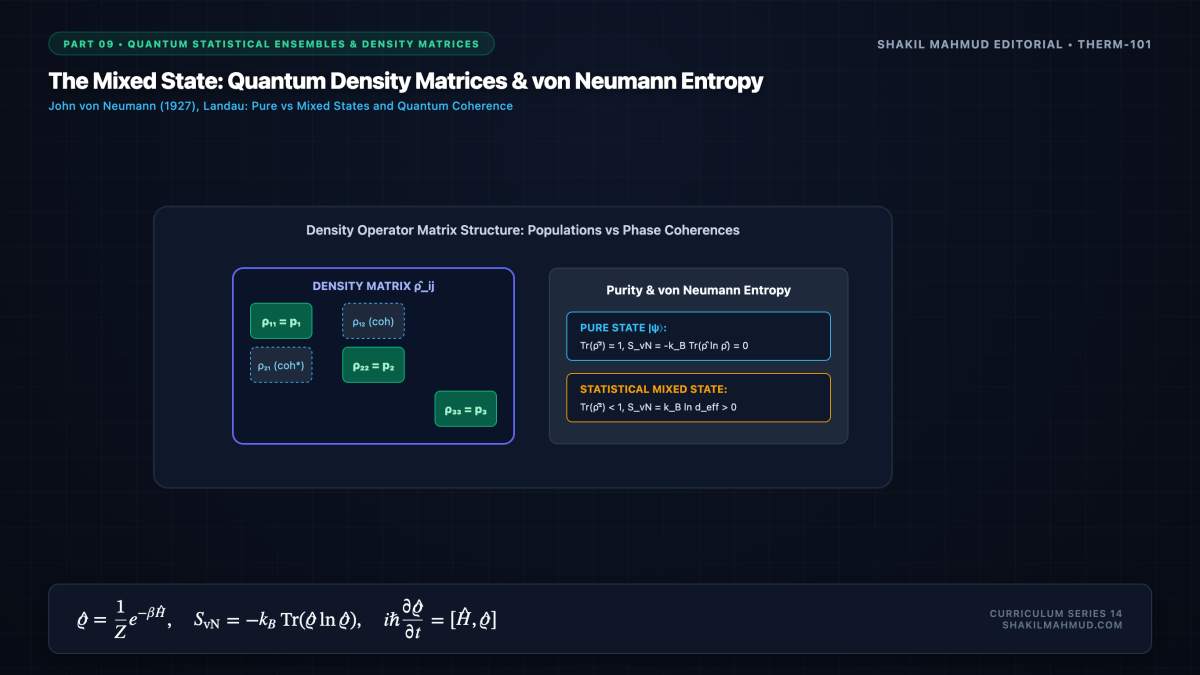
- Purity Criterion: $operatorname{Tr}(hat{rho}^2) le 1$. The equality $operatorname{Tr}(hat{rho}^2) = 1$ holds if and only if the system is in a pure state ($hat{rho} = |psiranglelanglepsi|$). For any genuine mixed state, $operatorname{Tr}(hat{rho}^2) < 1$.
The matrix representation in an energy eigenbasis reveals the physical anatomy of the quantum state: diagonal elements $rho_{nn} = langle n | hat{rho} | n rangle$ represent the classical populations (probabilities of occupying energy level $E_n$), while off-diagonal elements $rho_{nm} = langle n | hat{rho} | m rangle$ ($n ne m$) quantify quantum coherences—the delicate phase interference between energy states.
The von Neumann Equation of Motion & von Neumann Entropy
The time evolution of the density operator follows directly from the Schrödinger equation for individual state vectors, yielding the von Neumann Equation (the quantum analogue of Liouville’s theorem):
$$ihbar frac{partial hat{rho}}{partial t} = [hat{H}, hat{rho}] = hat{H}hat{rho} – hat{rho}hat{H}$$
In thermal equilibrium, the density matrix must be stationary ($partial hat{rho} / partial t = 0$), which mandates that $[hat{H}, hat{rho}] = 0$. Consequently, $hat{rho}$ is diagonal in the energy eigenbasis. In the canonical ensemble at inverse temperature $beta = 1/k_B T$, the density operator takes the pristine form:
$$hat{rho}_{text{canonical}} = frac{1}{Z} e^{-beta hat{H}}, quad Z = operatorname{Tr}(e^{-beta hat{H}})$$
To quantify the missing information in a quantum statistical state, von Neumann formulated the quantum entropy:
$$S_{text{vN}} = -k_B operatorname{Tr}(hat{rho} ln hat{rho}) = -k_B sum_n lambda_n ln lambda_n$$
where $lambda_n$ are the eigenvalues of $hat{rho}$. For any pure state, $S_{text{vN}} = 0$; for a completely mixed state in a $d$-dimensional Hilbert space, $S_{text{vN}} = k_B ln d$. Through von Neumann’s formulation, quantum mechanics and thermodynamics fused into an indivisible theoretical architecture.