If the Second Law of Thermodynamics dictates that entropy must inexorably increase, driving all closed systems toward featureless disorder and thermal death, how can the universe create galaxies, planets, living cells, and conscious minds? Is life an illegal rebellion against the laws of physics? In the 1960s and 1970s, Russian-born Belgian physical chemist Ilya Prigogine and the Brussels School revolutionized science by demonstrating that far from equilibrium, the Second Law does not destroy order—it creates it. When a system is driven by powerful external flows of energy and matter, classical thermodynamic branches become unstable, spontaneously bifurcating into dynamic, self-organizing structures: Dissipative Structures.
Near-Equilibrium Stability versus Far-From-Equilibrium Instability
In linear non-equilibrium thermodynamics, Prigogine proved the Theorem of Minimum Entropy Production: a system close to equilibrium subjected to fixed time-independent boundary constraints will settle into a stationary state that minimizes its total entropy production rate ($P = int sigma , dV = text{minimum}$). In this linear regime, the stationary state is unconditionally stable: any small fluctuation is immediately damped out, returning the system to uniform mediocrity.
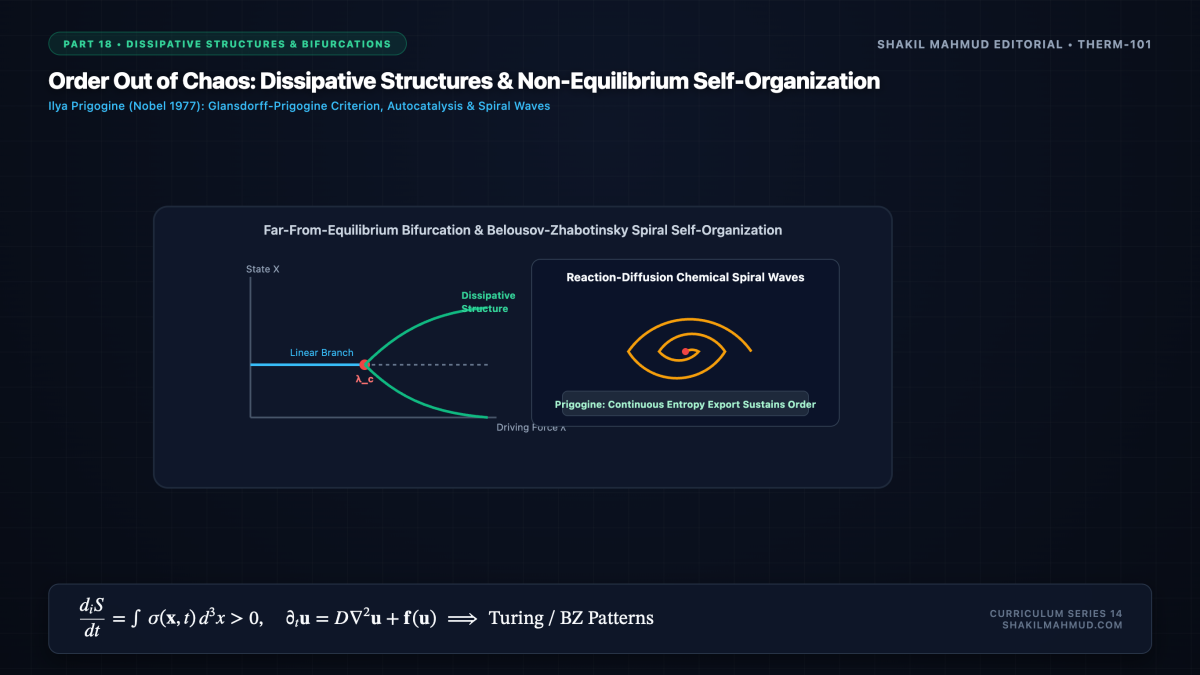
When the thermodynamic driving force $lambda$ is pushed far from equilibrium past a critical threshold $lambda_c$, however, linear response completely breaks down. Nonlinear chemical kinetics (such as autocatalysis) and hydrodynamic convective terms destabilize the system. Prigogine and Paul Glansdorff formulated the general stability criterion by examining the second-order variation of entropy $delta^2 S$. The time derivative of this excess entropy defines the Glansdorff-Prigogine Stability Criterion:
$$frac{1}{2} frac{partial}{partial t}(delta^2 S) = sum_{i} delta J_i , delta X_i > 0 quad (text{Stability})$$
If the excess entropy production becomes negative ($sum_i delta J_i , delta X_i < 0$), the thermodynamic branch becomes unstable. The system undergoes a catastrophic bifurcation: microscopic thermal fluctuations are amplified across macroscopic scales, driving the system into a brand-new, organized dynamic regime.
What is a Dissipative Structure?
Prigogine coined the term Dissipative Structure to capture a profound paradox. In equilibrium thermodynamics, static structures (such as crystals) are maintained by potential energy minima without consuming any energy ($dE = 0$). A dissipative structure, by contrast, is a dynamic macroscopic pattern that maintains its organized coherence only by continuously consuming free energy and dissipating entropy into its surroundings.
Decomposing the total entropy change into internal production $d_i S$ and environmental exchange $d_e S$:
$$dS = d_e S + d_i S, quad d_i S ge 0$$
While the internal entropy production $d_i S$ must strictly satisfy the Second Law ($d_i S ge 0$), an open system can export entropy to its environment such that $d_e S < 0$. If the exported entropy exceeds internal production:
$$|d_e S| > d_i S implies dS < 0$$
The system’s internal entropy decreases! Far from violating the Second Law, the creation of local order is purchased by pumping vast amounts of disorder and degraded heat into the wider universe.
Archetypes of Self-Organization: Bénard Cells & The BZ Reaction
Dissipative structures manifest throughout physics, chemistry, and biology:
- Rayleigh-Bénard Convection: A thin horizontal layer of oil heated from below. At small temperature gradients $Delta T$, heat is transported entirely by silent molecular conduction. But when $Delta T$ crosses a critical Rayleigh number $Ra_c approx 1708$, conduction becomes unstable. Trillions of molecules spontaneously coordinate their motion into millions of regular hexagonal convection cells, rotating clockwise and counterclockwise in stunning macroscopic harmony.
- The Belousov-Zhabotinsky (BZ) Reaction: An autocatalytic cocktail of bromate ions, malonic acid, and a cerium/ferroin catalyst. Instead of decaying into a uniform brown mixture, the solution acts as a chemical clock, pulsing periodically between red and blue. In a petri dish, it generates rotating target patterns and chemical spiral waves: dynamic reaction-diffusion structures governed by Alan Turing’s morphogenesis equations:
$$partial_t mathbf{u} = mathbf{D} nabla^2 mathbf{u} + mathbf{f}(mathbf{u})$$
Thermodynamics as the Mother of Complexity
For two centuries, the Second Law had been perceived as a grim cosmic executioner, condemning the universe to decay, rot, and entropic death. Prigogine transformed this perspective forever. For his pioneering work on dissipative structures, he was awarded the 1977 Nobel Prize in Chemistry. Non-equilibrium thermodynamics proved that living organisms, ecosystems, and human cities are not anomalous accidents; they are nature’s most sophisticated dissipative engines, extracting order from chaos by driving the thermodynamic flows of our cosmos.