In 1920, German physicist Wilhelm Lenz assigned his doctoral student Ernst Ising a mathematical problem: can a simplified lattice of interacting magnetic dipoles explain spontaneous ferromagnetism? In 1925, Ising solved the model in one dimension and found, to his deep dismay, that no phase transition occurred at any temperature above absolute zero ($T_c = 0$). Ising prematurely concluded that the model would never exhibit ferromagnetism in any dimension. For two decades, theoretical physics was haunted by the suspicion that statistical mechanics was mathematically incapable of producing true phase transitions. Then, in 1944, a quiet Norwegian-American chemist named Lars Onsager published an exact mathematical solution for the two-dimensional Ising model that stunned the scientific world.
The Ising Hamiltonian & The 1D Failure
The Ising model considers a discrete regular lattice of $N$ sites. Each site $i$ hosts a binary spin variable $s_i in {+1, -1}$, representing an up or down magnetic dipole. The Hamiltonian with nearest-neighbor ferromagnetic coupling ($J > 0$) and an external magnetic field $h$ is:
$$H(mathbf{s}) = -J sum_{langle i, j rangle} s_i s_j – h sum_{i=1}^N s_i$$
In one dimension, with periodic boundary conditions, the partition function can be expressed through a $2 times 2$ Transfer Matrix $mathbf{T}$:
$$Z_{1D} = sum_{s_1, dots, s_N} prod_{i=1}^N e^{beta J s_i s_{i+1}} = operatorname{Tr}(mathbf{T}^N) = lambda_+^N + lambda_-^N$$
where $lambda_pm = e^{beta J} cosh(beta h) pm sqrt{e^{2beta J} sinh^2(beta h) + e^{-2beta J}}$. In the thermodynamic limit $N to infty$, the free energy per spin is determined solely by the largest eigenvalue: $f = -k_B T ln lambda_+$. Because $lambda_+$ is strictly positive and infinitely differentiable for all $T > 0$, no singularity can ever develop. Rudolf Peierls later explained the physical reason: in 1D, creating a domain wall costs a finite energy $Delta E = 2J$ but gains an entropy $Delta S = k_B ln N$. The free energy change $Delta F = 2J – k_B T ln N$ is negative for any non-zero temperature as $N to infty$, causing thermal fluctuations to shred magnetic order instantly.
Peierls’ Argument & Kramers-Wannier Duality
In 1936, Peierls proved that in two dimensions, long-range order survives at low temperatures. A closed boundary separating opposite spin domains of perimeter $L$ costs energy $Delta E = 2 J L$. Because the number of self-avoiding closed loops of length $L$ scales as $c^L$, the free energy cost of a domain boundary is:
$$Delta F approx (2J – k_B T ln c) L$$
For sufficiently low temperatures ($T 0$ and scales proportionally with perimeter $L$, exponentially suppressing macroscopic domain walls and preserving spontaneous magnetization.
In 1941, Hendrik Kramers and Gregory Wannier discovered an astonishing geometrical symmetry: Kramers-Wannier Duality. They mapped the high-temperature expansion of the 2D Ising model on a square lattice into the low-temperature expansion on the dual square lattice, linking coupling constant $K = beta J$ to a dual coupling $K^* = beta^* J$ via:
$$sinh(2K) sinh(2K^*) = 1$$
Assuming a single phase transition exists, it must occur at the unique self-dual fixed point $K = K^*$. This predicted the exact critical temperature without solving the model:
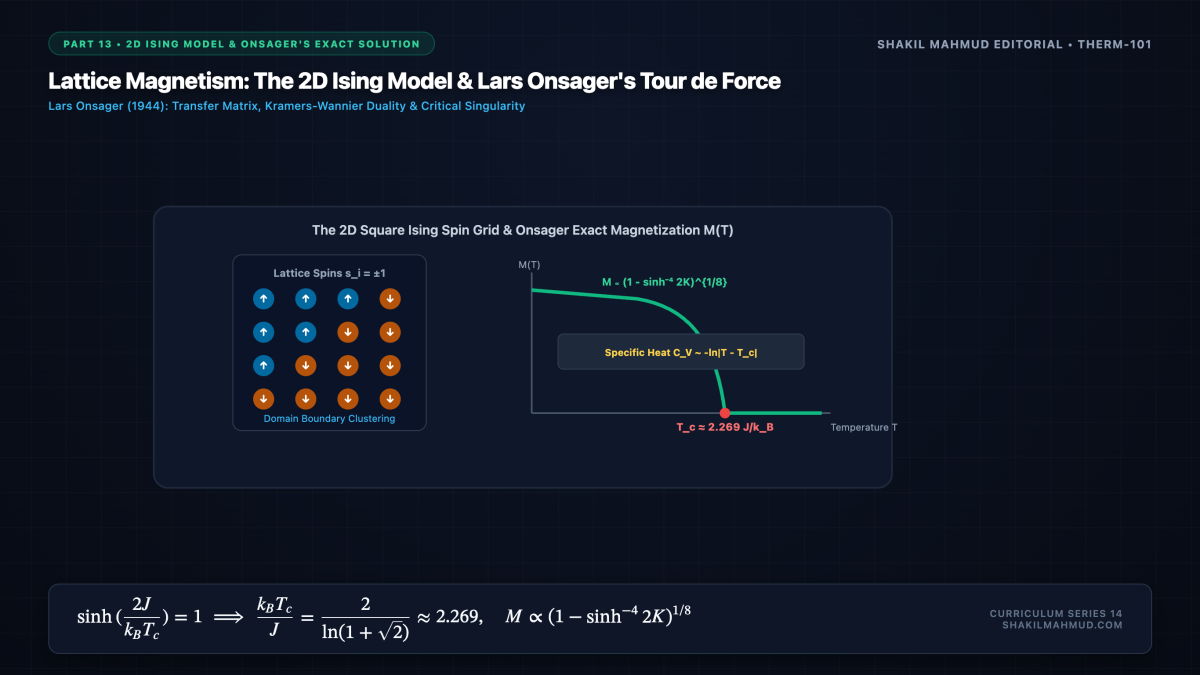
$$sinhleft(frac{2J}{k_B T_c}right) = 1 implies frac{k_B T_c}{J} = frac{2}{ln(1 + sqrt{2})} approx 2.269185$$
Onsager’s Exact Solution (1944)
In a tour de force of twentieth-century mathematical physics, Lars Onsager solved the 2D Ising partition function in zero external field for arbitrary system size using a row-to-row transfer matrix of dimension $2^M times 2^M$. By recognizing that the transfer matrix could be factorized into elements of an infinite-dimensional Clifford algebra and decomposed into $2M$ free fermionic operators, Onsager derived the exact free energy in the thermodynamic limit:
$$-beta f = ln(2 cosh 2K) + frac{1}{2pi} int_{0}^{pi} lnleft[ frac{1}{2}left( 1 + sqrt{1 – kappa^2 sin^2 theta} right) right] dtheta$$
where $kappa = frac{2 sinh 2K}{cosh^2 2K}$. At the critical temperature $T_c$, $kappa = 1$, producing an exact elliptic singularity. Differentiating $f$ twice, Onsager proved that the specific heat diverges logarithmically:
$$C_V sim – frac{2 k_B}{pi} left(frac{2J}{k_B T_c}right)^2 ln|T – T_c|$$
In 1952, C. N. Yang derived the exact spontaneous magnetization below $T_c$:
$$M(T) = left[ 1 – sinh^{-4}left(frac{2J}{k_B T}right) right]^{1/8} propto (T_c – T)^{1/8}$$
The critical exponent was $beta = 1/8 = 0.125$—radically different from Landau’s mean-field prediction of $beta = 1/2 = 0.5$. Onsager demonstrated that near a critical point, thermal fluctuations tear classical approximations to shreds, proving conclusively that statistical mechanics can generate true macroscopic singularities from smooth microscopic laws.