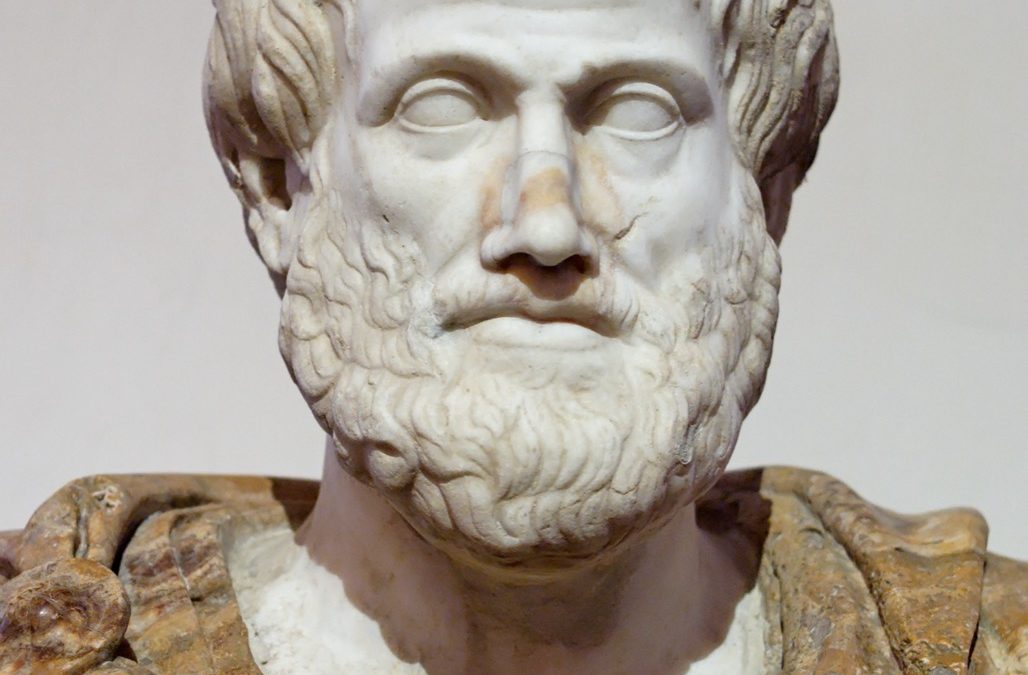
For two decades, Aristotle walked the shaded porticos of Plato’s Academy as its most formidable intellect. Yet when the time came to construct his own philosophical system at the Lyceum, Aristotle initiated a historic correction. In Raphael’s iconic fresco The School of Athens, Plato points his index finger toward the transcendent heavens of mathematical Forms, while Aristotle holds his palm horizontal toward the earth, gesturing to the empirical world of living organisms, tangible substances, and biological change: “Dear is Plato, but dearer still is truth.”
Substance, Matter, and Form (Hylomorphism)
Aristotle rejected Plato’s radical separation of the Forms into an ethereal second world. If Forms exist outside physical things, how can they cause movement, generation, or decay in material objects? Aristotle’s solution was Hylomorphism (from hyle, matter, and morphe, form): reality is composed of individual concrete substances (ousia). In every substance, matter provides the potentiality (dynamis) to become something, while form provides the actuality (energeia) that makes it what it is. A bronze statue cannot exist without both its bronze substrate and its sculptural shape.
The Four Causes (Aitia) of Being
To achieve genuine scientific comprehension (episteme) of any natural phenomenon, Aristotle argued that human reason must articulate four irreducible explanatory factors:
- Material Cause: That out of which something comes to be (e.g., the marble of a statue).
- Formal Cause: The blueprint, essence, or structural definition (e.g., the proportion and shape of the statue).
- Efficient Cause: The primary agent or motion that initiates the change (e.g., the sculptor wielding chisel and hammer).
- Final Cause (Telos): The purpose, function, or end toward which the entity aims (e.g., honoring an Olympian hero).
Teleology and the Biological Engine
Aristotle was the first great biologist in history. Dissecting marine organisms on the island of Lesbos, he recognized that nature is governed by Teleology: every acorn contains the internal imperative to actualize into a mature oak tree. Nature does nothing in vain; every organ, physiological cycle, and ecological niche serves an overarching functional end.
At the apex of this dynamic cosmic chain stands the Unmoved Mover (Prime Mover)—an eternal, immaterial entity composed of pure actuality (Actus Purus) with no unrealized potentiality. The Unmoved Mover does not push physical objects mechanically; rather, it moves the universe as the ultimate object of desire and love, inspiring all cosmic matter to realize its highest inherent form.
Nicomachean Ethics: Eudaimonia and the Golden Mean
Applying teleology to human action, Aristotle asked: What is the supreme final good for human life? While wealth, pleasure, and honor are pursued as instrumental means, only Eudaimonia (flourishing, true human fulfillment) is sought for its own sake. Because human beings are fundamentally rational animals, eudaimonia consists of an active life lived in accordance with excellence or virtue (arete).
“We are what we repeatedly do. Excellence, then, is not an act, but a habit.” — Aristotle
Moral virtue, Aristotle demonstrated, is governed by the Doctrine of the Golden Mean: the virtuous choice lies at an intermediate point between two destructive extremes of excess and deficiency. Courage is the mean between cowardice (deficiency) and rashness (excess); temperance is the mean between insensibility and gluttony. Virtue is thus not an innate biological reflex, but a cultivated habitual disposition (hexis) mastered through practical wisdom (phronesis).