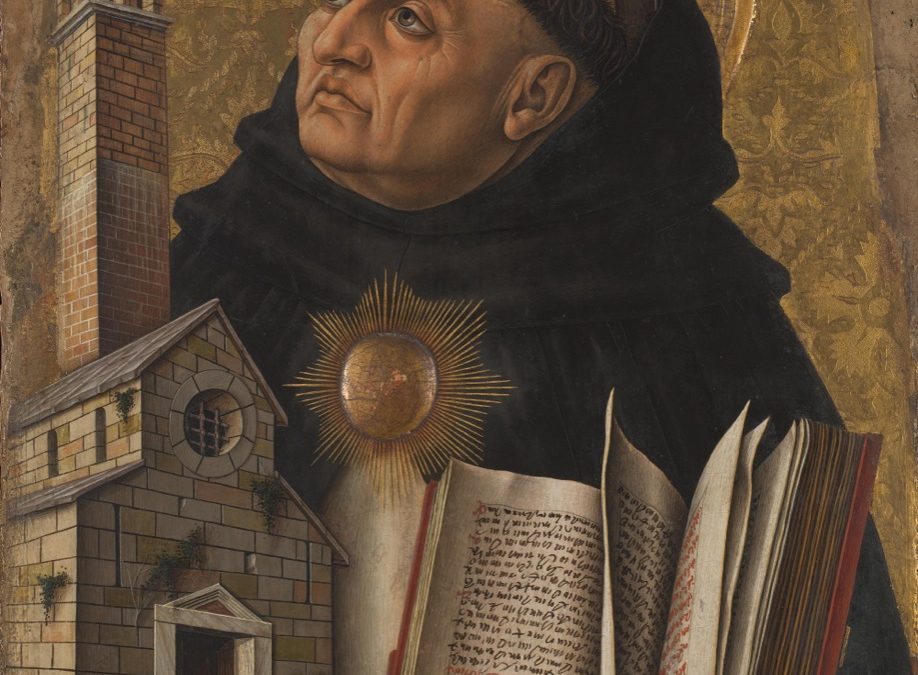
In the thirteenth century, Western Europe experienced a seismic intellectual reawakening. The rediscovery of Aristotle’s complete works—translated into Latin from Arabic and Greek alongside the commentaries of Avicenna and Averroës—flooded the newly chartered universities of Paris, Bologna, and Oxford. The initial reaction of the Catholic Church was panic: Aristotle was a pagan who taught that the universe was uncreated and eternal, and that the individual soul dies with the body. Church councils banned his natural philosophy. But at the University of Paris, a quiet, physically imposing Dominican friar named Thomas Aquinas (1225–1274)—dubbed “The Dumb Ox” by his classmates—embarked on the most audacious reconciliation in intellectual history: the Scholastic Synthesis.
Grace Does Not Destroy Nature, but Perfects It
Aquinas boldly rejected the anti-intellectual dogma that faith requires intellectual blindness. In his monumental masterpieces, the Summa Theologiae and Summa contra Gentiles, Thomas articulated the core principle of Christian humanism: “Gratia non tollit naturam, sed perficit” (Grace does not destroy nature, but perfects it). Human reason, endowed by God, is an autonomous, reliable instrument capable of discovering truth about the natural world through empirical observation and logical deduction.
“To one who has faith, no explanation is necessary. To one without faith, no explanation is possible… Yet reason in man is rather like God in the world.” — Saint Thomas Aquinas
Thomas mapped reality into two harmonious realms: Natural Reason (which discovers philosophy, mathematics, physics, and natural ethics) and Divine Revelation (which reveals the Trinity, the Incarnation, and salvation). Because God is the author of both natural reality and revelation, true philosophy and true theology can never contradict one another. Any apparent conflict is simply an error in philosophical reasoning or an incorrect interpretation of scripture.
The Five Ways (Quinque Viae): Proofs for the Existence of God
In Question 2 of the Summa Theologiae, Aquinas formulated five classical a posteriori demonstrations for God’s existence, beginning not with abstract definitions, but with observable empirical facts:
- The Argument from Motion: Whatever is moved must be moved by another; an infinite regress of simultaneous movers is impossible; therefore, there must exist a First Unmoved Mover.
- The Argument from Efficient Cause: Nothing can be the efficient cause of itself; an infinite regress of causes in the present cannot sustain reality; therefore, there must exist a First Uncaused Cause.
- The Argument from Contingency: Contingent things are capable of not existing; if everything were contingent, at one time nothing would have existed, and nothing could have begun; therefore, there must exist a Necessary Being.
- The Argument from Degree: Things possess more or less goodness, truth, and noble qualities; degrees of perfection require a maximum standard of comparison; therefore, there must exist a Supreme Perfection.
- The Teleological Argument: Non-intelligent natural bodies act regularly toward an end to achieve the best result; they cannot move toward a goal unless guided by intelligence; therefore, there exists an Intelligent Designer directing all nature.
Actus Purus: God as Ipsum Esse Subsistens
Aquinas adopted Avicenna’s distinction between essence and existence to formulate his revolutionary concept of the divine nature. In all created entities, essence and existence are distinct: a tree possesses tree-ness, but its existence is received and contingent. In God alone, however, Essence and Existence are identical: God is not an entity who happens to exist among other beings; God is Ipsum Esse Subsistens—the Subsistent Act of Existing Itself.
Because God is pure actuality (Actus Purus) with zero potentiality, God is eternal, immutable, and simple. We cannot know what God is in Himself (the apophatic way), but we can speak meaningfully of divine perfections through the Analogy of Being (analogia entis): human wisdom and goodness are analogical reflections of their infinite divine source.
The Silence of the Angelic Doctor
On December 6, 1273, while celebrating mass at the Dominican chapel in Naples, Thomas Aquinas experienced a profound mystical vision. He laid down his pen and left the final sections of the Summa Theologiae unfinished. When his secretary, Father Reginald of Piperno, urged him to resume writing, Thomas whispered: “I can do no more; such things have been revealed to me that all that I have written seems to me as so much straw.” The intellectual titan of Scholasticism fell silent, acknowledging that the ultimate horizon of Being transcends even the highest architecture of rational theology.