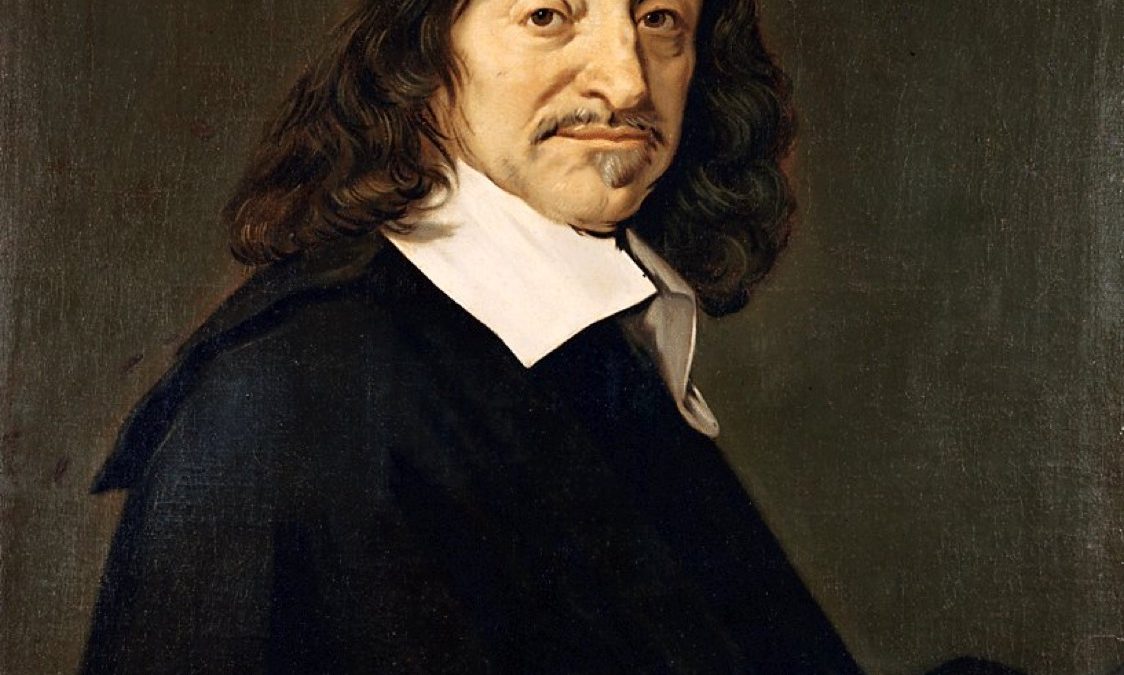
In the winter of 1619, while serving in the armies of the Thirty Years’ War in Bavaria, a twenty-three-year-old French soldier and mathematician named René Descartes shut himself inside a stove-heated room (poêle). Outside, Europe was tearing itself apart in religious warfare while Galileo’s telescope and Copernicus’s heliocentrism shattered the medieval Aristotelian cosmos. If the Earth moves, if the sun stands still, and if traditional scholastic authorities had been catastrophically mistaken for millennia, what can human beings ever know with absolute, indubitable certainty? Descartes resolved to dismantle the entire scaffolding of human belief and construct an unshakable foundation for science upon the bedrock of pure reason.
The Method of Radical Hyperbolic Doubt
In his 1641 masterpiece, Meditations on First Philosophy, Descartes unleashed a systematic intellectual purge known as Methodological Doubt. He did not seek to become a chronic skeptic who denies truth; rather, he weaponized skepticism as an acid to dissolve every opinion that contained even the slightest possibility of error:
- The Unreliability of the Senses: The senses routinely deceive us (a straight stick looks bent in water, distant towers look round when they are square). Wisdom demands never completely trusting that which has deceived us even once.
- The Dream Argument: There are no definitive empirical signs by which we can distinguish waking consciousness from vivid dreams. At this very instant, we could be asleep in bed dreaming of reading these words.
- The Malicious Demon (Genius Malignus): Descartes pushed doubt to its cosmic extreme: Imagine not a benevolent God, but an omnipotent, supremely cunning demon who devotes his entire power to systematically deceiving my mind—making me believe 2 + 3 = 5 or that a physical world exists when there is only cosmic void.
“I will suppose, then, not that Deity, who is sovereignly good and the fountain of truth, but that some malignant demon, who is at once exceedingly potent and deceitful, has employed all his artifice to deceive me.” — René Descartes
The Archimedean Point: Cogito, Ergo Sum
At the darkest depth of the Second Meditation, when all sensory reality, geometry, and bodily existence seem swallowed by the demon’s illusion, Descartes discovered his indubitable Archimedean point. Even if the evil demon deceives me with absolute power, he cannot deceive me unless I exist to be deceived. To doubt is to think; to be deceived is to think; and thought cannot occur without an existing subject:
“Cogito, ergo sum” — I think, therefore I am.
The Cogito is not a syllogistic deduction; it is an immediate, intuitive self-affirmation. At the precise instant the proposition is uttered or conceived in the mind, it is necessarily true. From this single unassailable foothold, Descartes established the sovereign authority of the individual conscious subject as the starting point of all modern epistemology.
Cartesian Substance Dualism
Having established the certainty of the thinking self, Descartes bifurcated reality into two completely separate, mutually exclusive substances:
| Property | Res Cogitans (Thinking Substance) | Res Extensa (Extended Substance) |
|---|---|---|
| Essence | Consciousness, thought, volition, doubt | Spatial extension (length, breadth, depth) |
| Divisibility | Indivisible, unified, non-spatial | Infinitely divisible into geometric parts |
| Causality | Free will, rational autonomy | Strict deterministic mechanical causality |
| Location | Immaterial soul (interfaces at pineal gland) | Physical bodies, clockwork universe, animals |
The Clockwork Universe and the Mind-Body Ghost
Descartes’ division between Res Cogitans and Res Extensa had colossal consequences for the history of science. By demythologizing the physical universe into pure geometric extension governed by mechanical laws of collision, Descartes liberated physics, astronomy, and biology from scholastic animism and occult qualities. Animals and physical bodies were clockwork machines that could be dissected and analyzed mathematically.
Yet this triumph created the notorious Mind-Body Problem that haunts cognitive science to this day: If the soul is purely immaterial with no spatial dimensions, and the brain is a mechanical physical machine, how can they causally interact? How does a non-physical thought move a physical finger, or a physical stubbed toe produce the conscious sensation of agony? In attempting to secure certainty for the human mind, Descartes created the ghost in the machine.