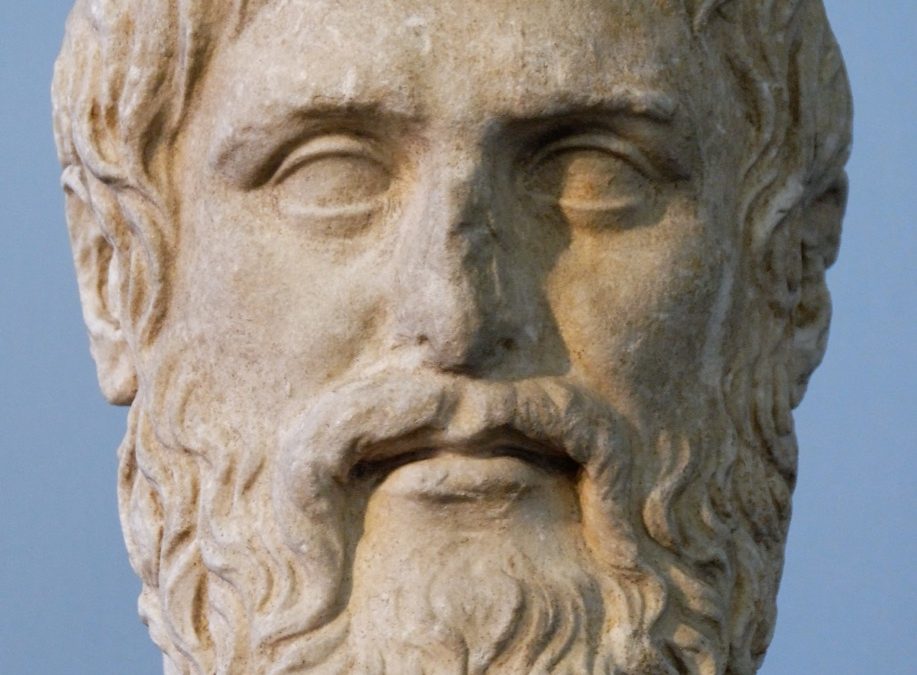
When the democratic court of Athens executed Socrates in 399 BCE, his brilliant thirty-year-old student Plato suffered an intellectual trauma that reshaped the destiny of world philosophy. How could the most civilized republic on earth legally put to death its most virtuous citizen? Plato concluded that empirical political regimes and sensory human experiences are fundamentally disordered because they mistake ephemeral shadows for enduring reality. Retiring from Athenian politics to found the Academy—the first university in the Western world—Plato constructed a breathtaking two-world ontology that answered both the Eleatic demand for immutable Being and the Socratic quest for universal virtue: the Theory of Forms (Ideai).
The Allegory of the Cave: The Prison of the Senses
In Book VII of the Republic, Plato presents the most famous thought experiment in philosophical literature. He asks us to imagine an underground cavern where human prisoners have been chained by their legs and necks since childhood, facing a blank stone wall. Behind them burns a fire, and between the fire and the prisoners is a raised walkway along which puppeteers carry figures of men, animals, and trees. The prisoners see only the flickering shadows cast upon the wall before them; because they have known nothing else, they take these shifting projections to be ultimate truth.
One prisoner is liberated, dragged forcefully upward along the steep, rugged ascent into the open sunlight. At first, the brilliance blinds him with pain; but gradually his eyes adjust: he perceives reflections in water, then physical trees and stars, and finally the Sun itself—the sovereign author of light, seasons, and life. The philosopher is the liberated prisoner who has ascended from the subterranean gloom of sensory opinions (doxa) into the intelligible sunlit realm of truth (episteme).
Plato’s Divided Line (The Epistemic Hierarchy)
| Realm | Cognitive State | Object of Knowledge |
|---|---|---|
| Intelligible World (Noesis) | Noesis (Understanding): Dialectical grasp of unhypothetical principles | The Forms (Justice, Beauty, The Good) |
| Dianoia (Reasoning): Deductive thought using axioms and figures | Mathematical & Geometric entities | |
| Sensible World (Doxa) | Pistis (Belief): Empirical observation of physical objects | Material organisms, manufactured artifacts |
| Eikasia (Illusion): Passive imagination and shadow-gazing | Shadows, reflections, political rhetoric |
The Theory of Forms: Metaphysical Monotheism of Ideas
Plato resolved the ancient standoff between Heraclitus and Parmenides through a brilliant metaphysical division of reality. The physical world accessible through the five senses is Heraclitean: material bodies decay, beauty fades, and opinions clash in constant flux. However, this empirical world is merely an imperfect copy or participation (methexis) in an eternal, immaterial, Parmenidean realm of Forms.
“The soul takes nothing with her to the next world but her education and her culture; and these said to be the greatest help or the greatest harm to the departed on the very beginning of her journey thither.” — Plato
A physical wooden chair may rot or burn, but the universal Form of “Chairness” remains eternally unchanged. More critically, individual human acts may approximate justice, but the Form of Justice Itself is an objective, transcendent benchmark that exists independent of human minds or democratic votes. Supreme above all Forms reigns the Form of the Good, which illuminates the intelligible world just as the physical sun illuminates the visible earth.
The Philosopher-King and the Return to the Shadows
Plato’s philosophy was never merely an escapist mysticism. The climax of the Cave allegory demands that the philosopher descend back into the darkness to guide his former fellow prisoners, even though they will ridicule him as incompetent and seek to kill him—an unmistakable tribute to the martyrdom of Socrates. For Plato, true justice in human society can only be achieved when knowledge and power coalesce: “Until philosophers become kings, or the kings and princes of this world have the spirit and power of philosophy, cities will never have rest from their evils.”