In the turbulent centuries as the Roman Empire slowly fractured under internal corruption and barbarian invasions, philosophical speculation turned inward with unprecedented psychological urgency. In Alexandria and Rome, the Egyptian-born philosopher Plotinus forged Neoplatonism—a magnificent metaphysical vision of the universe as a cascading emanation from a single, transcendent, ineffable source: The One (To Hen). A century later, as Visigoths under Alaric sacked the Eternal City in 410 CE, Augustine, the Bishop of Hippo, synthesized Plotinian metaphysics with Christian theology, laying the philosophical foundations that would govern Western Europe for a thousand years.
Plotinus and the Cosmic Emanation
Plotinus rejected the Aristotelian conception of an external mechanical God. For Plotinus, all of reality is an involuntary overflow—an eternal radiation like light from the sun—from the supreme, transcendent One. The One transcends all categories, predicates, and thoughts; it is beyond Being itself.
The Plotinian Metaphysical Triad
- The One (To Hen): The ineffable, absolute unity from which all existence radiates without diminishing itself.
- Intellect / Mind (Nous): The first emanation, housing the eternal Platonic Forms and contemplating the One.
- Soul (Psyche): The dynamic cosmic principle that mediates between the timeless intelligible world and the physical realm of space and time.
Matter, for Plotinus, is the absolute lowest limit of this downward emanation—the dark periphery where the light of the One fades into complete privation. Crucially, evil is not an independent cosmic substance; it is merely the absence or privation of good (privatio boni). The human soul’s philosophical purpose is epistrophe—the mystical, contemplative ascent back up the ladder of reality to reunite with the One in ecstatic henosis.
Augustine and the Invention of Interiority
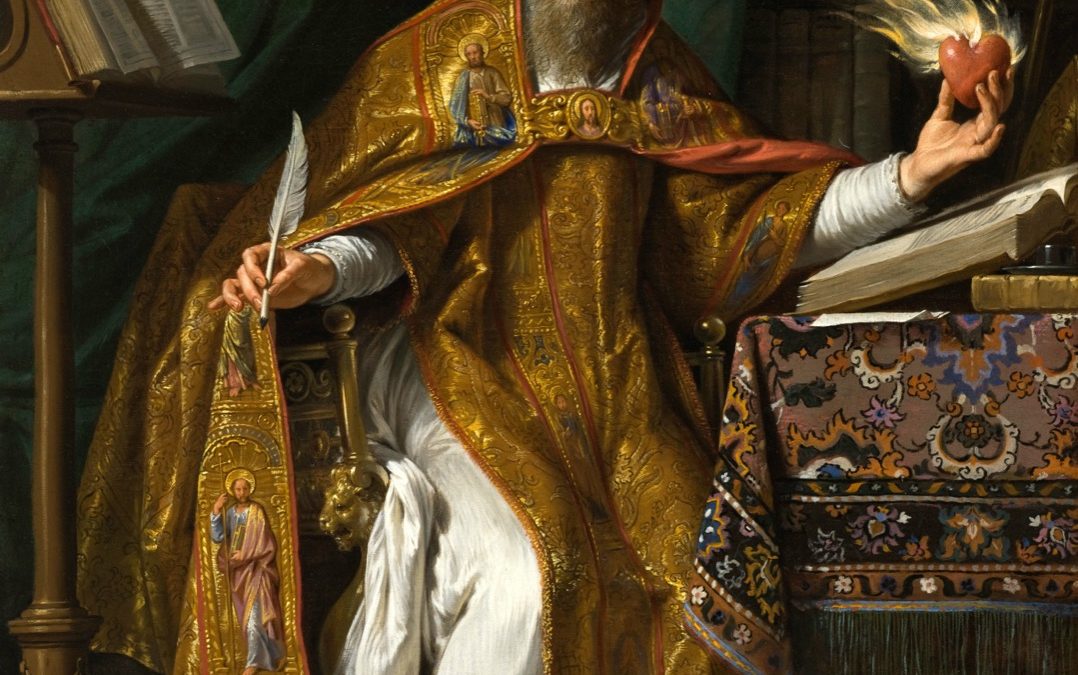
When Aurelius Augustinus penned his Confessions in 397 CE, he invented a radically new literary and philosophical genre: the intimate spiritual autobiography. Exploring his youthful struggles with lust, ambition, and the Manichaean heresy, Augustine established the concept of deep psychological interiority: “Do not go outward; return within yourself. In the inward person dwells truth.”
“Thou hast made us for Thyself, O Lord, and our hearts are restless until they rest in Thee.” — Saint Augustine of Hippo
Augustine adopted Plotinus’s insight on evil: God did not create evil because evil has no positive ontological existence; it is simply the perversion of the human will choosing lesser, created goods over the supreme Creator. The human will, crippled by original sin, suffers from a profound division—wanting the good yet choosing the base—requiring divine grace for redemption.
The Mystery of Time: Distentio Animi
In Book XI of the Confessions, Augustine formulated the most profound analysis of time in ancient philosophy. He famously confessed: “What then is time? If no one asks me, I know; if I want to explain it to someone who asks, I do not know.”
He observed a startling paradox: the past no longer exists, the future does not yet exist, and the present is an infinitely razor-thin instant that vanishes the moment it arrives. How then can time be measured? Augustine realized that time does not reside in physical clocks or planetary rotations, but within the human soul itself: time is a psychological extension (distentio animi). Memory preserves the past in the present; attention holds the present moment; and expectation projects into the future. Through this radical subjective turn, Augustine established the psychological foundation that would later inspire phenomenology, Kant, and Heidegger.
The City of God against the City of Man
When pagans blamed the Christian religion for the sack of Rome, Augustine composed his monumental De Civitate Dei (The City of God). He presented human history not as a cycle of rising and falling earthly empires, but as a grand dramatic conflict between two invisible cities: the Earthly City, motivated by the love of self unto the contempt of God; and the Heavenly City, motivated by the love of God unto the contempt of self. Earthly states, he warned, are provisional and fleeting: “Take away justice, and what are kingdoms but great bands of robbers?” True peace belongs only to the eternal commonwealth of truth.