In the golden age of classical Athens, while politicians competed for demagogic applause, sculptors erected the Parthenon, and sophists sold persuasive rhetorical eloquence for handsome fees, an unkempt, barefoot soldier walked into the Agora and challenged the very soul of the city. Socrates wrote not a single word; he held no political office, founded no formal academy, and accepted no money for his conversations. Yet by redirecting philosophical inquiry from the remote elemental astronomy of the Pre-Socratics to the intimate chambers of human virtue, ethics, and self-knowledge, he transformed human thought forever: “The unexamined life is not worth living.”
The Socratic Mission: The Oracle of Delphi and the Stench of Ignorance
According to Plato’s Apology, Socrates’ philosophical life began in earnest when his companion Chaerephon traveled to the Pythian oracle at Delphi and asked: Is there any man wiser than Socrates? The priestess replied that there was none. Perplexed—because he claimed to know nothing—Socrates set out to cross-examine Athens’ leading poets, politicians, and craftsmen in search of someone wiser. To his dismay, he discovered that while each expert possessed technical craft, they all falsely believed they held ultimate wisdom on justice, beauty, and virtue.
“I am wiser than this man, for neither of us appears to know anything great and good; but he fancies he knows something, although he knows nothing; whereas I, as I do not know anything, so I do not fancy I do.” — Socrates
Socrates realized the true meaning of the oracle: human wisdom is of little value; the wisest human is the one who recognizes his own intellectual bankruptcy. He compared himself to a divine Gadfly (myops) sent by the gods to sting a noble but sluggish horse—the city of Athens—into wakefulness.
The Anatomy of the Socratic Method (Elenchus)
- Irony (Eironeia): Socrates professes complete ignorance and flatters his interlocutor, asking for a universal definition of a moral concept (e.g., “What is Piety?” in the Euthyphro).
- Cross-Examination (Elenchus): Through a sequence of sharp, deductive yes-or-no questions, Socrates draws out hidden premises held by the interlocutor.
- Aporia (Impasse): The interlocutor’s proposed definition is shown to contradict his own fundamental beliefs, shattering false confidence.
- Intellectual Midwifery (Maieutics): Socrates acts as a philosophical midwife, helping the interlocutor give birth to genuine conceptual insight from within his own soul.
Virtue is Knowledge (Arete as Episteme)
Socrates’ moral philosophy was radically intellectualist. He argued that no person knowingly commits evil; moral wrongdoing is invariably the result of ignorance (hamartia). If one genuinely comprehends what is good, one cannot help but act in accordance with it. Consequently, virtue (arete) is not an innate aristocratic inheritance or a set of memorized social conventions, but a form of rational knowledge—an alignment of the soul’s desires with truth.
Furthermore, Socrates asserted the paradoxical doctrine that it is better to suffer injustice than to commit it. To suffer injustice harms only the body or property, which are transient; but to inflict injustice corrupts the soul (psyche), which is the only aspect of a human being possessing eternal and intrinsic moral value.
The Hemlock Cup: Martyrdom for Reason
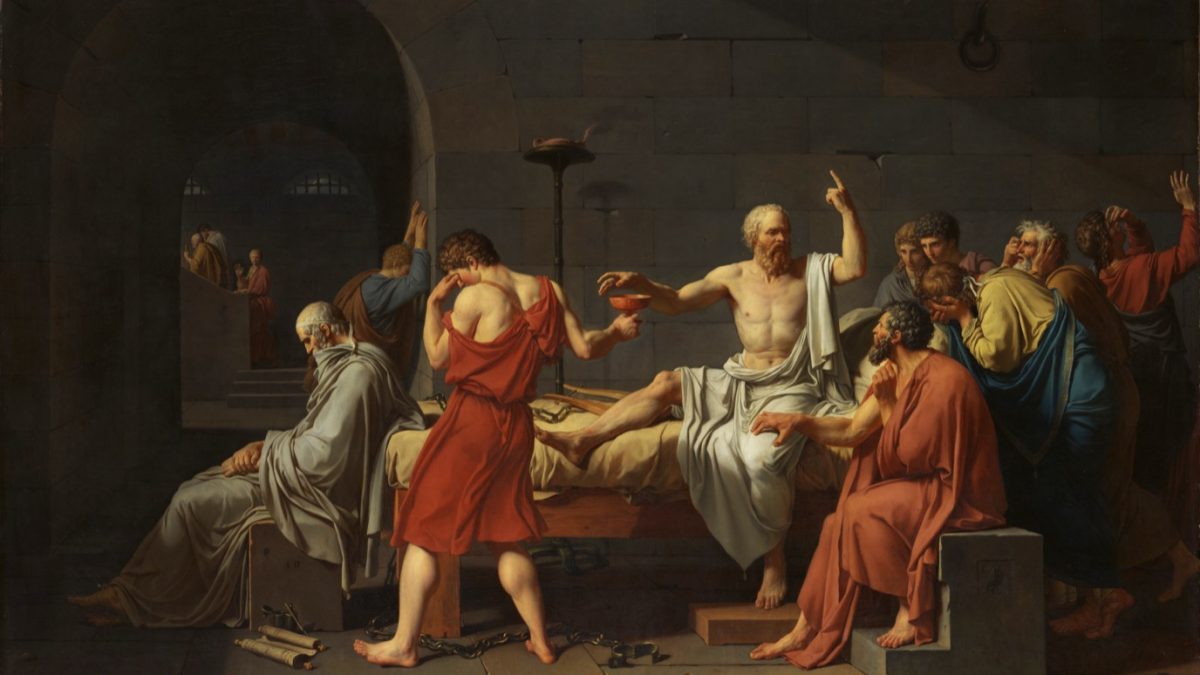
In 399 BCE, amid the political paranoia following Athens’ humiliating defeat in the Peloponnesian War, Socrates was brought to trial on capital charges of corrupting the youth and inventing new deities while rejecting the traditional gods of the polis. Offered exile, compromise, or silence, Socrates refused to barter his divine mission. Condemned to death by a jury of Athenian citizens, he drank the lethal cup of hemlock in prison with serene equanimity, consoling his weeping disciples and confirming with his final breath that philosophical integrity is worth more than mortal survival.