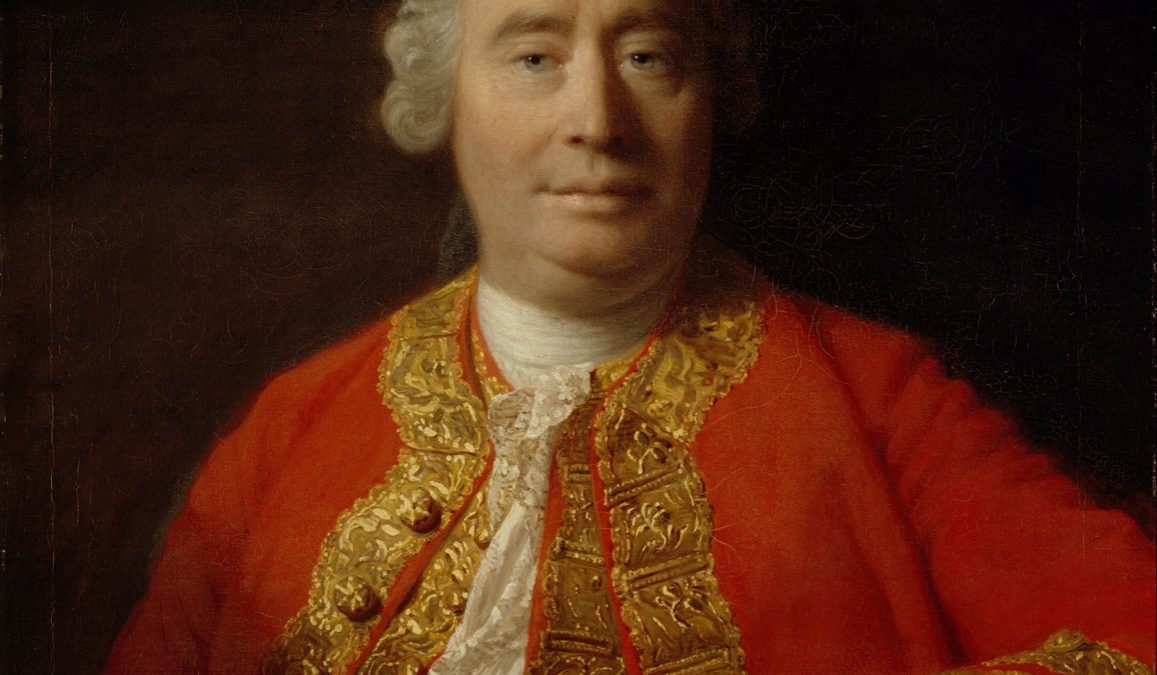
In the smoky taverns and intellectual salons of Edinburgh during the Scottish Enlightenment, a jovial, corpulent gentleman named David Hume (1711–1776) calmly dismantled the intellectual arrogance of the Western tradition. Philosophers for two millennia had boasted of possessing eternal certainty regarding the existence of God, the immortality of the soul, and the absolute mathematical necessity of natural laws. Hume, possessing the sharpest razor in the history of empiricism, subjected every metaphysical concept to a devastating litmus test in his 1739 masterpiece, A Treatise of Human Nature: From what sensory impression is that supposed idea derived? If none can be produced, commit it to the flames, for it can contain nothing but sophistry and illusion.
Hume’s Fork: Relations of Ideas vs. Matters of Fact
Hume cleaved all objects of human inquiry into two mutually exclusive territories, known to posterity as Hume’s Fork:
- Relations of Ideas: Propositions that are discoverable purely by thought and deductive logic, such as Euclidean geometry and algebra (e.g., 3 × 5 = 15, or all bachelors are unmarried). Their truth is necessary, and their negation is an immediate logical contradiction. However, they tell us nothing about whether their objects physically exist in the real world.
- Matters of Fact: Propositions concerning physical reality and empirical experience (e.g., the sun will rise tomorrow). The contrary of every matter of fact is always logically possible; it is not a contradiction to imagine the sun failing to rise. Therefore, matters of fact can never be established by pure deduction.
“Reason is, and ought only to be the slave of the passions, and can never pretend to any other office than to serve and obey them.” — David Hume
The Scandal of Reason: The Problem of Induction
How do we establish knowledge regarding matters of fact beyond immediate memory and sensory presence? We rely entirely on the relation of Cause and Effect. When one billiard ball rolls and strikes another, we assert that the collision caused the second ball to move. But Hume asked: What do we actually perceive?
We observe spatial contiguity, temporal priority (ball A moves before ball B), and Constant Conjunction (whenever A strikes B, B moves). We never, under any circumstance, perceive the supposed necessary connection between them. We cannot see, hear, or touch the “power” or “force” binding them.
The Inductive Trap
We believe the sun will rise tomorrow because it has risen every day in recorded history. But why do we believe that the future will resemble the past? Because in the past, the future always resembled the past!
Hume demonstrated that this argument is a flagrant, circular fallacy: it uses induction to justify induction! Causal necessity is not a rational law of the cosmos; it is an instinctual psychological habit (Custom) forged by repeated association. Science, therefore, rests not on immutable logical certainty, but on biological animal faith.
The Bundle Theory of the Self
Having demolished causal necessity, Hume turned his empirical scalpel onto the holy of holies: the substantial, immortal soul. Descartes had built his entire philosophy on the indubitable “I” of the Cogito. Hume challenged readers to look inside themselves:
“For my part, when I enter most intimately into what I call myself, I always stumble on some particular perception or other, of heat or cold, light or shade, love or hatred, pain or pleasure. I never can catch myself at any time without a perception, and never can observe anything but the perception.” — David Hume
The “Self,” Hume concluded, is not a unified, permanent substance. It is nothing but a Bundle of Fleeting Perceptions passing rapidly through a theater of consciousness that has no stage. When perceptions cease—as in dreamless sleep or death—the self vanishes completely. With this stroke, Hume arrived at the exact conclusion Siddhartha Gautama had formulated in India: the ego is a psychological fiction.
The Is-Ought Problem: The Limits of Moral Reason
Finally, Hume exposed the fatal flaw in moral philosophy known as Hume’s Guillotine: In every system of morality, authors begin by describing facts of nature (what is or is not), and suddenly, without explanation, transition to normative claims (what ought or ought not to be). Hume showed that no descriptive statement of fact can ever logically generate an ethical obligation. Morality is grounded not in rational proofs, but in human sentiment, empathy, and social sympathy.