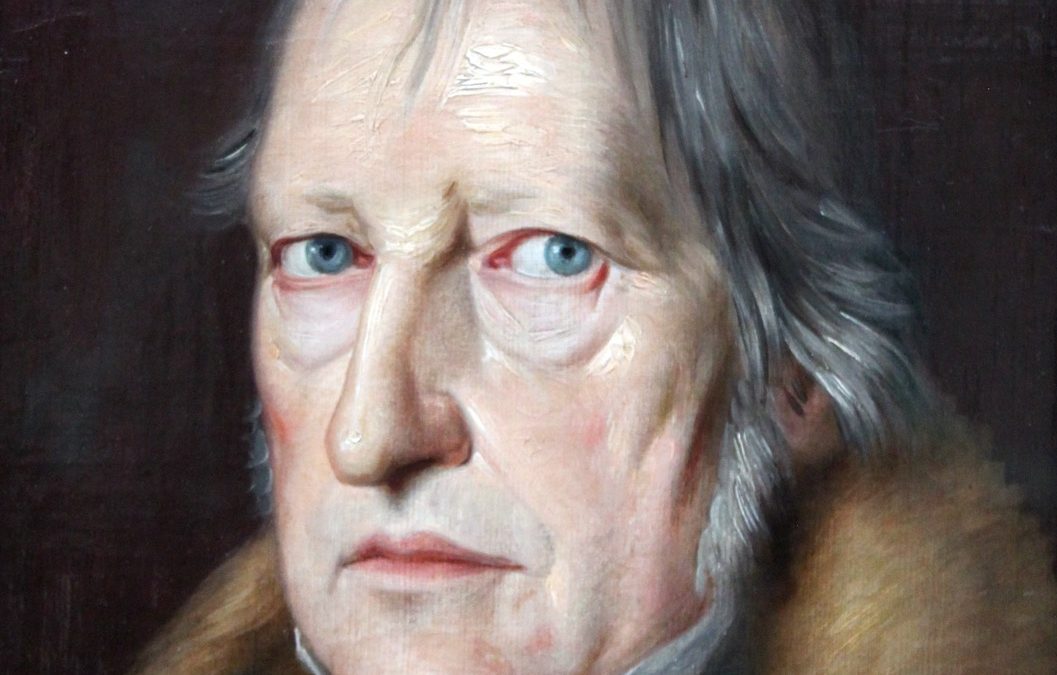
On the afternoon of October 13, 1806, as French artillery fire echoed across the university town of Jena, a thirty-six-year-old German philosopher rushed through the streets clutching the completed manuscript of his magnum opus. Peering out from his study window, Georg Wilhelm Friedrich Hegel (1770–1831) caught sight of Napoleon Bonaparte riding on horseback through the city gates. In an awe-inspired letter to a friend, Hegel wrote: “I saw the Emperor—this world-soul—riding out of the city on reconnaissance. It is indeed a wonderful sensation to see such an individual, who, concentrated here at a single point, astride a horse, reaches across the world and masters it.” For Hegel, history was not a random sequence of bloody skirmishes, but the grand, teleological march of divine Reason becoming conscious of its own freedom.
Overcoming Kant: Absolute Idealism
Hegel admired Kant’s epistemological breakthrough, but regarded Kant’s division between the knowable phenomenon and the unknowable noumenon (the thing-in-itself) as an untenable contradiction. To claim that something exists beyond thought is already to think it! If reality is rational, then reality must be fully accessible to reason:
“What is rational is actual; and what is actual is rational.”
Reality is not a static collection of material substances or subjective cognitive lenses. Reality is a dynamic, living, cosmic subject: Geist (Mind or Spirit). The universe is the process of Spirit alienating itself into material nature, struggling through human history, and returning to itself in absolute self-consciousness through art, religion, and philosophy.
The Dialectical Engine: Aufhebung (Sublation)
Hegelian dialectic does not follow traditional static formal logic where A equals A. Because reality is in perpetual historical development, truth develops through contradiction:
- Thesis (The Immediate / In-Itself): A one-sided conceptual determination or historical stage.
- Antithesis (The Negative / Out-of-Itself): The internal contradiction inherent in the thesis reveals itself, generating crisis and alienation.
- Synthesis (Sublation / Aufhebung): The contradiction is resolved. The German verb aufheben possesses a triple meaning: to cancel the limitation, to preserve the essential truth, and to elevate it to a higher, more comprehensive systemic unity.
The Master-Slave Dialectic (Herrschaft und Knechtschaft)
In the Phenomenology of Spirit (1807), Hegel presented one of the most brilliant psychological analyses in philosophical history. Self-consciousness cannot emerge in solitary isolation; it requires recognition (Anerkennung) from another self-consciousness. When two primitive consciousnesses meet, a life-and-death struggle for pure recognition ensues.
One fighter values freedom more than biological survival; the other trembles in fear of death and yields. The victor becomes the Master (Herr); the defeated becomes the Slave (Knecht). Yet the relationship contains an astonishing dialectical irony:
“The truth of the independent consciousness is accordingly the servile consciousness of the bondsman.” — G.W.F. Hegel
The Master becomes dependent on the Slave for his sustenance, trapped in idle consumption and receiving recognition only from an unfree inferior—which renders the recognition worthless. The Slave, by contrast, transforms physical nature through his Work (Arbeit). In shaping the external world with his hands, the slave objectifies his own consciousness, achieving true intellectual discipline and creative freedom. Historically, it is the slave who becomes the engine of human civilization and historical progress.
The Cunning of Reason (List der Vernunft)
How does Spirit realize freedom across millennia of human violence, hubris, and tragedy? Hegel introduced the concept of the Cunning of Reason (List der Vernunft). World-historical figures—Alexander, Caesar, Napoleon—are driven by their own selfish passions, thirst for glory, and political ambition. Yet unbeknownst to them, Reason uses their private passions as unconscious instruments to shatter obsolete legal systems, unify continents, and advance universal human freedom.
History, for Hegel, is the progressive realization of the consciousness of freedom: In ancient Oriental despotisms, only one person was free (the Emperor); in classical Greece and Rome, some were free (citizens, while slaves were excluded); in the modern constitutional state following the French Revolution, all human beings are recognized as fundamentally free. With Hegel, philosophy became radically historical, establishing the framework that would inspire Karl Marx, existentialism, and twentieth-century critical theory.