At the close of the nineteenth century, philosophy suffered a profound identity crisis. Physics had claimed empirical reality; psychology had claimed the mechanisms of the mind; and pure mathematics had discovered non-Euclidean geometries. What legitimate territory remained for the philosopher? The answer, initiated by a reclusive German mathematician named Gottlob Frege and brought to explosive fruition by an aristocratic Austrian prodigy named Ludwig Wittgenstein, triggered the greatest paradigm shift of modern philosophy: The Linguistic Turn. For centuries, philosophers had assumed that language is merely a transparent glass through which we inspect thoughts and objects. Frege and Wittgenstein revealed that language itself is the very matrix of thought: the limits of my language mean the limits of my world.
Gottlob Frege: Sense and Reference (Sinn und Bedeutung)
In Jena, Gottlob Frege (1848–1925) invented modern mathematical predicate logic, single-handedly replacing Aristotle’s two-thousand-year-old syllogistic system with quantifiers, functions, and variables. In his seminal 1892 paper, “On Sense and Reference” (Über Sinn und Bedeutung), Frege solved an ancient semantic puzzle:
Consider the two statements: “The Morning Star is the Morning Star” (a trivial tautology: $a = a$) and “The Morning Star is the Evening Star” (an astronomical discovery: $a = b$). Both phrases refer to the exact same physical celestial body: the planet Venus. Why then is the second statement informative while the first is empty?
Frege’s Semantic Distinction
- Reference (Bedeutung): The actual physical object in the external world to which the expression points (the planet Venus).
- Sense (Sinn): The mode of presentation or conceptual path by which the object is designated (“the bright body visible at dawn” vs. “the bright body visible at dusk”).
Frege proved that meaning is not an intangible psychological idea in an individual’s private skull; meaning is an objective, public semantic relation.
Wittgenstein and the Tractatus: The Picture Theory of Meaning
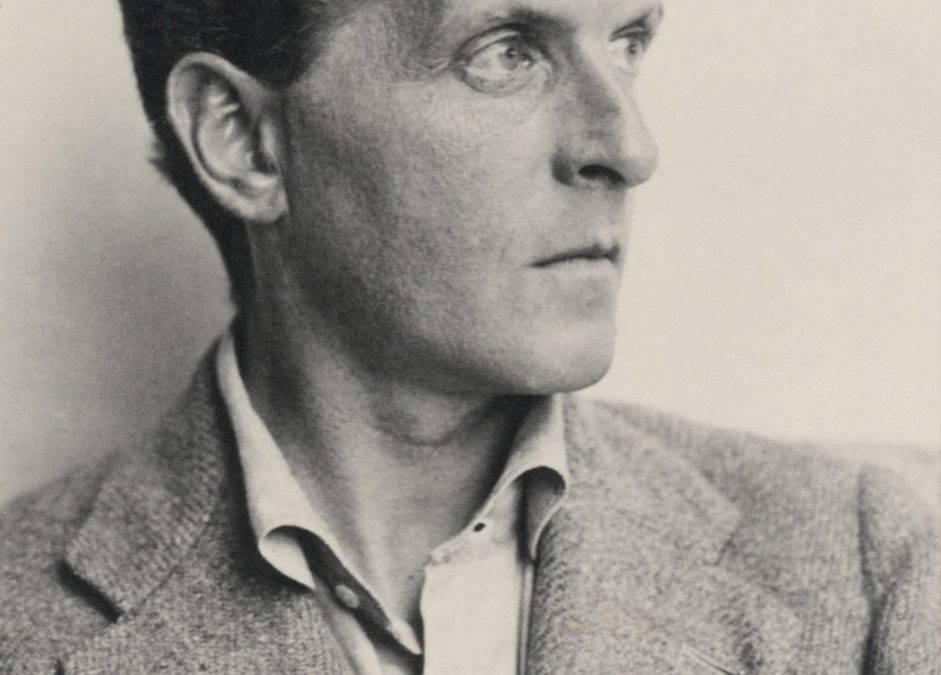
In 1911, an intense twenty-two-year-old Austrian aeronautical engineering student named Ludwig Wittgenstein (1889–1951) arrived unannounced at Bertrand Russell’s rooms in Cambridge. During the trenches of World War I, fighting in the Austro-Hungarian artillery on the Russian front, Wittgenstein scribbled in notebooks the manuscript of the Tractatus Logico-Philosophicus (1921)—the only philosophical book he published in his lifetime.
The Tractatus is structured around seven numbered, diamond-hard propositions. Its core is the Picture Theory of Meaning: The world is the totality of facts, not of things. Language consists of propositions that are logical pictures of atomic facts, sharing with reality a common “logical form” (logische Form), just as a musical score shares form with a symphony or a phonograph groove shares form with sound waves.
“Whereof one cannot speak, thereof one must be silent.” — Ludwig Wittgenstein, Tractatus 7
This led to a devastating conclusion: only empirical scientific propositions—which picture observable states of affairs in the world—possess cognitive sense. Metaphysics, theology, ethics, and aesthetics cannot picture facts; they attempt to speak of what lies beyond the boundary of the world. They are not false; they are literally Senseless (unsinnig). True philosophy is not a body of doctrine, but an activity: the logical clarification of thoughts.
The Later Wittgenstein: Language-Games and Forms of Life
Believing he had solved all philosophical problems, Wittgenstein gave away his inherited steel-industry fortune and worked as an elementary school teacher in rural Austria. But in the 1930s, he realized that his Tractatus was built on a catastrophic error: it assumed that language has a single, crystalline essence—to state facts.
In his posthumous masterpiece, Philosophical Investigations (1953), Wittgenstein repudiated his earlier dogmatism with the concept of Language-Games (Sprachspiele). Language does not just label objects; it is an organic human practice woven into diverse cultural Forms of Life (Lebensformen). Words are like tools in a toolbox: we use language to joke, pray, curse, promise, order, build, and console. Meaning is not an abstract picture; Meaning is Use in Context.
Traditional philosophical problems, Wittgenstein now revealed, are not profound metaphysical mysteries; they are Intellectual Cramps caused when “language goes on holiday”—when we wrench a word out of its natural, communicative language-game and treat it as a ghost-like metaphysical entity. The philosopher’s true therapeutic task is modest but liberating: “To show the fly the way out of the fly-bottle.”