While Western Europe entered centuries of agrarian fragmentation and intellectual insularity following the collapse of the Western Roman Empire, the torch of philosophical inquiry burned with dazzling brilliance in the Islamic world. From the eighth to the twelfth century, the Abbasid capital of Baghdad became the intellectual crossroads of the planet. In the legendary House of Wisdom (Bayt al-Hikma), Caliph al-Ma’mun funded an unprecedented translation movement that translated Plato, Aristotle, Euclid, Galen, and Indian mathematical treatises into Arabic. Islamic thinkers did not merely preserve antiquity; they subjected it to relentless analytical critique, creating the dynamic philosophical tradition of Falsafa.
Ibn Sina (Avicenna) and the Metaphysics of Existence
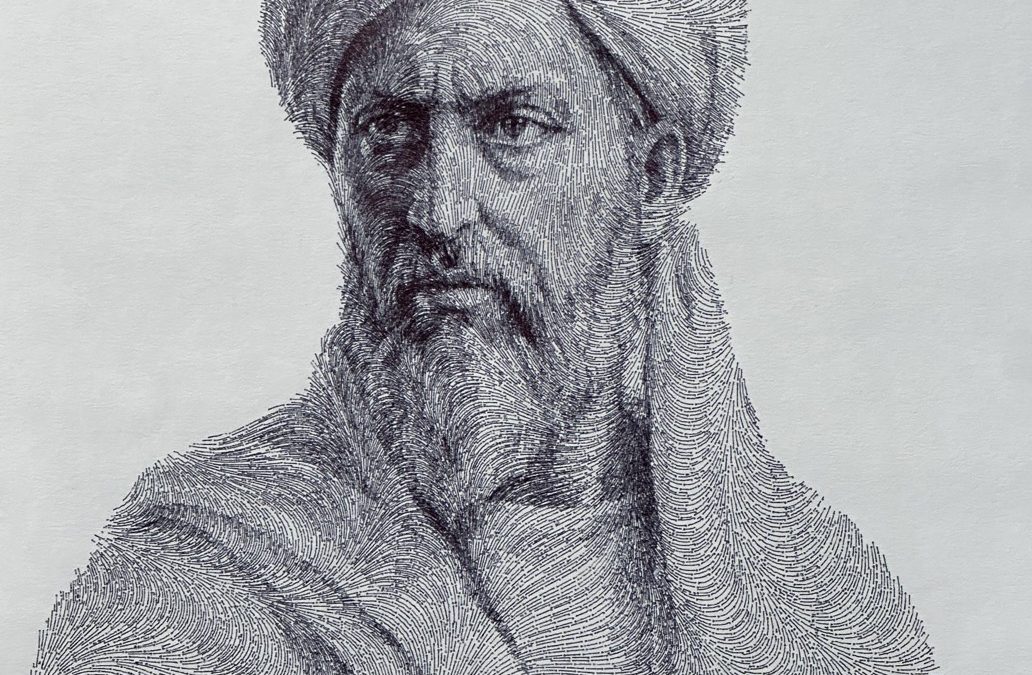
In Persia, Abu Ali al-Husayn ibn Sina—known to the West as Avicenna (980–1037)—demonstrated an intellectual prodigiousness that transformed both medicine and philosophy. In his philosophical magnum opus, The Book of Healing (Kitab al-Shifa), Avicenna resolved a fundamental ambiguity in Aristotle by formulating a radical distinction between Essence (mahiyya, what a thing is) and Existence (wujud, that a thing is).
For any created entity (a horse, a tree, a human), its essence does not logically require its physical existence. A unicorn’s essence can be clearly understood even though it does not exist. Therefore, existence is an accidental attribute bestowed upon contingent entities by an external cause. This led Avicenna to his famous cosmological proof: the chain of contingent beings (mumkin al-wujud) must ultimately terminate in a single, non-contingent Necessary Existent (Wajib al-Wujud)—God, whose very essence is existence itself.
Avicenna’s Floating Man Thought Experiment
Centuries before Descartes formulated the Cogito, Avicenna designed an astonishing thought experiment in the philosophy of mind:
“Imagine a person created fully mature in an instant, suspended in empty space or a void where the air is perfectly still, with eyes covered and limbs outstretched so that no body parts touch one another and no sensory sound, light, or tactile pressure reaches him. Would such a person be aware of his own existence?”
Avicenna answered emphatically: Yes. Even when stripped of all bodily sensations and external perceptions, the subject retains direct, unmediated self-awareness of the “I”. This proved that the human soul is an immaterial, incorporeal substance independent of the physical body.
The Great Debate: Al-Ghazali and the Incoherence of Philosophy
The philosophical rationalism of Falsafa faced a devastating theological challenge in the eleventh century from the brilliant jurist and mystic Abu Hamid al-Ghazali (1058–1111). In his blistering polemic The Incoherence of the Philosophers (Tahafut al-Falasifa), al-Ghazali used rigorous philosophical logic against the philosophers themselves.
Al-Ghazali attacked the Aristotelian doctrine of necessary causation. When cotton touches fire and burns, we observe only that combustion accompanies contact; we do not perceive a necessary connection inherent in the cotton or flame. Rather, God creates the burning at that moment through occasional divine will. Anticipating David Hume by seven centuries, al-Ghazali showed that empirical observation reveals only correlation, never metaphysical necessity.
Ibn Rushd (Averroës) and the Restoration of Pure Aristotle
A century later in Cordoba, Islamic Spain, Abu al-Walid Muhammad ibn Rushd—known as Averroës (1126–1198)—penned his counter-attack: The Incoherence of the Incoherence (Tahafut al-Tahafut). As chief Islamic judge (Qadi) of Seville and personal physician to the Caliph, Averroës argued that divine revelation and philosophical reason are two harmonious paths to the same universal truth. Scriptural allegories are intended for the general public, while demonstrative philosophical proofs are the duty of the intellectual elite.
Averroës stripped Islamic Aristotelianism of Neoplatonic accretions, writing comprehensive commentaries that earned him Dante’s title: “Averroës, who made the great commentary.” When his works were translated into Latin at the University of Paris and Oxford, they sparked the intellectual renaissance of medieval Christendom.