In the ashes of World War II, as European civilization confronted the smoking ruins of Auschwitz, the nuclear devastation of Hiroshima, and the rise of totalitarian bureaucratic states, philosophy was summoned once again to its most urgent task: interrogating the meaning and survival of human freedom. In Paris, Jean-Paul Sartre and Simone de Beauvoir sat in the Café de Flore articulating the existentialist creed that condemned human beings to be free. In Frankfurt, Theodor Adorno and Max Horkheimer dissected the dark underside of instrumental Enlightenment rationality. And in our twenty-first-century digital epoch, as neural networks and autonomous algorithms out-think human champions and generate art, philosophy finds itself standing before its ultimate frontier: What does it mean to be a conscious mind in a universe of computation?
Existentialism: Existence Precedes Essence
In his famous 1945 lecture, Existentialism Is a Humanism, Jean-Paul Sartre (1905–1980) formulated the defining axiom of twentieth-century existentialism:
“L’existence précède l’essence” — Existence precedes essence.
A manufactured artifact, such as a paperknife, has an essence conceived in the mind of the craftsman before it physically exists. But a human being begins from nothingness: we exist first, encounter ourselves in the world, and only through our subsequent sovereign choices do we define our essence. There is no biological teleology, divine blueprint, or deterministic script dictating who we must become.
This radical freedom is simultaneously a terrible condemnation: “Man is condemned to be free.” To blame biology, upbringing, or society for our moral choices is Bad Faith (mauvaise foi)—an inauthentic flight from personal responsibility. Simone de Beauvoir applied this existential insight to social structures in The Second Sex (1949), demonstrating that gender roles are not biological destinies, but socially constructed scripts that human freedom must critically dismantle: “One is not born, but rather becomes, a woman.”
Philosophy’s Modern Frontiers
- Existential Authenticity (Sartre, Camus, Beauvoir): Facing the absurd without illusions; creating sovereign meaning through radical responsibility and revolt.
- Critical Theory & Deconstruction (Frankfurt School, Foucault, Derrida): Unmasking how language, institutions, and technological surveillance encode power, disciplining human bodies and minds.
- The Philosophy of Mind & AI (Turing, Searle, Chalmers): Demarcating the boundary between computational syntax, intentional semantics, and the “Hard Problem” of phenomenal consciousness.
The Enigma of Synthetic Consciousness: Searle’s Chinese Room
As computer science advanced from Alan Turing’s abstract universal machines to modern large language models and deep neural networks, philosophy of mind moved to the center of the technological stage. Can a machine truly think?
In 1980, UC Berkeley philosopher John Searle presented his famous Chinese Room Argument. Imagine an English speaker locked in a room with a vast manual of formal rules. Slips of paper containing Chinese characters are passed under the door. By matching squiggles and following syntax instructions, the occupant produces perfectly fluent Chinese answers that pass the Turing Test with ease. Yet Searle pointed out an undeniable truth: the occupant does not understand a single word of Chinese. Syntax is not semantics; symbol manipulation is not intentional comprehension.
Concurrently, philosopher David Chalmers formulated the Hard Problem of Consciousness: Cognitive science can explain the “easy problems”—how the brain discriminates sensory stimuli, integrates information, and controls speech. But why should any physical information-processing in a brain or silicon chip be accompanied by subjective, phenomenal experience? Why does it feel like something to taste chocolate, perceive red, or suffer grief?
The Eternal School of Athens
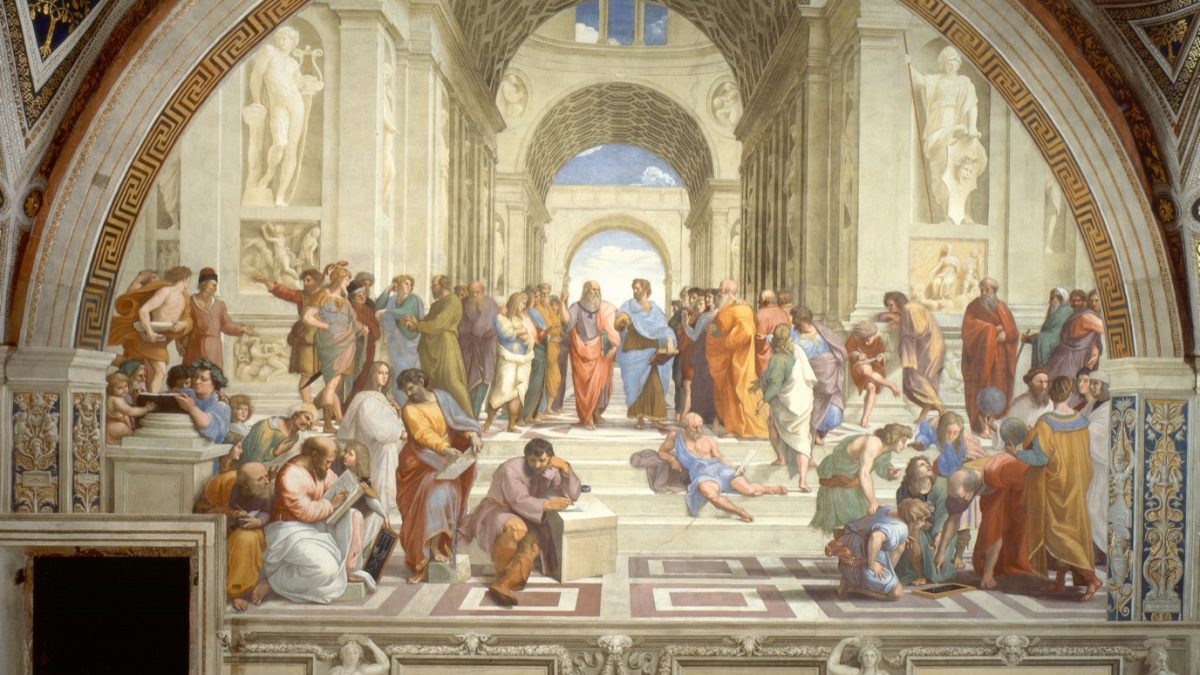
Two and a half millennia after Thales knelt by the waters of the Aegean to ask what reality is made of, the philosophical journey remains radically open. From the pre-Socratic dawn and the martyrdom of Socrates to the Cartesian cogito, the Kantian aesthetic, and the digital horizon of neural intelligence, philosophy has never been a static collection of settled dogmas. It is an enduring, courageous mode of life: the refusal to accept unexamined illusions, the hunger for conceptual clarity, and the relentless quest to understand our place in the cosmos.