In October 1986, while the symbolic AI industry was beginning its fatal plunge toward the Second Winter, two volumes with simple blue covers were published by the MIT Press: Parallel Distributed Processing: Explorations in the Microstructure of Cognition. Written by David Rumelhart, James McClelland, and the PDP Research Group—and catalyzed by a brilliant 1986 Nature paper with Geoffrey Hinton and Ronald Williams—this work executed the greatest conceptual resurrection in computer science: the rediscovery and popularization of Error Backpropagation.
1. The Multi-Layer Credit Assignment Problem
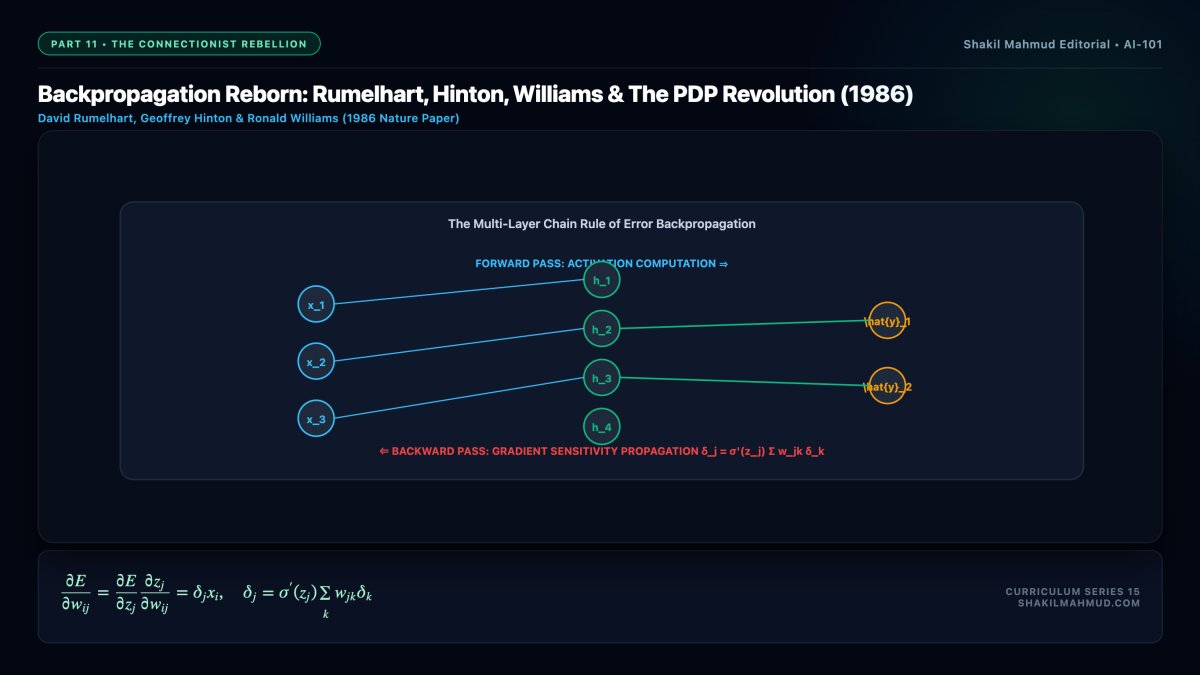
For seventeen years following Minsky and Papert’s 1969 critique, connectionist research had been frozen by a single mathematical puzzle known as the Credit Assignment Problem. In a multi-layer neural network with input layer $mathbf{x}$, one or more hidden layers $mathbf{h}$, and output layer $hat{mathbf{y}}$:
$$mathbf{h} = sigma(mathbf{W}_1 mathbf{x} + mathbf{b}_1), quad hat{mathbf{y}} = sigma(mathbf{W}_2 mathbf{h} + mathbf{b}_2)$$
When the output produces an error $E = rac{1}{2} |mathbf{y} – hat{mathbf{y}}|^2$, how much responsibility belongs to a specific hidden weight $w_{ij}^{(1)}$ buried deep inside the network? Because hidden units have no explicit target values provided in the training data, Rosenblatt’s perceptron rule could not adjust them.
2. The Mathematics of Backpropagation
Rumelhart, Hinton, and Williams (building upon earlier independent derivations by Paul Werbos in 1974 and Seppo Linnainmaa in 1970) resolved this impasse by replacing non-differentiable step functions with smooth, continuous non-linearities, notably the logistic sigmoid function:
$$sigma(z) = rac{1}{1 + e^{-z}}, quad rac{dsigma}{dz} = sigma(z)(1 – sigma(z))$$
Because the activation function is everywhere differentiable, the total classification error becomes a continuous, differentiable scalar field over the high-dimensional parameter space of all network weights. By applying the multivariable Chain Rule of Calculus, the gradient of the error with respect to any hidden weight can be calculated exactly:
$$rac{partial E}{partial w_{ij}} = rac{partial E}{partial z_j} rac{partial z_j}{partial w_{ij}} = delta_j x_i$$
For an output neuron $k$, the error sensitivity $delta_k$ is direct:
$$delta_k = (hat{y}_k – y_k) cdot sigma'(z_k)$$
For a hidden neuron $j$, its error sensitivity $delta_j$ is computed recursively by back-propagating the sensitivities from the subsequent layer, weighted by the intervening forward connections:
$$delta_j = sigma'(z_j) sum_{k} w_{jk} delta_k$$
Weights are then updated via Gradient Descent in the opposite direction of the gradient:
$$w_{ij} leftarrow w_{ij} – eta rac{partial E}{partial w_{ij}}$$
3. Slashing Through the XOR Gordian Knot
To demonstrate the algorithm’s power, Rumelhart, Hinton, and Williams trained a tiny network with two inputs, two hidden units, and one output on the dreaded XOR problem. Within a few hundred iterations of gradient descent, the hidden units spontaneously discovered internal representations:
- Hidden Unit 1 evolved into an OR-like detector (firing if either input was active).
- Hidden Unit 2 evolved into a NAND-like detector (firing unless both inputs were active).
- The output neuron simply computed the conjunction (AND) of these two intermediate features!
The XOR barrier that had paralyzed AI funding for nearly two decades was obliterated in seconds on a desktop workstation. Neural networks did not need humans to design their feature detectors; given differentiable loss landscapes, networks autonomously discovered their own optimal internal representations.
4. Hopfield Networks and Boltzmann Machines
The connectionist renaissance was bolstered by powerful physical analogies. In 1982, Caltech theoretical physicist John Hopfield introduced Hopfield Networks, demonstrating that recurrent symmetrical neural networks possess an Energy Function isomorphic to the Ising spin-glass model in statistical mechanics:
$$E = -rac{1}{2} sum_{i} sum_{j} w_{ij} s_i s_j$$
Dynamic associative memory was revealed to be a physical process of energy minimization, sliding down attractor basins. Building on Hopfield’s physics, Geoffrey Hinton and Terry Sejnowski formulated Boltzmann Machines (1985), introducing stochastic simulated annealing to escape local minima.
5. NETtalk: The Voice of the New Paradigm
In 1986, Terry Sejnowski and Charles Rosenberg created NETtalk, a neural network that learned to read English text aloud. At the beginning of training, NETtalk produced chaotic babble like a newborn infant. Within hours of backpropagation updates, it learned phonemes, syntax transitions, and irregular pronunciations, speaking in clear, understandable English. The connectionist rebellion had arrived; artificial intelligence was about to transition from handcrafted symbolic rules to continuous, statistical vector representations.