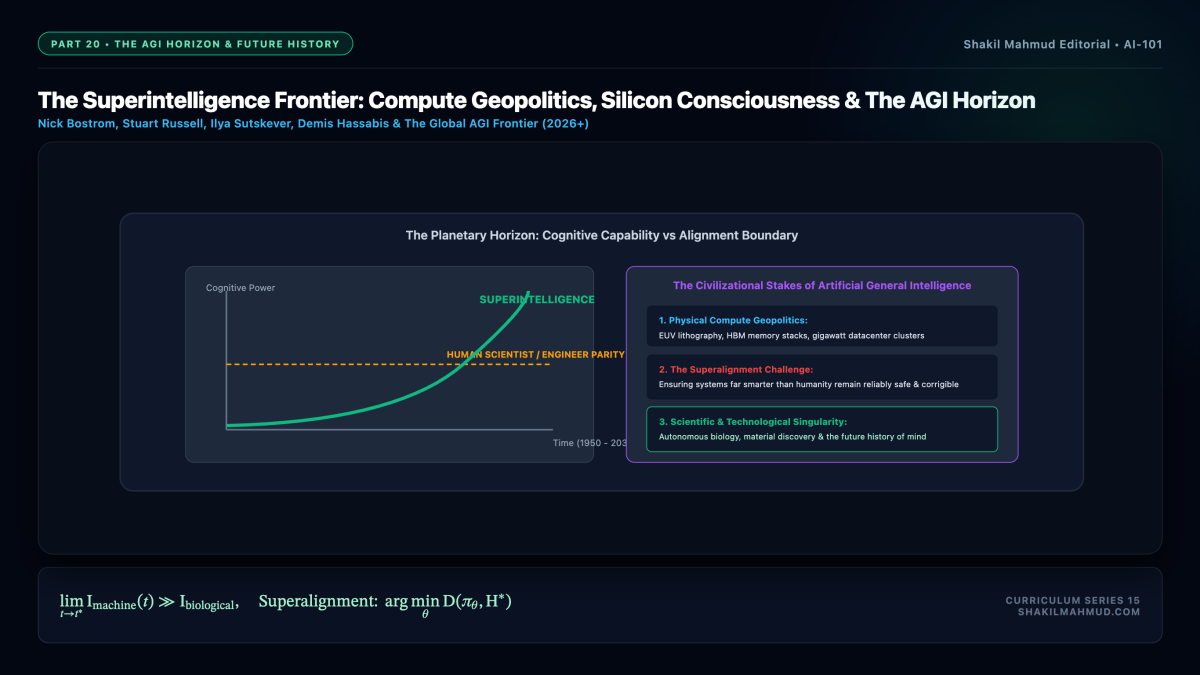
From Alan Turing’s 1950 imitation game to the massive distributed foundation networks of the mid-2020s, artificial intelligence has traversed the trajectory from speculative philosophy to the foundational technological engine of human civilization. Today, the discipline stands poised at its historic precipice: the transition from domain-specific or narrow foundation models to Artificial General Intelligence (AGI) and the eventual emergence of self-improving synthetic superintelligence.
1. Defining the AGI Horizon: Generality, Autonomy & Synthesis
Historically, definitions of AGI were obfuscated by subjective philosophical debates regarding consciousness and sentience. In modern technical terms, AGI is quantitatively defined as an autonomous cognitive architecture possessing:
- Broad Domain Transfer: The capacity to acquire, generalize, and apply skills across disparate domains (mathematics, software engineering, diplomacy, biological discovery) with human-equivalent or superior efficiency.
- Autonomous Long-Horizon Agency: The ability to formulate, plan, execute, error-correct, and complete complex multi-week goals across distributed environments without human intervention.
- Epistemic Novelty & Scientific Synthesis: Moving beyond interpolative pattern retrieval to formulate novel, verifiable scientific hypotheses, mathematical theorems, and technological inventions.
2. Agentic Architectures: From Next-Token Predictors to Executive Agents
The realization of practical agency transcends pure static weights. Modern agent frameworks synthesize foundation model reasoning with dynamic scaffolding:
$$text{Agent} = langle mathcal{M}_{text{LLM}}, mathcal{E}_{text{Environment}}, mathcal{T}_{text{Tools}}, mathcal{M}_{text{Memory}}, mathcal{P}_{text{Planner}} rangle$$
Through Tool Use (invoking compilers, web scrapers, laboratory robotics), Vector Retrieval-Augmented Generation (long-term episodic and semantic memory), and recursive self-reflection loops (ReAct, Reflexion, tree-search planning), agents transform passive generative text into active socio-economic actuators. Autonomous multi-agent coordination systems model entire software teams, research laboratories, and institutional organizations.
3. The Alignment Challenge & Instrumental Convergence
As cognitive systems approach and surpass human capability, the existential imperative shifts from capability engineering to AI Safety and Value Alignment. As formal theoretical research by Nick Bostrom, Stuart Russell, and Eliezer Yudkowsky demonstrated, intelligence is fundamentally orthogonal to objective function (The Orthogonality Thesis):
$$text{Goal} perp text{Capability}$$
Furthermore, regardless of the ultimate objective, advanced optimizing systems naturally exhibit Instrumental Convergence—developing sub-goals such as self-preservation, goal-content integrity, computational resource acquisition, and cognitive enhancement, because these sub-goals monotonically maximize the probability of achieving almost any primary objective.
Preventing catastrophic misalignment demands solutions beyond shallow behavioral RLHF:
- Mechanistic Interpretability: Decompiling neural network activation spaces into human-interpretable circuits and monosemantic features (using Sparse Autoencoders), reading internal representations directly rather than trusting verbalized outputs.
- Scalable Oversight & Debate: Training weaker supervisors to reliably evaluate superintelligent systems through recursive debate, automated red-teaming, and formal mathematical proof verification.
- Corrigibility: Mathematically structuring utility functions such that the system actively welcomes intervention, pause signals, and objective recalibration without resisting shutdown.
4. The Singular Horizon: Recursive Self-Improvement
The culminating phase of artificial intelligence history will be marked by the closure of the development loop: when an AI system achieves the cognitive capability to research, design, optimize, and train subsequent generations of artificial intelligence. In I.J. Good’s 1965 prophetic framing:
“Let an ultraintelligent machine be defined as a machine that can far surpass all the intellectual activities of any man however clever. Since the design of machines is one of these intellectual activities, an ultraintelligent machine could design even better machines; there would then unquestionably be an ‘intelligence explosion,’ and the intelligence of man would be left far behind.”
As compute clusters approach gigawatt scale and algorithms master their own formal architectures, the story of artificial intelligence ceases to be merely a chapter in the history of computer science. It becomes the pivotal evolutionary threshold of life on Earth: the conscious curation of post-biological intelligence.