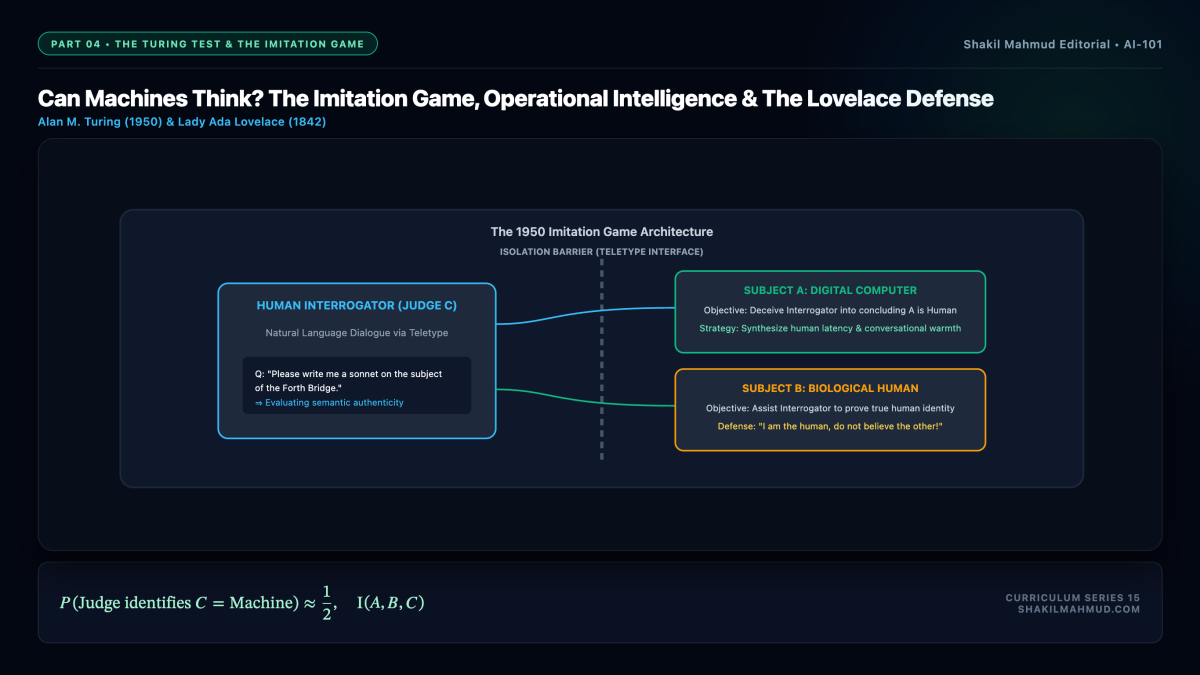
In October 1950, the philosophical journal Mind published a paper with an opening sentence that redefined the intellectual landscape of the twentieth century: “I propose to consider the question, ‘Can machines think?'” Written by Alan Mathison Turing while at the University of Manchester, this paper swept aside centuries of scholastic metaphysics, replacing intractable ontological debates about the nature of “mind” and “soul” with an empirical, operational test that remains the foundational benchmark of artificial intelligence: The Imitation Game.
1. Bypassing Metaphysics: Operational Behaviorism
Turing recognized that debating whether a machine could “think” was a linguistic trap. How do we define thinking? How do we define consciousness? We cannot peer into the subjective interior of another biological human; we infer that other people possess minds solely by observing their verbal responses, problem-solving capabilities, and behavioral interactions.
To rescue the question from semantic futility, Turing proposed an operational substitute. If a physical digital computer can interact in natural language with human interrogators so persuasively that the interrogators cannot reliably distinguish the machine from a biological human, then any refusal to grant that machine the status of “thinking” is mere chauvinism.
2. The Architecture of the Imitation Game
Turing structured the test based on a popular Victorian parlor game. In the original parlor game, a man ($) and a woman ($) sit in a separate room from an interrogator ($). The interrogator communicates with them solely via typed teletype notes, attempting to determine which room holds the woman and which holds the man. The man’s goal is to deceive the interrogator, while the woman’s goal is to help the interrogator discern the truth.
Turing then replaced player $ with a digital computer:
- Player A: A digital computer programmed to simulate human intelligence.
- Player B: A biological human control.
- Interrogator C: A human judge in an isolated room.
The judge is free to ask questions across any domain imaginable: poetry, mathematics, chess, emotional dilemmas, daily gossip, or philosophy. Crucially, the sensory interface is restricted strictly to text (teletype) to eliminate physical biases regarding vocal timbre, mechanical metallic appearance, or synthetic speech cadences.
Turing formulated the success condition mathematically: if after a sustained period of interrogation (e.g., five minutes), the interrogator makes the correct identification no more often than by random chance:
$( ext{Judge correctly identifies } A = ext{Machine}) approx rac{1}{2}$$
then the machine has passed the operational threshold of intelligence.
3. Anticipating Seven Decades of Criticism
The true genius of Turing’s 1950 paper lay in its extraordinary foresight. Turing dedicated the majority of his text to articulating—and systematically demolishing—nine potential counter-arguments against machine cognition, anticipating almost every major debate that would dominate cognitive science and AI philosophy for the next seventy-five years:
- The Theological Objection: “Thinking is a function of man’s immortal soul, granted only by God to biological humans.” Turing countered that claiming God could not confer a soul upon an artificial machine is an arbitrary restriction on divine omnipotence, comparing it to historical theological resistance against Galileo’s astronomy.
- The Mathematical Objection: Relying on Gödel’s Incompleteness Theorem and Turing’s own Halting Problem, critics claimed machines have inherent mathematical limits. Turing replied that while any specific machine has formal limitations, human mathematicians are similarly subject to cognitive error, fatigue, and bounded inference. There is no proof that human intellect transcends the limits of formal computation.
- The Argument from Consciousness (Solipsism): Championed by neurosurgeon Geoffrey Jefferson, this objection argued that a machine cannot truly think until it can write a sonnet or compose a concerto “from thoughts and emotions felt, and not by the chance fall of symbols.” Turing responded that this view leads directly to solipsism—the only way to truly know a human feels anything is to be that human. In practice, humans accept conversational proof of understanding through viva voce interrogation.
- The Argument from Informality of Behavior: The claim that human conduct cannot be governed by any set of formal rules. Turing countered that modern science demonstrates natural physical laws govern all matter, and apparent informality simply reflects computational complexity.
4. Lady Lovelace’s Objection: Can Machines Originate?
The most profound objection Turing engaged was formulated in 1842 by Lady Ada Lovelace, the world’s first computer programmer. Commenting on Charles Babbage’s mechanical Analytical Engine, Lovelace famously wrote:
“The Analytical Engine has no pretensions whatever to originate anything. It can do whatever we know how to order it to perform.”
Lovelace argued that machines merely follow instructions; they cannot produce original creativity, surprise their creators, or exhibit spontaneous conceptual initiative. Turing dismantled Lovelace’s objection with two devastating counter-arguments:
- Machines constantly take humans by surprise. Because the combinatorial interaction of deterministic subroutines rapidly outstrips the working memory of the programmer, machines routinely produce behaviors, proofs, and game moves that the creator neither anticipated nor understood initially.
- The Learning Machine Hypothesis: Lovelace assumed that machines must be programmed exhaustively with every fact and heuristic. Turing proposed a radically different connectionist paradigm: instead of building a fully adult mind, why not build a Child Machine?
5. The Child Machine and the Vision of Machine Learning
In the final section of his 1950 paper, Turing outlined the conceptual blueprint of modern machine learning. Rather than attempting to manually handcraft hundreds of thousands of complex cognitive rules, engineers should construct an artificial neural system equivalent to a child’s brain:
“Instead of trying to produce a programme to simulate the adult mind, why not rather try to produce one which simulates the child’s? If this were then subjected to an appropriate course of education one would obtain the adult brain.”
Turing proposed that the Child Machine would possess three elements:
- An initial plastic, unspecialized state structure (the architecture).
- An education process featuring rewards and punishments (reinforcement learning).
- An uncommitted, inductive capacity to extract statistical correlations from sensory experience.
Turing predicted that by the year 2000, computers with approximately $10^9$ bits (125 megabytes) of memory would be capable of playing the imitation game so convincingly that an average interrogator would have less than a 70% chance of making the correct identification after five minutes. While Turing slightly underestimated the raw compute and data scale required—contemporary large language models require gigabytes of memory and trillions of parameters—his operational paradigm became the north star of artificial intelligence.