Throughout the late 1980s, fully connected backpropagation networks suffered from a fatal curse of dimensionality when applied to 2D images. A small $100 imes 100$ pixel image produces a 10,000-dimensional input vector; connecting this to a modest hidden layer of 1,000 neurons requires 10,000,000 free weight parameters. This explosive parameter footprint triggered catastrophic overfitting and complete failure under simple pixel translations. The salvation of computer vision emerged from a deep biological insight into the mammalian visual cortex: Convolutional Neural Networks (CNNs).
1. The Biological Inspiration: Hubel and Wiesel (1959–1962)
In their Nobel Prize-winning experiments at Harvard Medical School, David Hubel and Torsten Wiesel inserted microelectrodes into the primary visual cortex (V1) of an anesthetized cat. They discovered that visual perception is not computed by global fully connected operations. Instead, biological vision is organized into a hierarchical architecture of localized receptive fields:
- Simple Cells: Fire maximally in response to localized linear edges oriented at specific angles ($ heta$) in a narrow spatial window.
- Complex Cells: Aggregate inputs from simple cells, responding to oriented edges across larger spatial regions with robustness to minor translations.
- Hypercomplex Cells: Detect higher-order geometric features such as corners, endpoints, and line intersections.
2. Kunihiko Fukushima and the Neocognitron (1980)
In 1980, Japanese researcher Kunihiko Fukushima at NHK Science & Technical Research Laboratories published the engineering incarnation of Hubel and Wiesel’s model: The Neocognitron. The Neocognitron alternated between two distinct structural layers:
- S-cells (Simple layers): Extracted local geometric features through spatial convolutions.
- C-cells (Complex layers): Performed spatial pooling, aggregating neighboring S-cell activations to build progressive translational invariance.
Although the Neocognitron proved that alternating convolutional and pooling hierarchies could recognize handwritten characters regardless of position or scale, it lacked a universal supervised learning algorithm. Fukushima relied on an unsupervised, competitive learning heuristic that was difficult to train reliably.
3. Yann LeCun and the Birth of LeNet-5 (1989–1998)
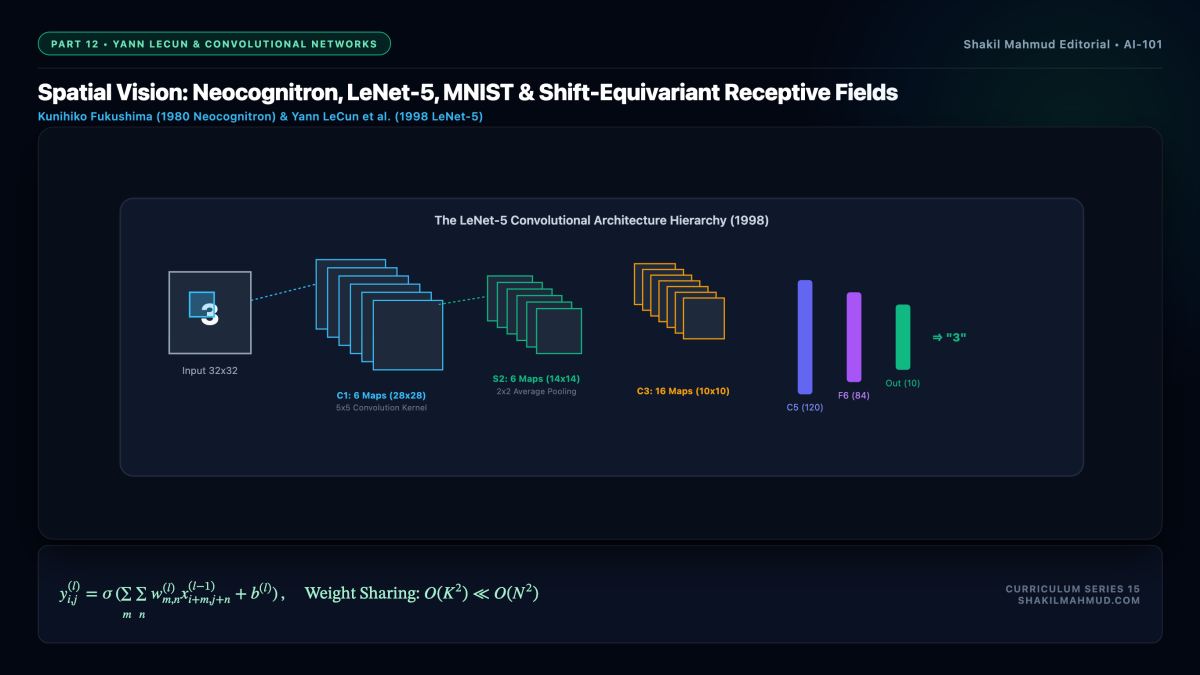
In 1989, a young French researcher named Yann LeCun joined AT&T Bell Laboratories in Holmdel, New Jersey. LeCun realized that Fukushima’s hierarchical convolutional architecture could be unified with Rumelhart, Hinton, and Williams’ gradient-descent backpropagation.
LeCun introduced three structural inductive biases that revolutionized machine vision:
- Local Receptive Fields: Instead of connecting every hidden neuron to every pixel, neurons are connected only to small, localized spatial patches (e.g., $5 imes 5$ pixels), preserving 2D topological locality.
- Shared Weights (Weight Tying): A single set of weights (a convolution kernel) is swept across the entire 2D image plane to compute a feature map:
$$y_{i,j} = sigma left( sum_{m} sum_{n} w_{m,n} x_{i+m, j+n} + b
ight)$$
Weight sharing enforces Translation Equivariance: if an edge shifts across the image, its feature representation shifts identically without requiring retraining. Crucially, weight sharing reduces free parameters by several orders of magnitude, curbing overfitting. - Spatial Subsampling (Pooling): Downsampling feature maps (e.g., $2 imes 2$ average or max pooling) reduces spatial resolution while increasing the effective receptive field of downstream layers, granting robust invariance to translation, skew, and distortion.
4. The Triumph on MNIST
In 1998, LeCun, Léon Bottou, Yoshua Bengio, and Patrick Haffner published their landmark 46-page paper in the Proceedings of the IEEE: Gradient-Based Learning Applied to Document Recognition, introducing LeNet-5.
Trained on the standardized MNIST dataset of 70,000 handwritten digits ($28 imes 28$ grayscale images), LeNet-5 achieved an astonishing error rate below 1%, vastly outperforming commercial OCR systems. Bell Labs and NCR deployed LeNet-5 commercially across the United States; by the late 1990s, LeCun’s convolutional network was autonomously reading and processing over 10% to 20% of all bank checks written in the United States.
Yet despite this industrial triumph, the broader machine learning community was about to turn away from neural networks once again. The late 1990s witnessed the rise of convex, mathematically pristine statistical algorithms that offered rigorous theoretical guarantees without local minima: the Support Vector Machine.