In the shadows of the Second World War, a radical interdisciplinary synthesis took shape. Neurophysiologists, mathematicians, and electrical engineers realized that purposeful, goal-directed behavior was not an exclusively biological phenomenon. By mapping the firing of biological neurons to formal mathematical logic and framing teleological behavior as closed-loop negative feedback, the cybernetic movement of the 1940s laid the foundational architecture of artificial neural networks.
1. The 1943 Breakthrough: Warren McCulloch and Walter Pitts
In 1943, an eccentric psychiatrist and neurophysiologist at the University of Illinois named Warren McCulloch joined forces with an eighteen-year-old runaway mathematical prodigy named Walter Pitts. Together, they published a paper in the Bulletin of Mathematical Biophysics that stands as the foundational cornerstone of connectionist artificial intelligence: A Logical Calculus of the Ideas Immanent in Nervous Activity.
McCulloch and Pitts drew upon the recent neurological discoveries of Santiago Ramón y Cajal, Edgar Adrian, and Charles Sherrington. Neurophysiologists had established that biological neurons communicate via the “all-or-none” law: when the electrical membrane potential of a neuron surpasses a critical threshold, it fires an action potential down its axon; if the potential falls short, the neuron does not fire at all.
McCulloch and Pitts recognized an astonishing mathematical equivalence: the all-or-none firing of biological neurons is isomorphic to the binary propositions of Boolean propositional logic. A firing neuron represents True ($1$); a resting neuron represents False ($0$).
2. The Mathematical Architecture of the Threshold Neuron
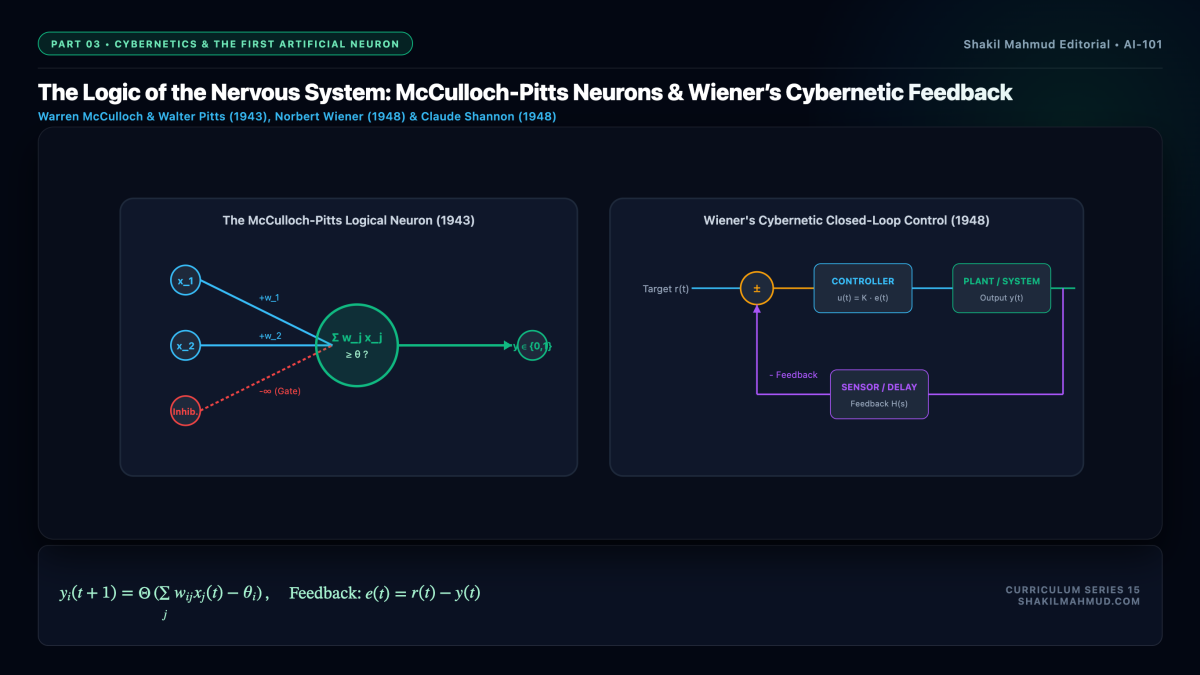
The McCulloch-Pitts (MCP) model abstracted away complex biochemical dynamics into a formal mathematical threshold unit. The state of neuron $ at discrete time step +1$ is determined by the weighted sum of inputs arriving from presynaptic neurons at time $:
$(t+1) = Theta left( sum_{j} w_{ij} x_j(t) – heta_i ight)$$
where $Theta(z)$ is the Heaviside step function:
$$Theta(z) = begin{cases} 1 & ext{if } z ge 0 0 & ext{if } z < 0 nd{cases}$$
The inputs in {0, 1}$ are scaled by synaptic weights {ij}$. Crucially, McCulloch and Pitts incorporated two biological classes of synapses:
- Excitatory Synapses ({ij} > 0$): Drive the somatic membrane potential closer to the firing threshold $ heta_i$.
- Inhibitory Synapses ({ik} = -infty$): Absolute inhibitory inputs that immediately prevent the neuron from firing, regardless of how much excitatory stimulation arrives simultaneously.
By arranging these idealized binary threshold units into simple feedforward networks, McCulloch and Pitts proved a theorem of staggering consequence: interconnected networks of formal neurons can compute any truth-functional logical operator.
- An AND gate is computed by a neuron with two excitatory inputs ( = 1, w_2 = 1$) and threshold $ heta = 2$.
- An OR gate is computed by the same inputs with threshold $ heta = 1$.
- A NOT gate is computed using an inhibitory synapse that vetoes the output whenever the input fires.
Furthermore, McCulloch and Pitts demonstrated that networks endowed with cyclic, recurrent loops could store state indefinitely, creating internal memory. Since a Turing machine’s finite-state controller can be constructed entirely from logical gates and delay lines, McCulloch and Pitts established that a sufficiently large artificial neural network is computationally universal. The biological brain was mathematically revealed to be a biological computer.
3. Norbert Wiener and the Science of Cybernetics (1948)
While McCulloch and Pitts formalized the neural building block, an MIT mathematician named Norbert Wiener was conceptualizing the dynamics of entire autonomous systems. During the war, Wiener had worked on automated anti-aircraft fire control systems, attempting to predict the evasive trajectories of enemy pilots.
Wiener realized that tracking an aircraft, navigating a ship, reaching for a glass of water, and maintaining human body temperature all shared the identical mathematical architecture: closed-loop negative feedback. In 1948, Wiener published his monumental book Cybernetics: Or Control and Communication in the Animal and the Machine, coining the term from the Greek kybernetes (steersman or governor).
In a cybernetic system, an agent perceives its current state (t)$, compares it to an internal goal state (t)$, and generates an error signal:
$(t) = r(t) – y(t)$$
The system uses this error signal to drive an actuator (t) = K cdot e(t)$, continually adjusting its physical behavior to minimize the discrepancy between where it is and where it desires to be. Wiener demonstrated that purposeful, goal-seeking behavior does not require a mystical vitalistic soul; teleology is the direct, physical consequence of circular causal feedback loops.
4. Shannon’s Mathematical Theory of Communication
Simultaneously in 1948, Claude Shannon of Bell Telephone Laboratories published A Mathematical Theory of Communication, founding modern information theory. Shannon abstracted information away from meaning, psychology, or linguistic content, defining information fundamentally as the resolution of statistical uncertainty.
Shannon quantified the informational entropy (X)$ of a discrete random variable $ with probability distribution (x)$:
$(X) = – sum_{x in mathcal{X}} p(x) log_2 p(x)$$
Shannon proved that binary digits—bits—are the fundamental universal currency of communication, establishing theoretical limits on data compression (source coding theorem) and error-free transmission over noisy channels (noisy channel coding theorem). Shannon’s work gave cybernetics and early AI an exact mathematical metric: knowledge acquisition could now be measured quantitatively as the reduction of informational entropy.
5. The Macy Conferences: The Crucible of Cognitive Science
Between 1946 and 1953, the Josiah Macy Jr. Foundation convened a series of ten legendary interdisciplinary conferences in New York City. The Macy Conferences brought together Norbert Wiener, Warren McCulloch (who chaired the meetings), Walter Pitts, John von Neumann, Claude Shannon, Margaret Mead, Gregory Bateson, and W. Ross Ashby.
It was a breathtaking intellectual crucible. Von Neumann presented the architecture of digital computing and self-reproducing automata; Ashby demonstrated the Homeostat, an electromechanical device capable of autonomous self-stabilizing ultrastability; Pitts discussed neural logic; and Wiener expounded on feedback and societal communication. For the first time in intellectual history, the barrier between mental phenomena and physical engineering dissolved. The mind was no longer an intangible Cartesian ghost—it was an information-processing, self-regulating cybernetic system.