While symbolic AI researchers in Cambridge and Pittsburgh were constructing logical proof trees, a psychologist named Frank Rosenblatt at the Cornell Aeronautical Laboratory in Buffalo, New York, took a diametrically opposed path. In 1957, Rosenblatt unveiled the Perceptron—the first artificial neural network instantiated in physical hardware, capable of learning to recognize visual patterns directly from sensory data.
1. The Architecture of the Mark I Perceptron
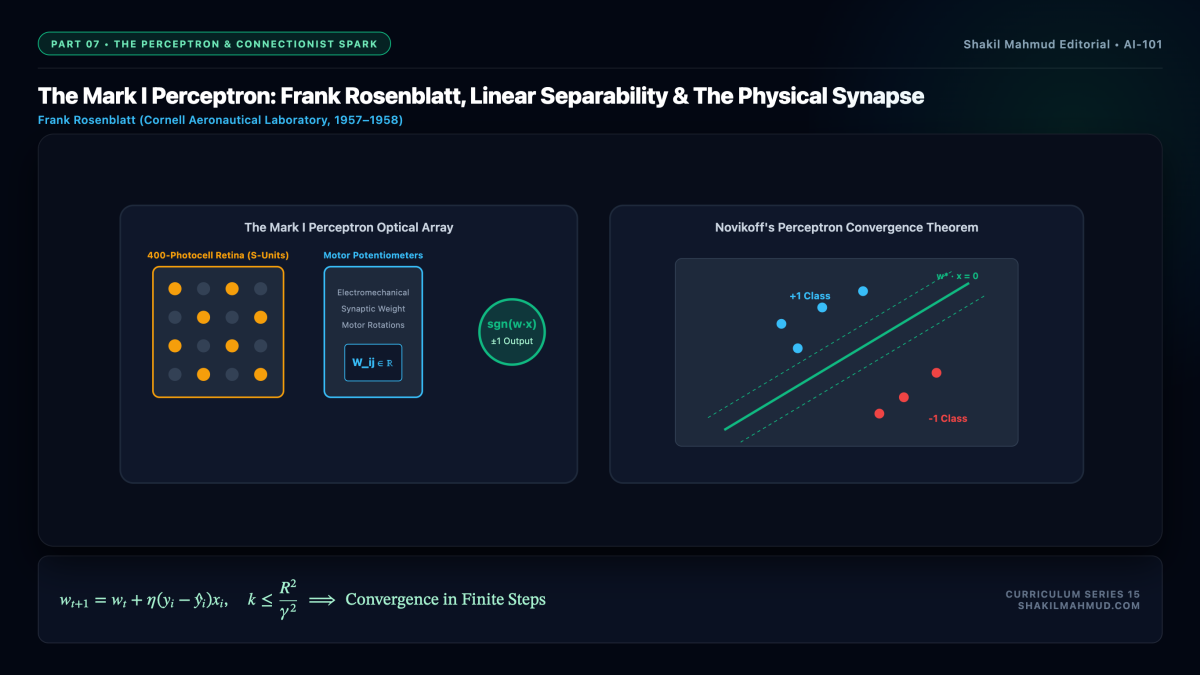
Completed in 1958, the Mark I Perceptron was not a software program; it was a physical electromechanical behemoth:
- Retina (Sensory S-Units): A $20 imes 20$ grid of 400 cadmium sulfide photocells mounted inside a camera housing, capturing optical patterns.
- Association Layer (A-Units): Fixed, random threshold interconnections that aggregated optical signals into intermediate feature detectors.
- Response Units (R-Units) & Potentiometers: Motor-driven precision potentiometers serving as adjustable synaptic weights. When a mistake was made during training, electric DC motors physically rotated the dials, increasing or decreasing electrical resistance to alter the synaptic weight $w_{ij}$.
2. The Perceptron Learning Algorithm
Rosenblatt’s fundamental breakthrough was the discovery of an automated, iterative error-correction learning rule. Unlike McCulloch and Pitts’ static threshold gates with hand-tuned weights, the Perceptron learned autonomously from empirical examples.
Given an input vector $mathbf{x} = (x_1, x_2, dots, x_d)^T$ and binary target label $y in {-1, +1}$, the output $hat{y}$ is computed by:
$$hat{y} = ext{sgn}(mathbf{w}^T mathbf{x} + b) = ext{sgn}left( sum_{i=1}^d w_i x_i + b
ight)$$
If the prediction is incorrect ($hat{y}
e y$), the weights are updated by:
$$mathbf{w}_{t+1} = mathbf{w}_t + eta y mathbf{x}$$
where $eta > 0$ is the learning rate. If the model predicts correctly, no update is made. Geometrically, this rule rotates and translates the separating decision hyperplane $mathbf{w}^T mathbf{x} + b = 0$ toward the misclassified sample until it falls on the correct side of the boundary.
3. The Perceptron Convergence Theorem
In 1962, Albert Novikoff provided the rigorous mathematical proof of the Perceptron Convergence Theorem. He proved that if a dataset is linearly separable with margin $gamma > 0$, such that there exists an optimal unit vector $mathbf{w}^*$ where:
$$y_k (mathbf{w}^* cdot mathbf{x}_k) ge gamma quad orall k$$
and the input vectors are bounded within a hypersphere of radius $R$ ($|mathbf{x}_k| le R$), then the perceptron learning algorithm is mathematically guaranteed to find a separating hyperplane in at most $k_{ ext{max}}$ updates:
$$k_{ ext{max}} le left( rac{R}{gamma}
ight)^2$$
This was the first time in human history that a physical machine had been mathematically proven to learn an optimal classification boundary in finite steps directly from empirical sensory experience.
4. Media Euphoria and the Connectionist Dream
The announcement of the Perceptron sparked sensational headlines. On July 8, 1958, The New York Times published an article quoting the U.S. Navy and Rosenblatt, describing the Perceptron as “the embryo of an electronic computer that [the Navy] expects will be able to walk, talk, see, write, reproduce itself and be conscious of its existence.”
Rosenblatt envisioned multi-layer networks capable of abstract concept formation and speech recognition. But dark storm clouds were gathering on the horizon. The symbolic camp viewed these connectionist claims as reckless biological mysticism lacking mathematical rigor. The collision between these two paradigms was about to trigger the most catastrophic crisis in AI history.