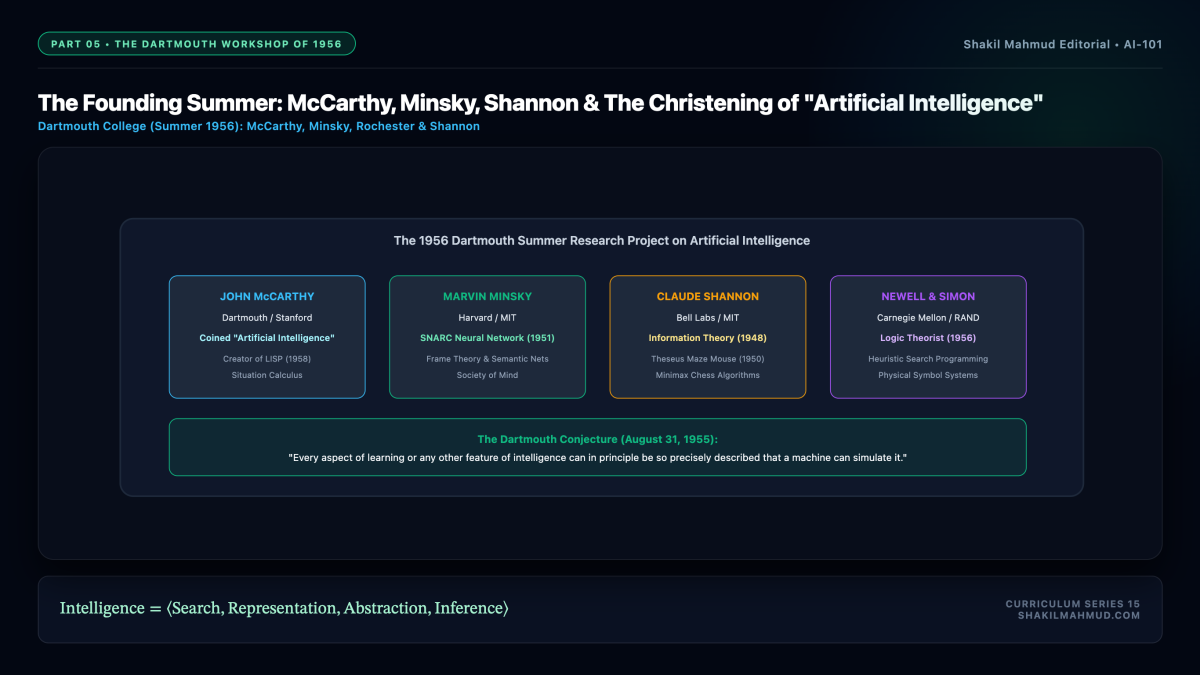
In the humid summer of August 1956, ten scientists gathered on the top floor of the Hanover Inn at Dartmouth College in New Hampshire. Organized by a twenty-seven-year-old assistant professor named John McCarthy, alongside Marvin Minsky, Nathaniel Rochester, and Claude Shannon, this small, freewheeling workshop would coin the term “Artificial Intelligence” and officially establish it as a distinct, rigorous scientific discipline.
1. The Pre-Dartmouth Fragmentation
Prior to 1956, researchers investigating synthetic thought were scattered across competing terminologies and disciplinary silos: Norbert Wiener championed Cybernetics; Claude Shannon and W. Ross Ashby analyzed Automata Theory; Alan Turing spoke of Machine Intelligence; others referred to Complex Information Processing. McCarthy deliberately chose the phrase Artificial Intelligence to escape the conceptual dominance of cybernetics, which he felt was overly constrained by analog feedback loops and physical hardware.
2. The Founding Conjecture
The proposal submitted to the Rockefeller Foundation on August 31, 1955, contained what is perhaps the most audacious research hypothesis in scientific history:
“We propose that a 2 month, 10 man study of artificial intelligence be carried out during the summer of 1956 at Dartmouth College… The study is to proceed on the basis of the conjecture that every aspect of learning or any other feature of intelligence can in principle be so precisely described that a machine can be made to simulate it.”
The proposal outlined seven core research frontiers: Automatic Computers, How Can a Computer be Programmed to Use a Language, Neuron Nets, Theory of the Size of a Calculation, Self-Improvement, Abstractions, and Randomness and Creativity.
3. The Logic Theorist: Newell and Simon Steal the Show
While the workshop did not produce an immediate unified mathematical framework, it featured one extraordinary intellectual triumph. Allen Newell, J.C. Shaw, and Herbert Simon from the Carnegie Institute of Technology and RAND arrived with a working computer program named the Logic Theorist.
Running on the JOHNNIAC computer at RAND, the Logic Theorist did not merely calculate numbers; it manipulated symbolic lists and used heuristic search to discover mathematical proofs. It successfully proved 38 of the first 52 theorems in Chapter 2 of Whitehead and Russell’s Principia Mathematica—even finding a proof for Theorem 2.85 that was vastly shorter and more elegant than the original authors’ proof.
4. The Split Path: Symbolic Logic vs Connectionist Networks
The Dartmouth workshop also sowed the seeds of the foundational schism that would define the next seven decades of AI research:
- Symbolic AI (Neats): Championed by McCarthy, Newell, and Simon, arguing that human intelligence is fundamentally a physical symbol system executing deductive logic, heuristic search, and explicit declarative representations.
- Connectionism (Scruffies): Championed by Minsky, Rosenblatt, and Selfridge, arguing that intelligence emerges from statistical, sub-symbolic networks of simple interconnected artificial neurons mimicking neurobiology.
With Dartmouth, the quest for artificial intelligence was no longer speculative philosophy. It was an empirical, well-funded scientific crusade that promised to conquer human cognition within a single generation.