Between 1956 and 1970, artificial intelligence entered its first triumphal Golden Age. Guided by the unshakeable conviction that human reasoning was fundamentally the mechanical manipulation of symbolic structures, researchers pioneered heuristic state-space search algorithms that conquered symbolic integration, chess tactics, geometric proofs, and natural language microworlds.
1. The Physical Symbol System Hypothesis
In their Turing Award lecture, Allen Newell and Herbert Simon formalized the philosophical foundation of early AI: The Physical Symbol System Hypothesis (PSSH):
“A physical symbol system has the necessary and sufficient means for general intelligent action.”
This hypothesis asserted that intelligence does not depend on biological wetware or carbon-based chemistry. Any physical system—be it a biological brain or an electromechanical computer—that can instantiate symbols, concatenate them into expressions, and transform those expressions via algorithmic rules is capable of general intelligence.
2. Means-Ends Analysis and the General Problem Solver (GPS)
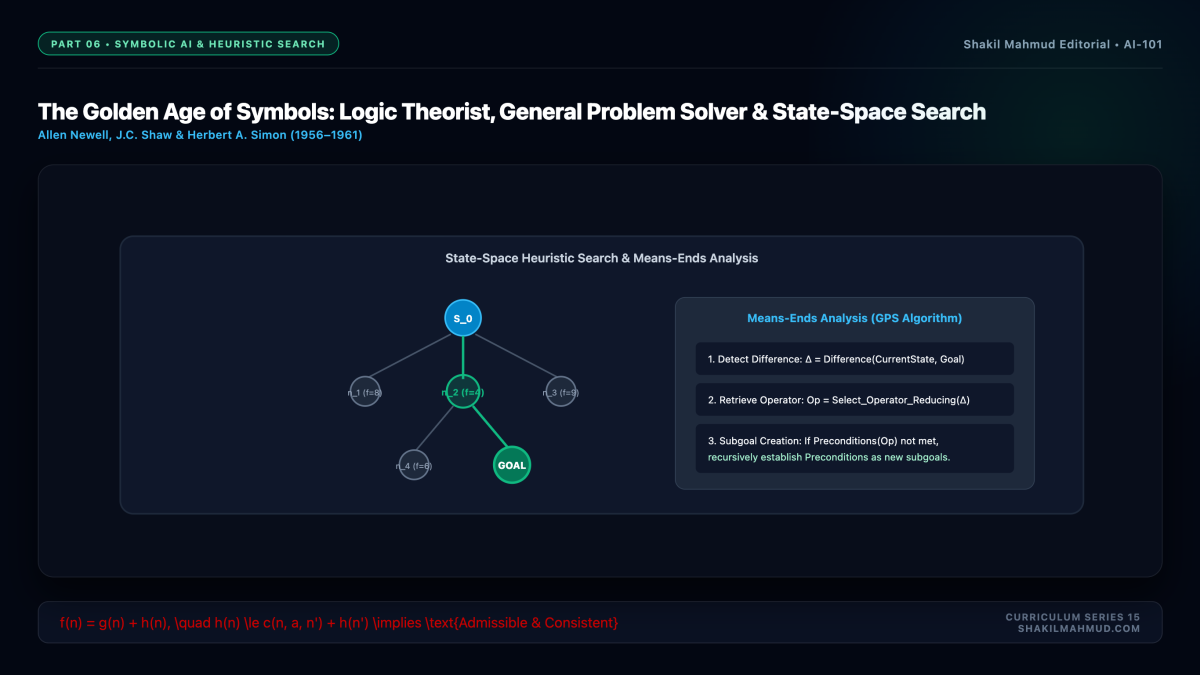
In 1959, Newell, Shaw, and Simon unveiled the General Problem Solver (GPS). Unlike specialized calculators, GPS was designed to solve any formal problem expressible in terms of states and operators. GPS introduced Means-Ends Analysis (MEA):
- Evaluate the difference $Delta = ext{Diff}(S_{ ext{current}}, S_{ ext{goal}})$ between current state and goal state.
- Search an operator table to find an action $a$ known to reduce this difference.
- If the preconditions for action $a$ are not satisfied, recursively spawn a new sub-goal to achieve those preconditions.
- Execute the action and iterate until the goal state is reached.
GPS successfully solved classic puzzles such as the Tower of Hanoi, the Missionaries and Cannibals problem, and symbolic formal logic proofs.
3. Heuristic Search and the A* Algorithm
The fundamental challenge of symbolic AI was combinatorial explosion. In a game of chess, evaluating all possible move sequences across 40 plies requires exploring $10^{120}$ board states—more than the number of atoms in the observable universe. Pure brute-force search is mathematically impossible.
The solution was Heuristic Search. In 1968, Peter Hart, Nils Nilsson, and Bertram Raphael at the Stanford Research Institute developed the A* Search Algorithm, optimizing pathfinding for the Shakey the Robot project:
$$f(n) = g(n) + h(n)$$
where $g(n)$ is the exact cost from the start node to node $n$, and $h(n)$ is an admissible heuristic estimate of the remaining cost to the goal ($h(n) le h^*(n)$). They proved that if $h(n)$ never overestimates the true cost, A* is mathematically guaranteed to find the globally optimal path while expanding the minimum possible number of search nodes.
4. Microworlds and Early Natural Language: ELIZA and SHRDLU
The late 1960s witnessed stunning demonstrations of symbolic competence in constrained domains (“microworlds”):
- ELIZA (1966): Joseph Weizenbaum at MIT created the first conversational chatbot, simulating a Rogerian psychotherapist via pattern matching and syntactic transformation rules. Even though ELIZA had zero semantic comprehension, users developed intense emotional attachments (the “ELIZA effect”).
- SHRDLU (1970): Terry Winograd created a symbolic natural language system capable of understanding complex English commands (“Pick up a big red block”) inside a simulated 3D “Blocks World”, reasoning about spatial relations, executing actions, and explaining its reasoning in grammatically perfect English.
To outside observers and funding agencies, full human-level artificial intelligence seemed just around the corner. Herbert Simon famously predicted in 1965: “Machines will be capable, within twenty years, of doing any work a man can do.” They had underestimated the vast chasm between toy microworlds and the messy, ambiguous reality of common-sense knowledge.