In March 2016, in a sealed banquet room at the Four Seasons Hotel in Seoul, South Korea, hundreds of millions of people worldwide watched a machine perform what philosophers and grandmasters had insisted was uniquely human: unadulterated intuitive creativity. An artificial intelligence named AlphaGo, developed by Demis Hassabis and the team at Google DeepMind, defeated 18-time world champion Lee Sedol 4 to 1 in the ancient board game of Go. In the match’s immortal Game 2, AlphaGo played Move 37—a move so shocking and transcendent that it severed humanity’s monopoly on strategic intuition forever.
1. The Impossibility of Go
For decades after Deep Blue defeated Kasparov in chess, Go remained the unconquered Everest of classical AI. Originating in China over 3,000 years ago, Go is deceptively simple: two players take turns placing black and white stones on a $19 imes 19$ grid, seeking to encircle surrounding territory. Yet its combinatorial complexity is staggering:
- State Space: There are approximately $10^{170}$ legal board configurations—vastly more than the total number of subatomic particles in the observable universe ($pprox 10^{80}$).
- Branching Factor: While chess has an average branching factor of 35 legal moves per turn, Go averages 250 moves per turn across 150 plies.
- The Evaluation Bottleneck: In chess, pieces have objective material values (a Queen is 9 points, a Pawn is 1). In Go, every stone is identical, and a single stone placed on move 10 can dictate territorial life or death 100 moves later. Top human masters relied not on calculation, but on visual shape, aesthetic harmony, and subconscious intuition.
Conventional wisdom held that a computer would not defeat a premier 9-dan professional for at least another generation.
2. Demis Hassabis and the DeepMind Vision
In London in 2010, child chess prodigy, neuroscientist, and video game designer Demis Hassabis co-founded DeepMind alongside Shane Legg and Mustafa Suleyman. DeepMind’s mission was uncompromising: “Solve intelligence, and then use that to solve everything else.”
In 2013, DeepMind published a landmark breakthrough: Deep Q-Networks (DQN). Using a single deep neural network with raw pixels as input, DQN learned to play seven Atari 2600 video games (such as Breakout and Space Invaders) from scratch, surpassing human experts without being told the rules of the games, guided solely by reinforcement learning rewards.
3. The Architecture of AlphaGo
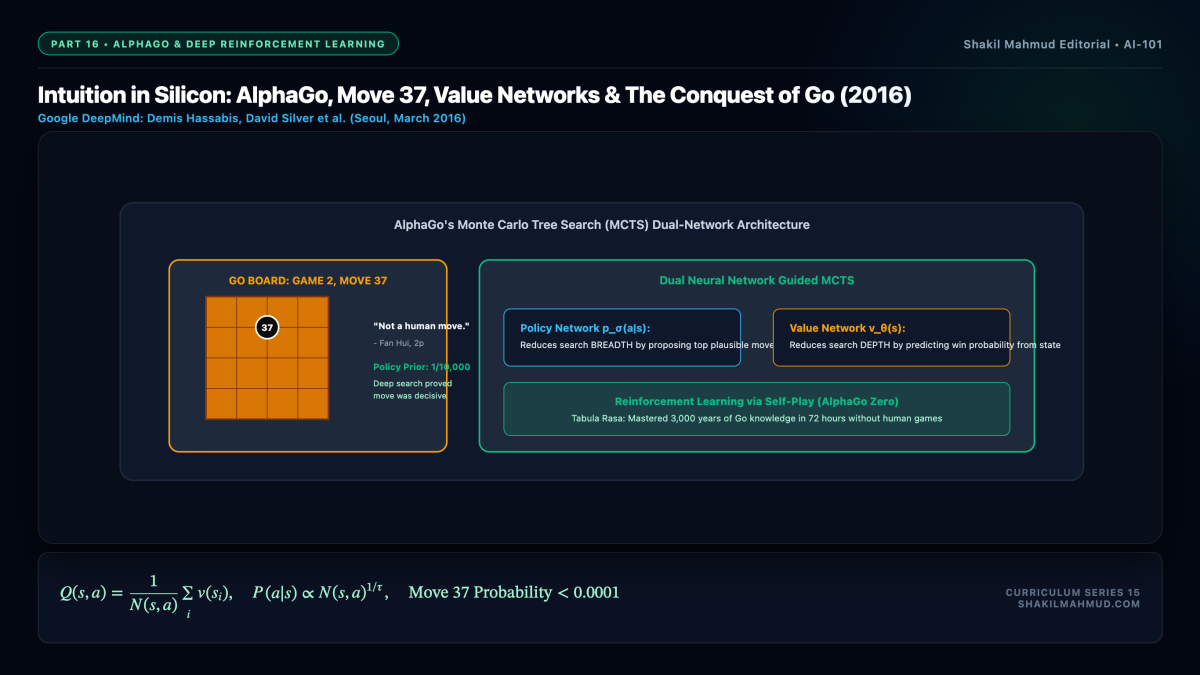
Acquired by Google in 2014, DeepMind tackled Go under the leadership of David Silver and Aja Huang. In January 2016, they revealed AlphaGo in a landmark Nature paper. AlphaGo triumphed by marrying Monte Carlo Tree Search (MCTS) with two deep convolutional neural networks:
- The Policy Network ($p_sigma$):
A 13-layer deep CNN trained first on 30 million moves from human amateur and professional games, and subsequently refined via Reinforcement Learning (RL) self-play. The policy network drastically narrowed the search breadth, evaluating the board and proposing only the top 3 or 4 candidate moves. - The Value Network ($v_ heta$):
A deep CNN trained on millions of self-play games to predict the probability of victory from any given board position $s$:
$$v_ heta(s) pprox V^*(s) in [-1, +1]$$
The value network eliminated the need to simulate rollouts to the very end of the game, drastically pruning the search depth.
During live play, MCTS simulated thousands of prospective games per second, combining policy priors with value network static predictions and fast rollouts to select the move with the highest visit count:
$$a^* = rgmax_a N(s, a)$$
4. The Seoul Showdown: Move 37
The Seoul match pitted AlphaGo against Lee Sedol, the legendary South Korean 9-dan master celebrated for his aggressive, volatile, and deeply creative style.
In Game 2, on move 37, AlphaGo placed a black stone on the fifth line from the edge of the board ($10 imes 4$). In 3,000 years of Go literature, playing on the fifth line so early in the opening was considered a catastrophic amateur blunder; classical theory dictated playing on the third or fourth line. Lee Sedol stared in frozen disbelief, stood up, and left the room for fifteen minutes. Fan Hui, the reigning European champion analyzing the match, whispered: “It’s not a human move. I’ve never seen a human play this.”
AlphaGo’s internal logs later revealed that it had calculated the probability of a human playing Move 37 as less than 1 in 10,000. Yet its value network calculated that the move decisively controlled the center of the board. Move 37 proved to be the winning move, dismantling Lee Sedol’s territory.
5. Move 78 and Tabula Rasa: AlphaGo Zero
Lee Sedol struck back in Game 4 with his own flash of human genius: Move 78 (The “Divine Touch”), an extraordinary wedge play inside AlphaGo’s territory that caused the machine’s evaluation to collapse, securing a heroic human victory. Yet AlphaGo won the match 4–1.
In 2017, DeepMind unveiled AlphaGo Zero. It was trained with zero human data (Tabula Rasa)—given only the rules of the game and learning entirely through self-play reinforcement learning. Within 72 hours, AlphaGo Zero defeated the version that beat Lee Sedol by 100 games to 0, discovering and discarding three millennia of human strategic wisdom within three days. Silicon had unlocked an alien, transcendent domain of strategic reasoning.