In the long history of artificial intelligence, there are many milestone conferences and theoretical papers, but there is only one undeniable Big Bang: the autumn of 2012. At the European Conference on Computer Vision (ECCV) workshop in Florence, an unprecedented deep convolutional neural network named AlexNet demolished the world’s elite computer vision systems in the ImageNet competition. In a single stroke, two decades of hand-crafted feature engineering were swept into obsolescence, and the modern era of Deep Learning was born.
1. Fei-Fei Li’s Audacious Bet: Big Data over Clever Algorithms
In 2006, machine learning was dominated by Support Vector Machines and handcrafted visual feature descriptors (SIFT, HOG). The prevailing consensus held that progress required ever more mathematically sophisticated models operating on small, curated datasets of a few thousand images (e.g., Caltech-101).
A young assistant professor at Princeton named Fei-Fei Li saw the problem in reverse. Drawing on developmental psychology, she realized that a human child’s visual cortex is exposed to hundreds of millions of real-world visual scenes. To teach a machine to see, one did not need a more intricate mathematical filter; one needed an astronomical, comprehensive visual dataset mapping the entire physical world.
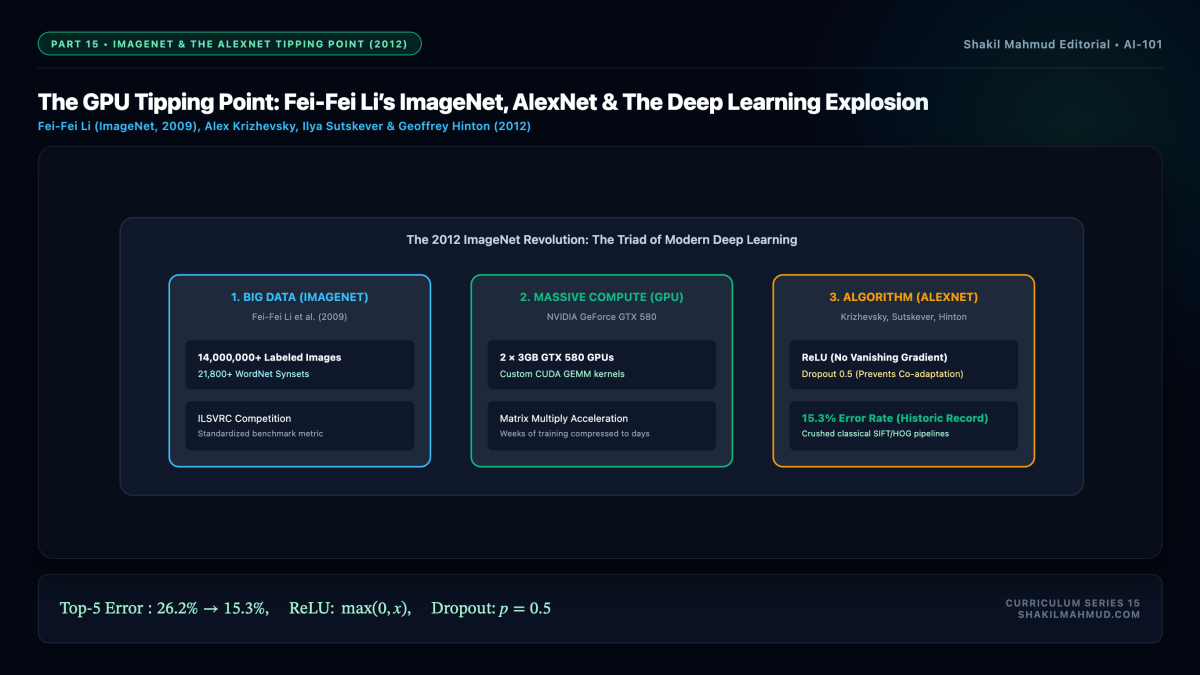
Beginning in 2007, Fei-Fei Li, Jia Deng, and their team utilized Amazon Mechanical Turk to crowd-source annotations for millions of images downloaded from search engines. By 2009, they unveiled ImageNet: an unprecedented visual ontology organized according to the WordNet hierarchy, containing over 14 million labeled photographs spanning 21,800 categories.
In 2010, the team established the ImageNet Large Scale Visual Recognition Challenge (ILSVRC), presenting a standardized test of 1.2 million images across 1,000 diverse classes (from Siberian huskies and leopard geckos to container ships and acoustic guitars). For two years, classical algorithms scraped modest annual gains of 1% to 2%, with top-5 error rates stagnating around 26%.
2. Alex Krizhevsky, Ilya Sutskever, and Geoffrey Hinton
In Toronto, Canada, a small band of unrepentant connectionists led by Geoffrey Hinton had spent the statistical winter nursing neural networks. Among Hinton’s graduate students were two prodigies: Alex Krizhevsky, a coding virtuoso who could hand-craft assembly-level CUDA kernels, and Ilya Sutskever, a brilliant theorist with profound intuition for deep computational graphs.
Krizhevsky recognized that training deep networks on millions of images was fundamentally a matrix multiplication bottleneck. CPUs were hopelessly slow. Krizhevsky purchased two gaming graphics cards—NVIDIA GeForce GTX 580s with 3 gigabytes of memory each—and wrote blistering fast parallel 2D convolution and GEMM routines in raw CUDA, splitting the network layers across the two GPUs.
3. The Architecture of AlexNet
AlexNet was an 8-layer deep convolutional network (5 convolutional layers followed by 3 fully connected layers) containing 60 million parameters and 650,000 neurons. Its overwhelming superiority was powered by three critical architectural breakthroughs:
- Rectified Linear Unit (ReLU) Activations:
$$f(x) = max(0, x)$$
For decades, neural nets had utilized saturating sigmoid or tanh activations, which caused gradients to vanish exponentially across deep layers. ReLU’s constant gradient of $1$ for all positive inputs eliminated vanishing gradients, accelerating training by a factor of six. - Dropout Regularization (Hinton et al., 2012):
During each forward-backward training pass, random neurons were temporarily zeroed out with probability $p = 0.5$. Dropout prevented complex co-adaptations between features, functioning as an implicit ensemble of exponentially many thinned networks and effectively conquering overfitting on 60 million weights. - Data Augmentation:
Artificially expanding the dataset via random horizontal reflections, $224 imes 224$ crops, and PCA color jittering, forcing the network to learn invariant geometric representations.
4. The ImageNet Tipping Point (October 2012)
The results of the 2012 ILSVRC competition landed like a thunderclap:
- Second Place (State-of-the-art classical computer vision): 26.2% top-5 error rate (using Fisher vectors and SIFT features).
- First Place (AlexNet): 15.3% top-5 error rate.
A deep neural network had not merely beaten the state-of-the-art; it had crushed it by an unheard-of 10.9 percentage points. The error gap was so enormous that the organizers initially re-checked the submission code for evaluation bugs. There were none. Deep Learning had won decisively.
5. The Gold Rush: Big Tech Mobilizes
The global tech industry pivoted instantly. Within months, Google acquired Hinton’s three-person startup DNNresearch for $44 million in an auction that included Microsoft and Baidu. Yann LeCun was recruited to found Facebook AI Research (FAIR). Andrew Ng championed large-scale deep learning at Stanford and Google Brain.
GPU maker NVIDIA, whose CEO Jensen Huang had bet the company’s future on CUDA acceleration, transformed from a video game hardware vendor into the indispensable computational foundry of the 21st century. The modern era of Artificial Intelligence had arrived. The question was no longer whether deep neural networks worked; the question was how far scale could take them.