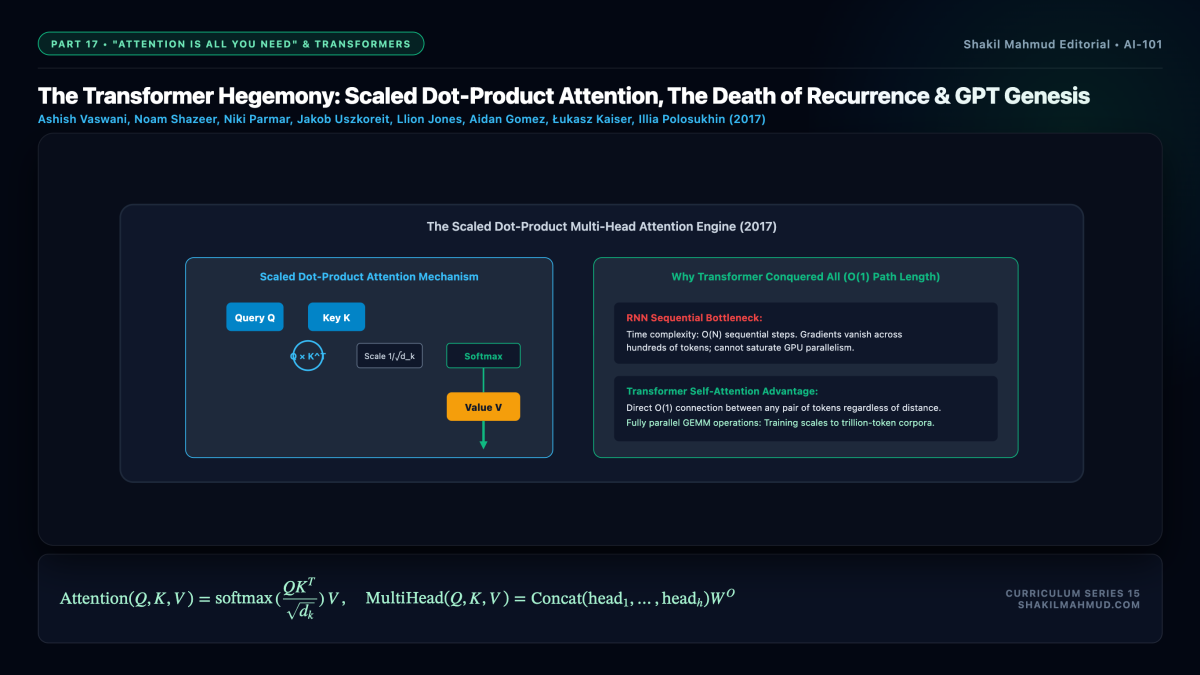
In June 2017, an eight-author research team from Google Brain and Google Research published an eight-page paper bearing the audaciously declarative title “Attention Is All You Need”. Within thirty-six months, its core invention—the Transformer—had systematically dismantled three decades of recurrent and convolutional hegemony across natural language processing, speech synthesis, protein folding, and computer vision. By entirely discarding recurrence in favor of pure, vectorized self-attention, the Transformer solved the fundamental engineering bottleneck of deep sequential learning: time-step serial dependency.
1. The Bottleneck of Recurrence: $O(n)$ Sequential Computation
From the mid-1980s through 2017, sequence-to-sequence modeling was dominated by Recurrent Neural Networks (RNNs) and their gated variants, Long Short-Term Memory (LSTM) and Gated Recurrent Units (GRU). While mathematically expressive, recurrent architectures suffered from an inherent computational constraint: sequential processing.
In an LSTM, computing hidden state $h_t$ strictly requires the prior state $h_{t-1}$:
$$h_t = sigma(W x_t + U h_{t-1} + b)$$
Because state computation at temporal index $t$ depends sequentially on index $t-1$, an input sequence of length $n$ demands $O(n)$ sequential forward operations. This sequential bottleneck prevented modern GPU/TPU massive parallelization. Furthermore, despite gating mechanisms, signals propagating over sequences of hundreds of tokens inevitably suffered from gradient attenuation and information bottlenecking.
2. Scaled Dot-Product & Multi-Head Self-Attention
The Transformer replaced sequential recurrence with Self-Attention, where every token in a sequence attends directly to every other token simultaneously. Given packed matrices of Queries ($Q$), Keys ($K$), and Values ($V$) projected into dimension $d_k$:
$$text{Attention}(Q, K, V) = text{softmax}left(frac{QK^T}{sqrt{d_k}}right)V$$
The scaling factor $frac{1}{sqrt{d_k}}$ is mathematically vital: for large projection dimensions $d_k$, the dot product yields large magnitudes, pushing the softmax function into regions of extremely vanishing gradients. Dividing by $sqrt{d_k}$ preserves unit variance across the pre-softmax activations.
Rather than performing a single attention function, Multi-Head Attention (MHA) projects queries, keys, and values $h$ times with distinct learned linear projections:
$$text{MultiHead}(Q, K, V) = text{Concat}(text{head}_1, dots, text{head}_h)W^O$$
$$text{where} quad text{head}_i = text{Attention}(Q W_i^Q, K W_i^K, V W_i^V)$$
Multi-Head Attention empowers the model to jointly attend to information from different representation subspaces at different positions—capturing syntactic agreements, coreference, semantic hierarchies, and long-range structural dependencies simultaneously.
3. Eliminating Inductive Bias in Exchange for Infinite Scalability
Convolutional networks incorporate strong spatial inductive biases (translation invariance and local connectivity). RNNs incorporate temporal inductive biases (sequential temporal continuity). The Transformer, by contrast, possesses minimal structural inductive bias: it treats tokens as an unordered set, requiring explicit Positional Encodings (using sinusoidal bases or learned positional embeddings) to retain token ordering:
$$PE_{(pos, 2i)} = sinleft(frac{pos}{10000^{2i/d_{text{model}}}}right), quad PE_{(pos, 2i+1)} = cosleft(frac{pos}{10000^{2i/d_{text{model}}}}right)$$
The absence of rigid inductive biases was initially viewed with skepticism. However, when scaled with massive compute and datasets, the Transformer proved vastly superior to specialized architectures. Its quadratic $O(n^2)$ pairwise attention matrix allowed arbitrary information routing across sequences without state bottlenecking.
4. From BERT and GPT to Universal Foundation Systems
The Transformer bifurcated into three distinct paradigm trajectories:
- Encoder-Only (BERT, RoBERTa): Optimized for bidirectional representations via Masked Language Modeling (MLM), mastering discriminative classification, semantic retrieval, and named entity recognition.
- Encoder-Decoder (T5, BART): Retaining the original Vaswani sequence-to-sequence formulation, ideal for translation, summarization, and multi-task text rewriting.
- Decoder-Only (GPT series): Utilizing causal masking to enforce autoregressive next-token prediction, transforming sequence modeling into generative probabilistic completion.
By 2020, Vision Transformers (ViT) replaced convolutions in computer vision, AlphaFold 2 revolutionized molecular structural biology, and whisper transformed automatic speech recognition. The Transformer emerged as the universal architectural substrate of modern artificial intelligence.