Long before silicon microprocessors, deep neural networks, or electronic vacuum tubes, humanity dreamed of mechanizing thought. The quest for Artificial Intelligence did not begin in a mid-century American laboratory; it emerged from an ancient, persistent philosophical longing: to distill human cognition into formal, physical systems that could calculate truth with the same inexorable necessity as clockwork gears.
1. Antiquity’s Dreams: Mythological Automata and Pneumatic Mechanisms
In Greek mythology, the artisan god Hephaestus forged Talos—a colossal automaton of bronze endowed with life by divine ichor—to patrol the shores of Crete. Hephaestus likewise fashioned golden attendants, mechanical handmaidens endowed with speech, strength, and divine intelligence. While these figures were mythological projections, the Hellenistic world transformed divine fantasy into pneumatic and hydraulic reality.
In Alexandria during the 1st century CE, Hero (Heron) of Alexandria authored Pneumatica and Automata, detailing programmable mechanical theaters powered by falling weights, ropes wrapped around geared axles, and siphoning water chambers. Hero’s devices were essentially primitive analog state machines: sequential cam configurations could trigger mechanical figures to pour wine, strike bells, or open temple doors automatically upon the lighting of an altar fire. Yet Hero’s automata were physically programmed spectacles rather than reasoning machines. They lacked an essential spark: the representation and manipulation of symbolic meaning.
2. Ramon Llull and the Combinatorial Dawn (Ars Magna)
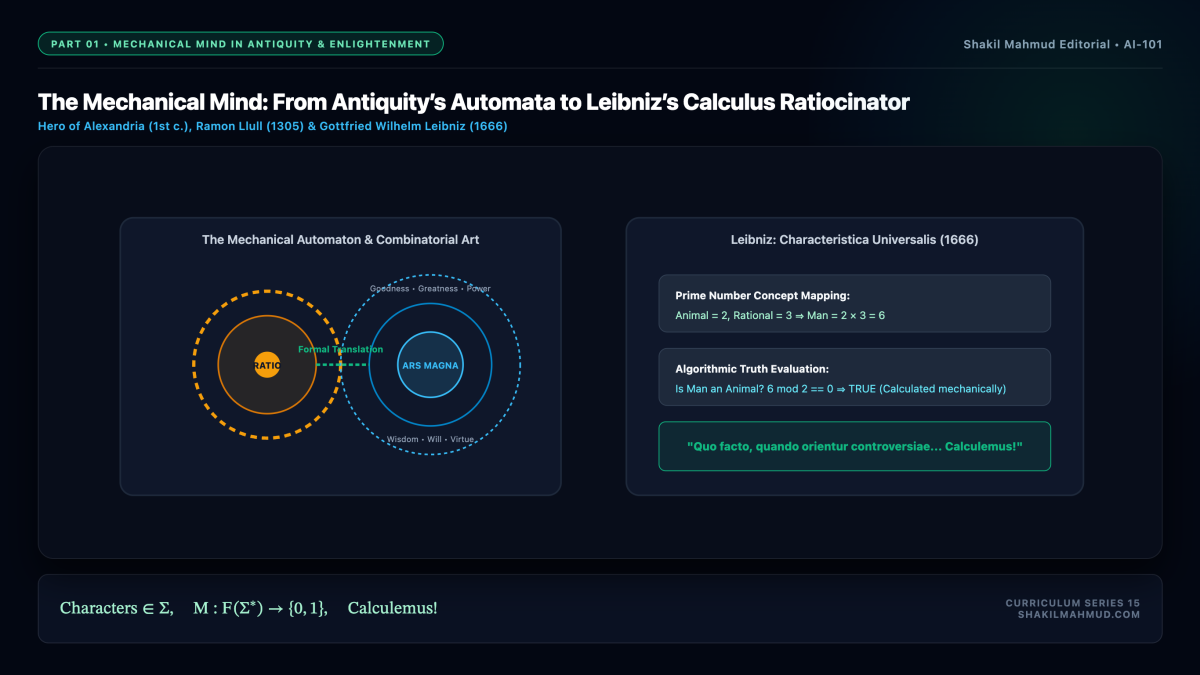
The true conceptual bridge toward symbolic computation was crossed in the late 13th century on the island of Mallorca by the philosopher and mystic Ramon Llull. In his 1305 masterwork Ars Magna (The Ultimate General Art), Llull proposed that all theological and philosophical truths could be systematically uncovered by combining a finite set of fundamental concepts.
Llull constructed physical paper-and-parchment apparatuses: concentric, independently rotating wheels inscribed with Latin letters representing divine attributes (Goodness, Greatness, Eternity, Power, Wisdom, Will, Virtue, Truth, Glory). By rotating these concentric volvelles, a practitioner could mechanically generate all valid binary and ternary combinations of fundamental theological predicates:
$$mathcal{C} = Sigma_1 imes Sigma_2 imes dots imes Sigma_k$$
Llull believed that false propositions would reveal self-evident internal contradictions, leaving only unassailable philosophical truths. Although primitive and burdened by scholastic mysticism, the Ars Magna was a monumental intellectual leap: it asserted that knowledge generation is an algorithmic, combinatorial operation that can be executed by a physical instrument. Llull’s work was studied extensively across Renaissance Europe, profoundly influencing Giordano Bruno, René Descartes, and, most crucially, a young German polymath named Gottfried Wilhelm Leibniz.
3. Leibniz’s Vision: The Characteristica Universalis and Calculus Ratiocinator
In 1666, at just nineteen years of age, Gottfried Wilhelm Leibniz published his dissertation De Arte Combinatoria. Leibniz saw beyond Llull’s mystical theological circles to a radical mathematical vision: the entire universe of human thought could be reduced to a formal symbolic algebra.
Leibniz envisioned two complementary pillars that would form the conceptual blueprint of symbolic artificial intelligence three centuries before its physical realization:
- The Characteristica Universalis (Universal Characteristic): An exhaustive, formal symbolic language in which every fundamental human concept is assigned an irreducible mathematical symbol. Leibniz suggested mapping primitive ideas to prime numbers (e.g., Animal = $2$, Rational = $3$), such that compound concepts could be represented through prime factorization (e.g., Man = $2 imes 3 = 6$).
- The Calculus Ratiocinator (Reasoning Calculus): A formal mechanical calculus of deduction. To determine whether proposition $ is inherently a property of $, one would merely compute whether the integer representing $ divides the integer representing $ without remainder ( pmod A quiv 0$).
Leibniz’s ambition was breathtakingly modern. He envisioned an age where disputes between philosophers, statesmen, and scientists would no longer be resolved by rhetoric or violent war, but by algorithmic computation:
“When controversies arise, there will be no more need of disputing between two philosophers than between two accountants. For it would suffice to take their pencils in their hands, sit down at their abacuses, and say to one another: Calculemus! (Let us calculate!)”
4. Mechanical Computation: Pascal’s Pascaline to Leibniz’s Stepped Reckoner
Leibniz understood that symbolic calculation demanded physical manifestation. Blaise Pascal had taken the first monumental step in 1642 with the Pascaline, a mechanical calculator capable of adding and subtracting via interlocking toothed gear wheels and gravity-assisted carry mechanisms. However, Pascal’s machine was constrained to linear addition.
Leibniz dramatically expanded mechanical power by inventing the Stepped Drum (the Leibniz Wheel) in 1673. By utilizing a cylinder with stepped gear teeth of increasing lengths, Leibniz’s Stepped Reckoner could perform mechanical multiplication and division through repeated gear rotations. It was the first mechanical device capable of executing all four fundamental arithmetic operations.
Simultaneously, Leibniz formalized the binary number system in his 1679 treatise Explication de l’Arithmétique Binaire. Recognizing that all numbers and logical relations could be expressed using only two digits ($0$ and $1$), Leibniz noted that physical machines could represent states using simple mechanical detents: engaged ($1$) or disengaged ($0$). In a single stroke, Leibniz laid the theoretical foundations for digital logic, binary computation, and automated inference.
5. The Enlightenment Legacy: From Mechanical Man to Computational Mind
The philosophical implications of mechanical calculation exploded during the 18th-century Enlightenment. If physical gears could perform arithmetic, and if human thought was at its core a formal calculation, then was the human mind itself an extraordinarily intricate machine?
In 1748, Julien Offray de La Mettrie published L’Homme Machine (Man a Machine), asserting that human consciousness, emotion, and intellect are direct physical manifestations of organized matter. In the salons of Paris, Jacques de Vaucanson stunned the world with mechanical automata of astonishing lifelike complexity: a mechanical flutist capable of playing twelve melodies by modulating breath pressure with mechanical bellows, and a digesting duck with flexible rubber intestines.
Yet these automata remained rigid mechanical puppets. They could not adapt to novel sensory inputs; they could not learn; they could not generalize. The mechanical paradigm had revealed that physical devices could mimic action and execute calculation, but it could not yet answer the ultimate riddle: how can a deterministic physical mechanism originate creative, autonomous, and self-correcting thought? The mathematical and engineering journey to resolve that question was about to begin.