On May 11, 1997, on the 35th floor of the Equitable Center in midtown Manhattan, humanity crossed a psychological Rubicon. Garry Kasparov, widely regarded as the greatest human chess player in history and the reigning World Chess Champion, buried his face in his hands, stood up from the board after just 19 moves of Game 6, and stormed out of the playing hall in disbelief. An IBM supercomputer named Deep Blue had defeated him 3.5 to 2.5 in a six-game match. For the first time in history, the undisputed world champion of the ultimate intellectual game had fallen to a machine.
1. The 50-Year Quest: Chess as the Drosophila of AI
Ever since the dawn of computing, chess had been revered as the supreme benchmark of human intellect—what geneticist Alexander Kronrod called the “Drosophila of Artificial Intelligence.” If a machine could master chess, surely it had mastered the summit of human strategic reasoning.
In 1950, Claude Shannon published Programming a Computer for Playing Chess, proposing two contrasting search philosophies:
- Type A (Brute-Force): Exhaustively searching all legal moves across several plies using minimax evaluation.
- Type B (Human-Like Selective Search): Pruning unpromising branches aggressively using chess heuristics, evaluating only a handful of candidate moves deeply.
For decades, pioneers like Norbert Wiener, Alan Turing, Herbert Simon, and John McCarthy debated which path would triumph. By the 1980s, specialized hardware proved that brute-force compute, executed with absolute tactical precision, ruthlessly punished human psychological frailties.
2. The Architecture of IBM Deep Blue
Deep Blue was the intellectual culmination of Hsu Feng-hsiung’s doctoral research on the ChipTest and Deep Thought projects at Carnegie Mellon University, which was subsequently acquired and financed by IBM Research alongside Murray Campbell, Joe Hoane, and grandmaster Joel Benjamin.
Completed in 1997, Deep Blue was a massive parallel hybrid supercomputer:
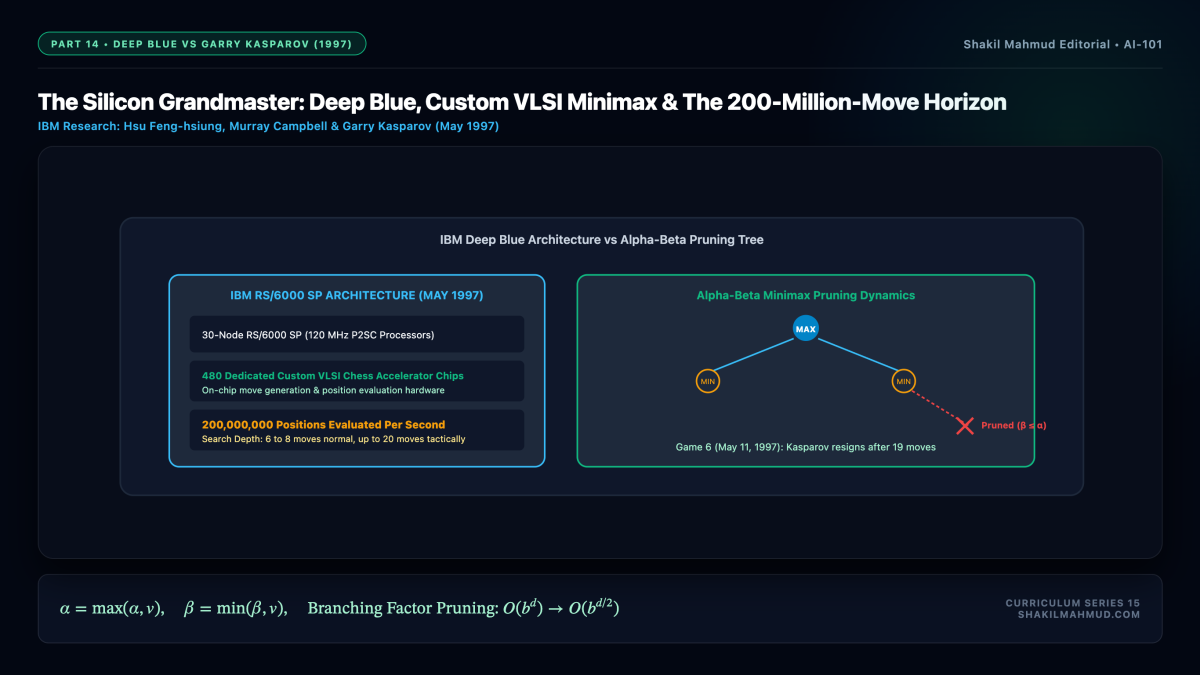
- Host System: A 30-node IBM RS/6000 SP supercomputer utilizing 120 MHz P2SC microprocessors running AIX.
- Dedicated VLSI Hardware: The RS/6000 nodes hosted 480 custom VLSI chess accelerator chips. Each chip contained 1.5 million transistors fabricated on 0.6-micron CMOS, capable of generating legal moves, searching move trees, and computing static position evaluations entirely in hardware.
- Raw Computational Power: Deep Blue evaluated an astounding 200,000,000 board positions per second. Its standard search depth extended 6 to 8 moves ahead (12 to 16 plies), with selective tactical extensions reaching up to 20 or more plies in tactical skirmishes.
3. The Mechanics of Alpha-Beta Minimax Pruning
Evaluating $10^{120}$ chess positions by pure brute force is impossible. Deep Blue utilized the Minimax Algorithm with Alpha-Beta Pruning:
$$lpha = max(lpha, v), quad eta = min(eta, v)$$
Alpha represents the minimum score the maximizing player is assured of; beta represents the maximum score the minimizing player is assured of. Whenever $eta le lpha$, the remaining child nodes cannot possibly influence the final decision and are instantly pruned from consideration.
Under optimal move ordering, alpha-beta pruning slashes the effective branching factor from $b$ to $sqrt{b}$, doubling the search depth achievable within a fixed time budget ($O(b^d) o O(b^{d/2})$). Deep Blue combined this with a grandmaster evaluation function containing over 8,000 handcrafted features (king safety, pawn structures, pin tactics, piece mobility) and an endgame tablebase containing every theoretically solved chess position with five or fewer pieces.
4. The Historic Match: May 1997
Kasparov had defeated an earlier iteration of Deep Blue 4–2 in Philadelphia in 1996. But in Manhattan in 1997, Deep Blue was an entirely different beast:
- Game 1: Kasparov won with brilliant positional play. At the end of the game, Deep Blue executed an inexplicable bugged move (a random move selected when time expired). Kasparov misinterpreted this glitch as a sign of deep, inscrutable machine genius.
- Game 2: Deep Blue played with astonishing positional maturity, declining a poisoned pawn and slowly grinding Kasparov down. Visibly shaken, Kasparov resigned in a position that was later discovered to be a theoretical draw.
- Games 3, 4, 5: Ended in tense draws.
- Game 6 (May 11): Playing the Black side of the Caro-Kann Defense, Kasparov made an uncharacteristic opening mistake ($7…h6?$). Deep Blue instantly struck with a standard knight sacrifice ($8. Nxe6!$), shattering Black’s king safety. Kasparov resigned after just 19 moves.
5. The Philosophical Legacy of Deep Blue
Deep Blue’s triumph sent shockwaves across global culture. Newsweek featured Kasparov on its cover with the headline: “The Brain’s Last Stand.”
Yet in the halls of computer science, Deep Blue’s victory carried an ironic realization: mastering chess was not the same as achieving intelligence. Deep Blue was a brilliant, brute-force calculating automaton; it did not know it was playing chess, it felt no joy in victory, and it could not transfer a single bit of its knowledge to recognize a handwritten digit, converse in English, or diagnose a disease. True intelligence would require systems that could learn, see, and abstract directly from raw data. That revolution was fifteen years away, waiting for a massive visual benchmark named ImageNet.