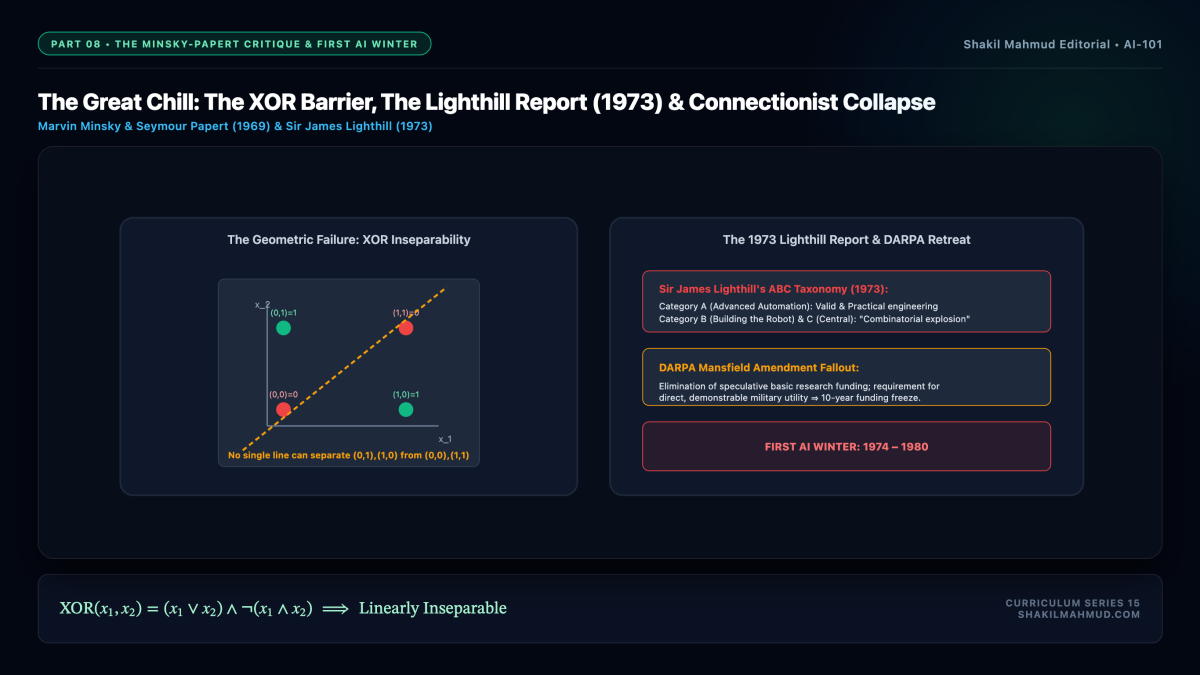
In 1969, the Massachusetts Institute of Technology Press published an imposing mathematical monograph entitled Perceptrons: An Introduction to Computational Geometry by Marvin Minsky and Seymour Papert. What was intended as a rigorous analysis of single-layer neural models landed like a nuclear strike on connectionist research, halting neural network funding for over a decade and precipitating the First AI Winter.
1. The Geometric Barrier: Linear Inseparability of XOR
Minsky and Papert proved with devastating mathematical precision that single-layer perceptrons have severe, insurmountable topological limitations. The most famous example was the simple Exclusive-OR (XOR) function:
| $x_1$ | $x_2$ | XOR Output ($y$) |
|---|---|---|
| 0 | 0 | 0 |
| 0 | 1 | 1 |
| 1 | 0 | 1 |
| 1 | 1 | 0 |
Plotted on a Cartesian coordinate plane, the positive points $(0, 1)$ and $(1, 0)$ lie diagonal to the negative points $(0, 0)$ and $(1, 1)$. It is geometrically impossible to draw a single straight line (hyperplane) that separates the positive outputs from the negative outputs.
To classify XOR, a decision boundary must possess non-linearity—requiring at least two separating lines operating in concert. This necessitates a multi-layer perceptron (MLP) with intermediate hidden units.
2. The Fatal Conjecture: The Multi-Layer Impasse
Rosenblatt had already recognized the need for multi-layer networks. However, in 1969, no mathematical algorithm existed to train hidden layers. The Perceptron learning rule depended on knowing the exact error at the output; but for an internal hidden neuron buried between the input and output, there was no known method to compute how much a specific hidden weight contributed to the final classification error.
Minsky and Papert delivered what appeared to be the death sentence for connectionism:
“Our intuitive judgment is that the extension to multi-layer systems is sterile.”
The impact was catastrophic. DARPA, the National Science Foundation, and international research councils interpreted Minsky and Papert’s critique as definitive proof that neural networks were a mathematical dead end. Connectionist grant applications were systematically rejected, laboratories closed, and the study of artificial neural networks became a career-destroying taboo.
3. The Lighthill Report (1973) and the Collapse of Funding
Meanwhile, the symbolic AI camp was facing its own reckoning. Programs that worked brilliantly on toy microworlds failed completely when confronted with real-world ambiguity, machine translation, and visual clutter.
In 1973, the British Science Research Council commissioned Sir James Lighthill, a distinguished hydrodynamicist at Cambridge, to evaluate the state of AI research. The resulting Lighthill Report was devastating:
- Lighthill classified AI into three domains: Category A (Advanced Automation), Category B (Building the Robot), and Category C (Central AI / cognitive studies).
- He concluded that research in Categories B and C had suffered total failure due to combinatorial explosion, failing to deliver on any of its grandiose promises.
- The British government immediately terminated AI funding across almost all UK universities, dismantling prestigious research groups at Edinburgh, Sussex, and Essex.
Simultaneously in the United States, the passage of the Mansfield Amendment (1973) mandated that DARPA fund only projects with direct, demonstrable military utility. Speculative cognitive exploration was abandoned. Artificial Intelligence entered its long, frigid First Winter (1974–1980).