By the mid-1980s, the artificial intelligence industry was intoxicated with triumph. Venture capital flowed into specialized AI hardware startups, and the Japanese Ministry of International Trade and Industry (MITI) launched a colossal $400-million geopolitical crusade known as the Fifth Generation Computer Systems project. Yet within five years, the entire market imploded, delivering the devastating Second AI Winter (1987–1993).
1. Japan’s Fifth Generation Crusade (FGCS)
In October 1981, Japan shocked the Western technological world by announcing the Fifth Generation Computer Systems (FGCS) Project (1982–1992). Having achieved mastery in consumer electronics and automotive manufacturing, Japan sought absolute technological hegemony in computing.
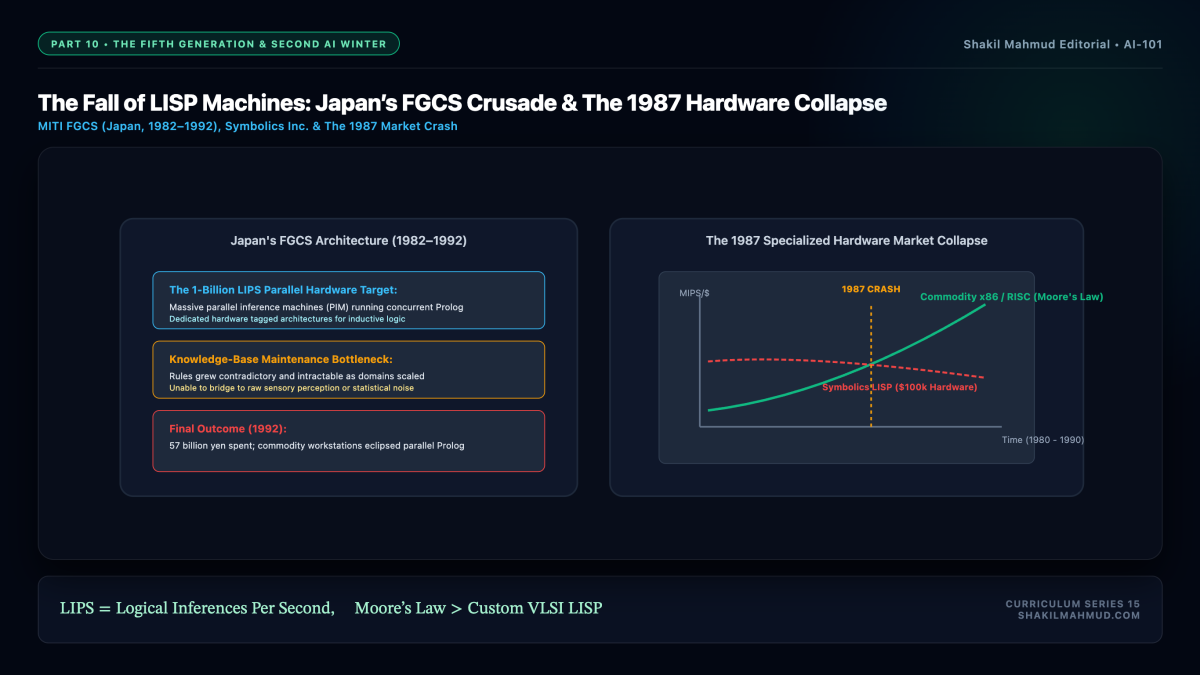
MITI poured 57 billion yen into the newly formed Institute for New Generation Computer Technology (ICOT). The FGCS mission was audaciously ambitious:
- Abandon the traditional Von Neumann CPU architecture.
- Construct massively parallel supercomputers containing thousands of custom processors operating directly on Logic Programming (Concurrent Prolog).
- Achieve 1 Billion LIPS (Logical Inferences Per Second) by 1992.
- Build machines capable of seamless natural language speech recognition, machine translation, and autonomous visual perception.
2. The Strategic Counter-Offensive: MCC and Alvey
The Western world reacted with panic. Viewing FGCS as an existential economic threat, the United States formed the Microelectronics and Computer Technology Corporation (MCC) in Austin, Texas, under Admiral Bobby Inman, backed by heavy DARPA Strategic Computing funding. In the United Kingdom, the government reversed its post-Lighthill freeze to launch the £350-million Alvey Programme. The geopolitical AI arms race had officially begun.
3. The LISP Machine Bubble
In the private sector, symbolic AI software was notoriously compute- and memory-intensive. General-purpose IBM mainframes and PCs could not run complex LISP programs efficiently. This gave rise to the LISP Machine Industry.
Spun out of the MIT AI Lab in 1979, companies like Symbolics and Lisp Machines Inc. (LMI) built specialized desktop supercomputers featuring tagged-memory hardware architectures, hardware garbage collection, and custom microcode designed exclusively for LISP. By 1986, Symbolics was generating over $100 million annually, and its machines were the undisputed Ferrari of high-tech research.
4. The Crash of 1987: The Commodity Guillotine
The catastrophic collapse of the AI market in 1987 was driven by a ruthless technological reality: Moore’s Law and General-Purpose Microprocessors.
In the late 1980s, general-purpose personal computers and Unix workstations powered by Intel 80386/80486 processors and Sun Microsystems SPARC RISC chips accelerated exponentially. General-purpose desktop computers became capable of compiling and running LISP faster than a $100,000 specialized Symbolics workstation—at a fraction of the cost.
Overnight, the commercial justification for proprietary AI hardware vanished. Between 1987 and 1988, sales collapsed:
- Symbolics, LMI, and IntelliCorp saw their revenues plummet, leading to mass bankruptcies.
- Over 300 expert system software startups folded as enterprise clients realized that maintaining massive rule bases was an expensive software engineering nightmare.
- In 1992, Japan’s FGCS project quietly concluded: despite technical brilliance in parallel hardware design, massive parallel logic programming had failed to conquer common-sense reasoning or practical machine translation.
5. The Deep Freeze: 1987 to 1993
The aftermath was brutal. Corporate executives banned the phrase “Artificial Intelligence” from their business plans; researchers submitted grant proposals disguised as “computational statistics,” “informatics,” or “pattern recognition” to avoid the toxic stigma of failed promises. DARPA slashed funding for strategic computing.
Yet in the quiet shadows of this Second AI Winter, a defiant band of cognitive scientists, physicists, and mathematicians were already building the mathematical engine that would overthrow the symbolic paradigm forever: the multi-layer backpropagation neural network.