In the late 1970s, artificial intelligence emerged from its First Winter by abandoning the dream of general-purpose, domain-independent inference. Led by Edward Feigenbaum at Stanford University, researchers realized that human chess grandmasters, physicians, and organic chemists do not reason via naked first-order logic; their intellectual supremacy derives from vast, highly specialized, and domain-specific knowledge.
1. The Knowledge Principle
Feigenbaum codified this philosophy as The Knowledge Principle:
“A system exhibits intelligent behavior primarily because of the wealth of its domain-specific knowledge, rather than the sophistication of its domain-agnostic inference methods.”
This insight ignited the era of Knowledge-Based Systems (KBS) and Expert Systems. Instead of writing general theorem provers, AI engineers became “Knowledge Engineers”—conducting hundreds of hours of interviews with domain experts to extract implicit rules of thumb, clinical intuitions, and empirical heuristics, encoding them into formal production rules.
2. Production Rule Architecture
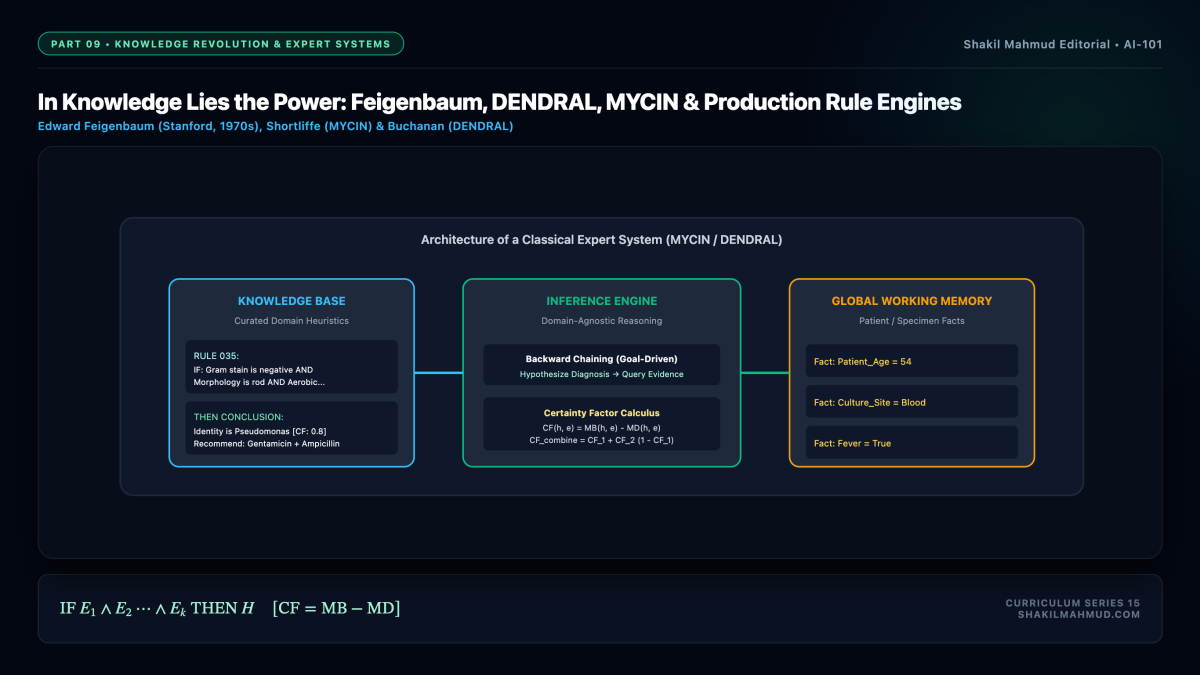
An expert system cleanly separates domain knowledge from general reasoning:
- Knowledge Base (KB): A library of declarative production rules in the form:
$$ ext{IF } langle ext{Condition}_1 land ext{Condition}_2 land dots land ext{Condition}_k
angle implies ext{THEN } langle ext{Action / Conclusion}
angle$$ - Working Memory: A dynamic database storing facts currently known to be true about the specific case (e.g., patient vital signs, chemical spectrum peaks).
- Inference Engine: Executes formal chaining mechanisms:
- Forward Chaining (Data-Driven): Starts with known facts, matches rule antecedents, and derives new conclusions until a goal is established.
- Backward Chaining (Goal-Driven): Hypothesizes a final conclusion (e.g., “Patient has Meningitis”) and works backward recursively to find supporting evidence in working memory or queries the human operator.
3. Pioneer Systems: DENDRAL and MYCIN
The paradigm proved its potency through landmark systems:
- DENDRAL (1965–1975): Developed at Stanford by Feigenbaum, Joshua Lederberg (Nobel laureate in genetics), and Bruce Buchanan. Given mass spectrometry and nuclear magnetic resonance data, DENDRAL deduced candidate molecular chemical structures with accuracy exceeding human organic chemists.
- MYCIN (1976): Created by Edward Shortliffe at Stanford to diagnose blood infections and prescribe appropriate antibiotic regimens. MYCIN handled real-world ambiguity through Certainty Factor (CF) Calculus:
$$ ext{CF}(h, e) = ext{MB}(h, e) – ext{MD}(h, e)$$
where $ ext{MB}$ is the measure of increased belief and $ ext{MD}$ is the measure of increased disbelief. In clinical evaluations, MYCIN’s therapeutic recommendations matched or outperformed senior infectious disease faculty at Stanford Medical School. - XCON/R1 (1978): Developed by John McDermott at Carnegie Mellon for Digital Equipment Corporation (DEC). XCON automatically configured complex VAX computer systems based on customer orders. By 1986, XCON was saving DEC an estimated $40 million annually, proving for the first time that AI could generate immense corporate economic value.
4. The Commercial Boom and the Seeds of Brittle Collapse
Between 1980 and 1985, billions of dollars poured into commercial AI startups. Corporations rushed to build in-house expert systems, and venture capitalists funded specialized hardware companies (Symbolics, Lisp Machines Inc., Intellicorp). Yet expert systems suffered from a fatal flaw: brittleness. A medical expert system could diagnose rare bacterial meningitis brilliantly, but if a patient had a broken leg or atypical symptoms, the system lacked common sense to recognize that its rules were inapplicable. The maintenance costs of massive rule bases were about to trigger a second catastrophe.