By the mid-1990s, artificial intelligence had grown weary of grand philosophical promises that culminated in winters. Disillusioned by brittle expert systems and frustrated by the uninterpretable non-convex loss surfaces and vanishing gradients of multi-layer neural networks, the field executed a profound pivot known as The Statistical Turn. Pragmatic, mathematically grounded algorithms—most notably Vladimir Vapnik’s Support Vector Machines (SVMs)—seized hegemony across academia and industry.
1. Vapnik-Chervonenkis (VC) Theory and Structural Risk Minimization
Developed over decades in the Soviet Union by Vladimir Vapnik and Alexey Chervonenkis, Statistical Learning Theory provided what connectionism lacked: rigorous mathematical bounds on generalization.
Classical models had focused on Empirical Risk Minimization (ERM)—minimizing training error. However, a model with excessive capacity can memorize noise, triggering catastrophic overfitting. Vapnik introduced Structural Risk Minimization (SRM), proving that with probability at least $1 – eta$, the true risk $R(h)$ on unseen data is upper-bounded by the training risk $R_{ ext{emp}}(h)$ plus a capacity penalty:
$$R(h) le R_{ ext{emp}}(h) + sqrt{rac{h_{ ext{VC}} left( log(2N / h_{ ext{VC}}) + 1
ight) – log(eta / 4)}{N}}$$
where $h_{ ext{VC}}$ is the Vapnik-Chervonenkis Dimension—a measure of the model’s capacity to shatter arbitrary label assignments. Vapnik showed that generalization does not depend on the number of parameters, but on the geometric margin separating the classes.
2. The Support Vector Machine: Convex Quadratic Optimization
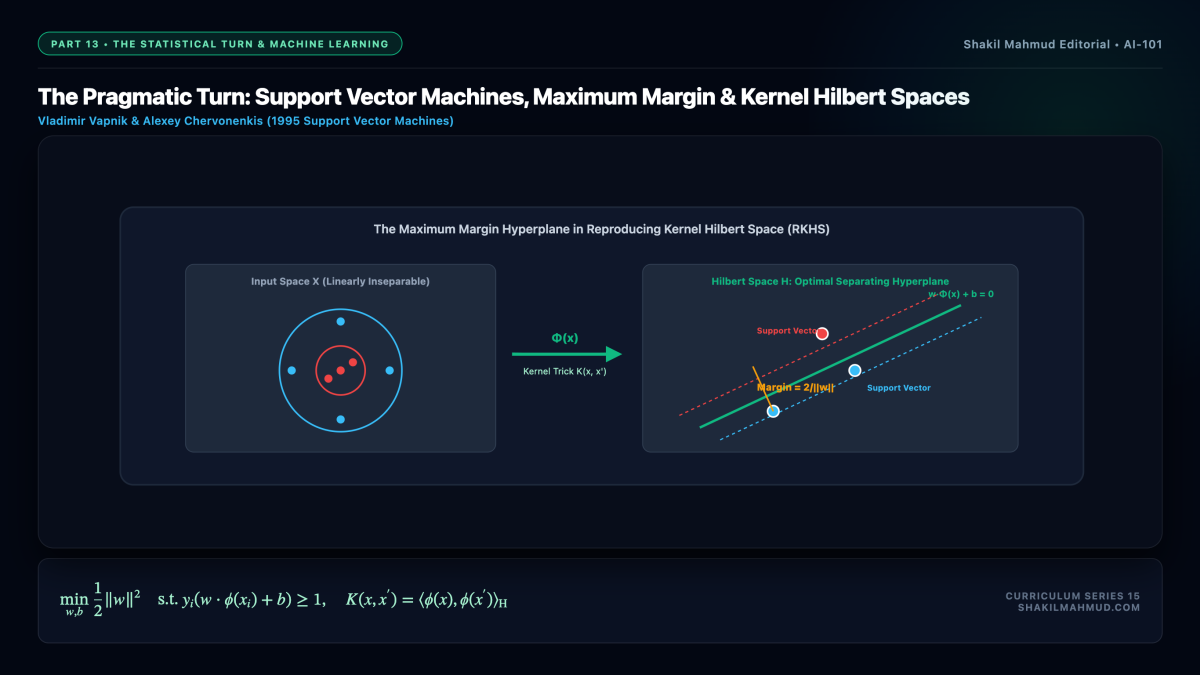
In 1992–1995, Vapnik, Bernhard Boser, and Corinna Cortes unveiled the Support Vector Machine. Given linearly separable training data $(x_i, y_i)$ with $y_i in {-1, +1}$, the objective is to find a decision hyperplane $w cdot x + b = 0$ that maximizes the geometric margin $rac{2}{|w|}$:
$$min_{w, b} rac{1}{2} |w|^2 quad ext{subject to } y_i (w cdot x_i + b) ge 1 quad orall i$$
By formulating the Lagrangian dual via Karush-Kuhn-Tucker (KKT) conditions:
$$max_{lpha} sum_{i=1}^N lpha_i – rac{1}{2} sum_{i,j=1}^N lpha_i lpha_j y_i y_j (x_i cdot x_j) quad ext{s.t. } lpha_i ge 0, quad sum_{i=1}^N lpha_i y_i = 0$$
The optimization becomes a strictly convex quadratic programming problem. Unlike neural networks plagued by chaotic local minima and saddle points, SVMs have a single, unique global optimum that can be found deterministically! Crucially, the optimal weight vector depends solely on a sparse subset of data points lying directly on the margin: the Support Vectors.
3. The Kernel Trick: Infinite Dimensions at Finite Cost
What if the data is non-linear? In 1992, Boser, Guyon, and Vapnik resurrected Aizerman’s 1964 potential functions to formulate the legendary Kernel Trick.
By mapping input vectors into a high-dimensional (or even infinite-dimensional) feature space via non-linear mapping $phi(x) in mathcal{H}$, previously inseparable data becomes linearly separable. Because the dual formulation depends strictly on dot products $phi(x_i) cdot phi(x_j)$, one never needs to compute the coordinates in Hilbert space directly! One simply substitutes a Kernel Function $K(x_i, x_j) = langle phi(x_i), phi(x_j)
angle$:
- Polynomial Kernel: $K(x, x’) = (x cdot x’ + c)^d$
- Radial Basis Function (RBF / Gaussian): $K(x, x’) = expleft( -gamma |x – x’|^2
ight)$
Mercer’s Theorem guaranteed that any positive semi-definite kernel implicitly computes dot products in a valid Reproducing Kernel Hilbert Space (RKHS). With an RBF kernel, an SVM implicitly computes hyperplanes in an infinite-dimensional feature space using simple elementary arithmetic on desktop PCs.
4. The Pragmatic Renaissance
The statistical turn transformed AI from speculative philosophy into an applied engineering powerhouse. Throughout the late 1990s and 2000s, SVMs, Hidden Markov Models (HMMs) in speech recognition, Bayesian Networks in probabilistic reasoning, and Random Forests in tabular data dominated academic conferences. Neural networks were dismissed as outdated relics of the 1980s. Yet a major psychological Rubicon was about to be crossed in a Manhattan skyscraper: human grandmaster supremacy was about to fall.