At the close of the nineteenth century, mathematics stood on the brink of an existential crisis. Georg Cantor’s revolutionary creation of transfinite set theory had revealed infinite infinities, yet naive set comprehension soon spawned fatal logical contradictions—most famously Russell’s Paradox. In response, mathematicians reconstructed the bedrock of human thought upon rigorous, formal axiomatic foundations: the Zermelo-Fraenkel Set Theory with the Axiom of Choice (ZFC).
1. The Collapse of Naive Comprehension & Russell’s Paradox
Gottlob Frege’s logicist program relied on the Unrestricted Comprehension Principle: for any predicate $phi(x)$, there exists a well-defined set $S = {x mid phi(x)}$. In 1901, Bertrand Russell destroyed this assumption with a single self-referential counterexample. Consider the set of all sets that do not contain themselves as members:
R = { x mid x notin x }
Now query whether $R in R$:
- If $R in R$, then by definition of $R$, $R$ must satisfy $R notin R$ (a contradiction).
- If $R notin R$, then $R$ satisfies the defining membership predicate, forcing $R in R$ (a contradiction).
Thus, $R in R iff R notin R$. The law of excluded middle is violated; unrestricted comprehension makes naive mathematics internally contradictory.
2. The Zermelo-Fraenkel Axiom System (ZFC)
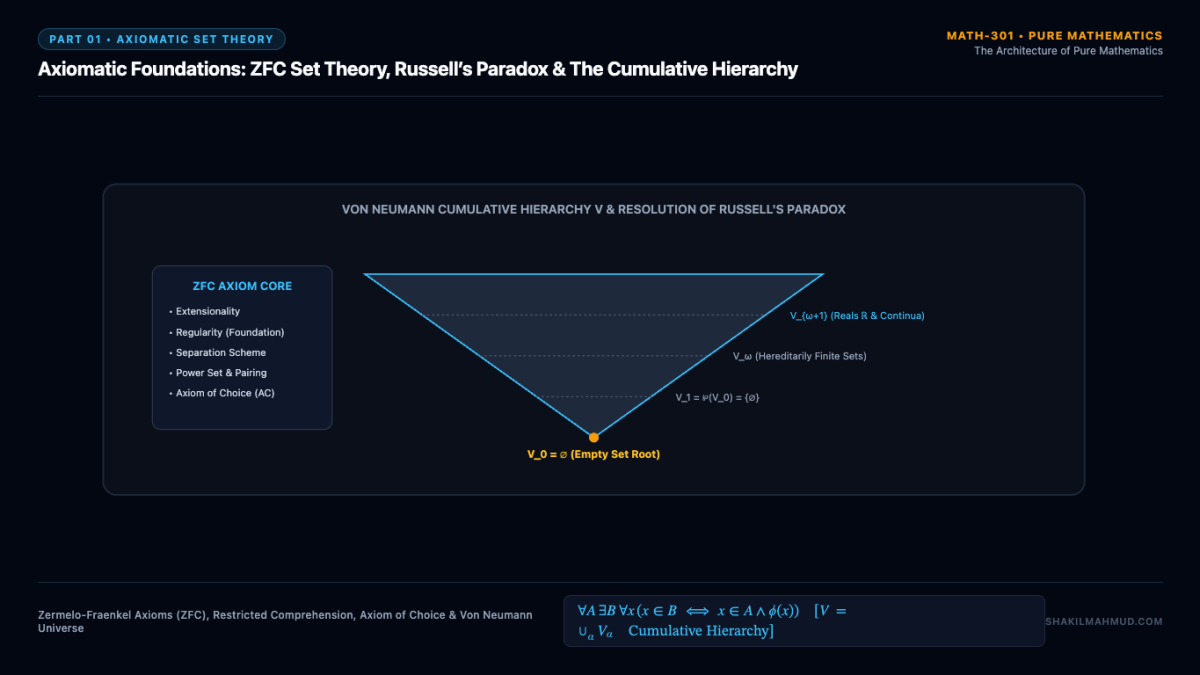
Ernst Zermelo (1908) and Adolf Fraenkel (1922) eliminated Russell’s paradox by replacing unrestricted comprehension with the Axiom Schema of Separation (Specification): you cannot create sets out of thin air; you can only carve out subsets from an already existing set $A$:
forall A , exists B , forall x , (x in B iff x in A land phi(x))
The standard ZFC system comprises nine foundational axioms:
- Extensionality: Sets are identical if and only if they share identical members: $forall x (x in A iff x in B) implies A = B$.
- Regularity (Foundation): Every non-empty set $A$ contains an $in$-minimal element ($x cap A = emptyset$), eliminating infinite descending membership chains ($dots in x_2 in x_1 in x_0$) and preventing sets from containing themselves ($x notin x$).
- Pairing: Given elements $a$ and $b$, the unordered pair ${a, b}$ exists.
- Union: For any set of sets $mathcal{F}$, the unified set $bigcup mathcal{F} = {x mid exists A in mathcal{F}, x in A}$ exists.
- Power Set: For any set $A$, the set of all subsets $mathcal{P}(A) = {x mid x subseteq A}$ exists.
- Infinity: There exists an inductive set containing $emptyset$ and closed under successor $x cup {x}$, guaranteeing the existence of the natural numbers $mathbb{N}$.
- Replacement Scheme: The image of any set under a definable function is a set.
- Empty Set: There exists a set $emptyset$ containing no elements.
3. The Axiom of Choice (AC) & Equivalent Formulations
The ninth axiom, the Axiom of Choice (AC), states that for any non-empty family of pairwise disjoint non-empty sets $mathcal{F}$, there exists a choice function $f: mathcal{F} to bigcup mathcal{F}$ selecting exactly one element from each set:
prod_{A in mathcal{F}} A neq emptyset
The Axiom of Choice is logically equivalent to two master theorems across pure mathematics:
- Zermelo’s Well-Ordering Theorem: Every set $X$ can be endowed with a well-ordering (every non-empty subset has a least element).
- Zorn’s Lemma: Every partially ordered set in which every chain has an upper bound contains at least one maximal element. Zorn’s Lemma is indispensable for proving that every vector space has a basis, every ring has a maximal ideal, and Tychonoff’s theorem holds in topology.
4. The Von Neumann Cumulative Hierarchy
In modern set theory, the entire universe of mathematical discourse is structured as the Von Neumann Cumulative Hierarchy $mathbf{V}$, built transfinitely from the empty set $emptyset$ along the ordinal numbers $alpha$:
V_0 = emptyset, quad V_{alpha+1} = mathcal{P}(V_alpha), quad V_lambda = bigcup_{beta < lambda} V_beta quad (text{for limit ordinals } lambda)
The axiom of regularity guarantees that every mathematical object—integers, real numbers, Hilbert spaces, manifolds, and category functors—resides at some definite rank $V_alpha$, establishing a contradiction-free universe for pure mathematics.