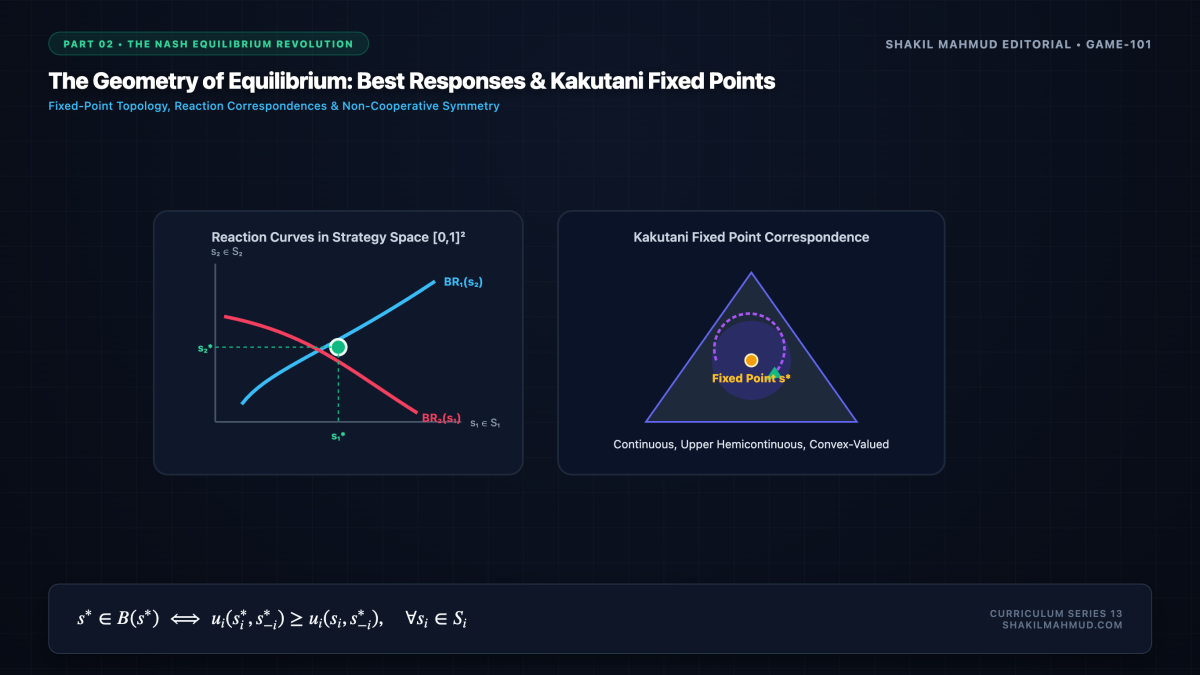
In November 1949, a twenty-one-year-old graduate student at Princeton University named John Forbes Nash Jr. walked into the office of John von Neumann. Nash possessed a revolutionary idea that would shatter the boundaries of zero-sum mechanics: a proof that every finite non-cooperative game—regardless of whether it was zero-sum, cooperative, symmetric, or asymmetric—possesses at least one stable mutual equilibrium. Von Neumann famously dismissed the initial proposal as trivial: “That’s trivial, you know. That’s just a fixed point theorem.” Yet Nash’s 28-page doctoral dissertation established the universal equilibrium concept that today governs modern economics, biology, geopolitical strategy, and computer science.
Beyond Zero-Sum: General Non-Cooperative Games
Von Neumann’s minimax framework was extraordinarily powerful, but it suffered from an existential limitation: real-world interactions are almost never zero-sum. International trade creates mutual wealth; bilateral nuclear armaments risk mutual annihilation; corporate technology standards yield network externalities. In non-zero-sum games, player goals are neither purely adversarial nor purely harmonious—they are inextricably entangled.
Consider an $n$-player game $Gamma = (N, (S_i)_{i in N}, (u_i)_{i in N})$, where $N = {1, dots, n}$ is the set of players, $S_i$ is the pure strategy set for player $i$, and $u_i: S to mathbb{R}$ is player $i$’s utility over joint strategy profiles $S = S_1 times dots times S_n$. When players randomize over pure strategies, player $i$ chooses a probability distribution $sigma_i in Delta(S_i)$.
Defining the Nash Equilibrium
A mixed strategy profile $sigma^* = (sigma_1^*, dots, sigma_n^*) in Sigma$ is a Nash Equilibrium if no player possesses a profitable unilateral deviation. That is, for every player $i in N$ and for every alternative strategy $sigma_i in Delta(S_i)$:
$$u_i(sigma_i^*, sigma_{-i}^*) ge u_i(sigma_i, sigma_{-i}^*), quad forall sigma_i in Delta(S_i)$$
where $sigma_{-i}^*$ denotes the strategy profile of all players other than $i$. At a Nash equilibrium, every player’s strategy is an optimal response to the strategies chosen by everyone else. Expectations are self-fulfilling: no individual agent has an incentive to alter their behavior given the status quo.
The Topological Proof via Kakutani’s Fixed Point Theorem
To establish that such an equilibrium must always exist, Nash introduced the concept of the Best-Response Correspondence. For each player $i$, their best response to opponent strategies $sigma_{-i}$ is the set of strategies that maximize utility:
$$B_i(sigma_{-i}) = argmax_{sigma_i in Delta(S_i)} u_i(sigma_i, sigma_{-i})$$
The collective best-response correspondence $B: Sigma rightrightarrows Sigma$ maps the compact, convex strategy simplex $Sigma = prod_{i=1}^n Delta(S_i)$ into subsets of itself:
$$B(sigma) = B_1(sigma_{-1}) times B_2(sigma_{-2}) times dots times B_n(sigma_{-n})$$
A strategy profile $sigma^*$ is a Nash equilibrium if and only if it is a fixed point of $B$:
$$sigma^* in B(sigma^*)$$
Nash invoked the Kakutani Fixed-Point Theorem (a generalization of Brouwer’s theorem to set-valued correspondences). Kakutani’s theorem states that if $X subset mathbb{R}^m$ is non-empty, compact, and convex, and $F: X rightrightarrows X$ is a correspondence satisfying:
- $F(x)$ is non-empty and convex for all $x in X$, and
- $F$ possesses a closed graph (upper hemicontinuity),
then there exists at least one $x^* in X$ such that $x^* in F(x^*)$.
Because expected utility $u_i(sigma_i, sigma_{-i})$ is multilinear, the maximum over a compact set is non-empty. Furthermore, because utility is linear in player $i$’s own mixed strategy, any convex combination of optimal mixed strategies is also optimal, guaranteeing that $B_i(sigma_{-i})$ is convex. The maximum theorem ensures upper hemicontinuity. Thus, Kakutani’s theorem applies unconditionally: every finite game has at least one Nash equilibrium in mixed strategies.
Nash divorced equilibrium from cooperation. In classical economics, equilibrium meant market clearing or social balance. In Nash’s formulation, equilibrium is the cold, decentralized resting state of mutually suspicious agents acting purely in self-interest—a mathematical mirror of reality.