For decades, game theory operated under the presumption that human players are hyper-rational mathematical calculators possessing infinite cognitive depth. But in 1973, an aeronautical engineer turned evolutionary biologist named John Maynard Smith, working with population geneticist George R. Price, published a revolutionary paper in Nature: “The Logic of Animal Conflict”. Maynard Smith realized that game theory did not require rationality, conscious thought, or human intent at all. In nature, strategies are encoded in genomes, payoffs are measured in Darwinian reproductive fitness, and the equilibrium engine is natural selection itself. Thus was born Evolutionary Game Theory.
The Hawk-Dove Conflict: Territorial Contests
Consider an animal population competing over a valuable resource of biological fitness $V > 0$ (such as food, territory, or a mate). During ritualized contests, individuals display one of two genetically programmed behavioral phenotypes:
- Hawk ($H$): An aggressive escalating fighter. A Hawk always attacks violently until it is severely injured or the opponent flees.
- Dove ($D$): A peaceful displayer. A Dove bluffs and postures, but retreats immediately without injury if the opponent escalates.
If two Doves meet, they share or contest peacefully, earning expected payoff $V/2$. If a Hawk meets a Dove, the Hawk captures the entire resource without injury ($V$) while the Dove retreats ($0$). But if two Hawks meet, an escalatory bloodbath ensues: each has a $50%$ chance of winning $V$ and a $50%$ chance of suffering a catastrophic physical injury costing $C > 0$. Expected payoff: $(V – C)/2$.
$$begin{pmatrix} & H & D \ H & frac{V – C}{2} & V \ D & 0 & frac{V}{2} end{pmatrix}$$
The Concept of an Evolutionary Stable Strategy (ESS)
In standard Nash theory, an equilibrium is stable if no rational individual chooses to deviate. In biology, Maynard Smith and Price defined an Evolutionary Stable Strategy (ESS) as a behavioral phenotype that, if adopted by an entire population, cannot be invaded by any rare mutant strategy $Y$ emerging through genetic mutation.
Let $u(X, Y)$ denote the fitness payoff of strategy $X$ when facing strategy $Y$. Strategy $X$ is an ESS if and only if for every alternative mutant strategy $Y neq X$:
- $u(X, X) > u(Y, X)$, or
- If $u(X, X) = u(Y, X)$, then $u(X, Y) > u(Y, Y)$.
The second condition is the legendary Bishop-Cannings condition: if a mutant performs equally well against the native population, it must suffer lower fitness when mutants inevitably encounter each other in small sub-populations.
Solving the Hawk-Dove Game
Suppose the cost of serious injury exceeds the value of the prize ($C > V$), which is typical in animal contests with lethal claws and fangs:
- Can pure Dove be an ESS? No. In an all-Dove population, $u(D, D) = V/2$. A mutant Hawk earns $u(H, D) = V > V/2$. Hawks multiply exponentially, invading the Doves.
- Can pure Hawk be an ESS? No. In an all-Hawk population, $u(H, H) = (V – C)/2 (V – C)/2$. Doves invade the Hawks!
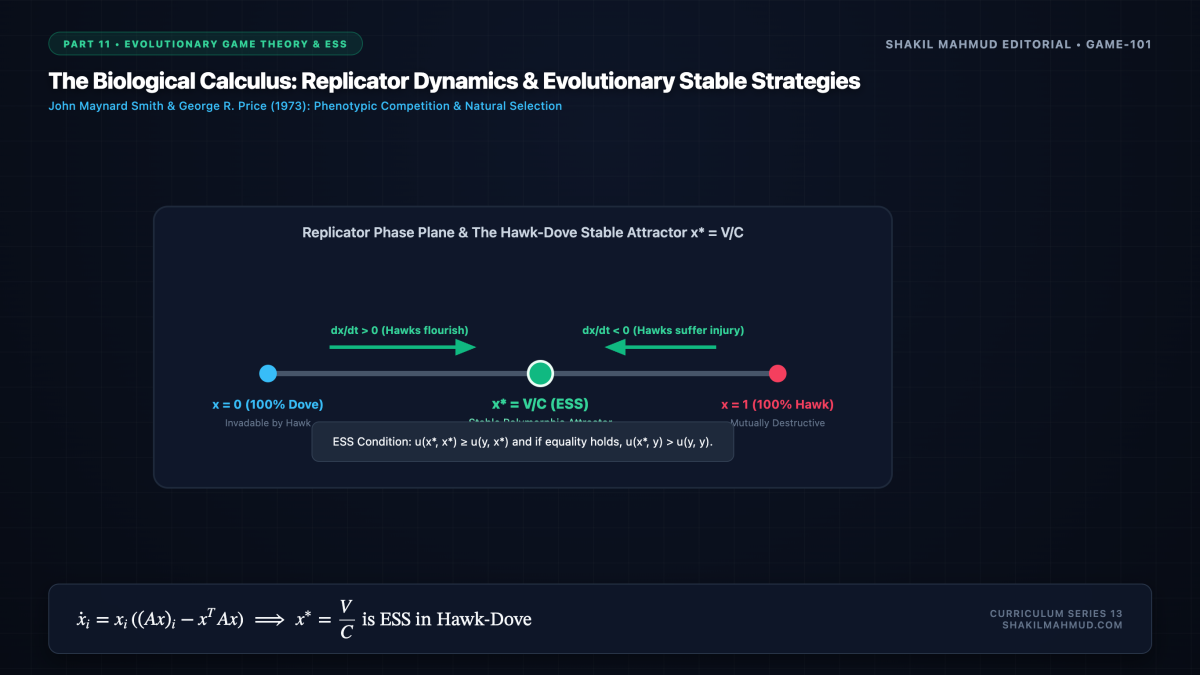
Neither pure phenotype can resist invasion. The unique ESS is a mixed polymorphic population where a proportion $x^*$ plays Hawk and $1 – x^*$ plays Dove. By equating fitness $u(H, x) = u(D, x)$:
$$x left( frac{V – C}{2} right) + (1 – x) V = x (0) + (1 – x) left( frac{V}{2} right) implies x^* = frac{V}{C}$$
The stable equilibrium ratio of aggressive fighters in nature is identically the ratio of the resource’s value to the cost of physical destruction ($V/C$). When fights are deadly ($C gg V$), aggressive behavior becomes remarkably rare.
Replicator Dynamics: The Flow of Natural Selection
Peter Taylor and Leo Jonker (1978) formalized how frequencies evolve over time through the Replicator Equation. Let $x_i$ be the population share of phenotype $i$, $f_i(x) = (Ax)_i$ be its fitness, and $bar{f}(x) = x^T A x$ be the population average fitness:
$$dot{x}_i = x_i left( f_i(x) – bar{f}(x) right)$$
If a phenotype’s reproductive fitness exceeds the average ($dot{x}_i > 0$), natural selection increases its representation in the gene pool; if below average, it declines toward extinction. In the Hawk-Dove phase plane, $x^* = V/C$ is a globally asymptotically stable attractor. Natural selection acts as a decentralized thermodynamic optimizer, grinding biology toward game-theoretic equilibria without a single conscious thought.