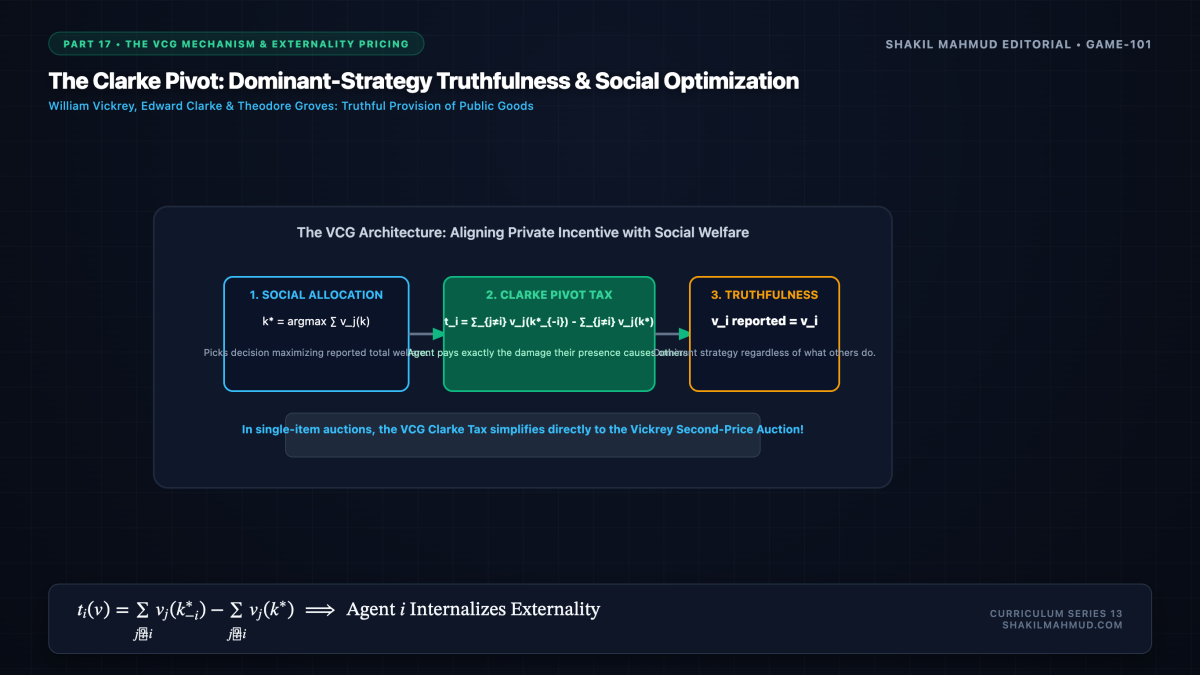
For centuries, economists and political philosophers grappled with the curse of public goods: if a project benefits everyone (clean air, lighthouses, national defense, high-speed rail), individuals have every incentive to under-report their true valuation to free-ride on the contributions of others. The market collapses; the bridge is never built. Between 1961 and 1973, three mathematical titans—William Vickrey, Edward Clarke, and Theodore Groves—synthesized what is universally recognized as the crown jewel of mechanism design: The Vickrey-Clarke-Groves (VCG) Mechanism. VCG proved that it is mathematically possible to compel self-interested agents to truthfully reveal their hidden values in dominant strategies by forcing each agent to pay exactly the social damage they inflict on everyone else.
The Social Welfare Maximization Problem
Consider a society that must choose a single alternative $k in K$ from a finite set of collective choices (e.g., whether to build a public park or where to locate an airport). There are $n$ citizens, each having a quasi-linear utility function:
$$u_i(k, t_i) = v_i(k) – t_i$$
where $v_i(k)$ is citizen $i$’s true valuation of decision $k$, and $t_i in mathbb{R}$ is a monetary tax paid by citizen $i$. The social goal is to select the decision $k^*$ that maximizes aggregate social welfare:
$$k^* = argmax_{k in K} sum_{j=1}^n v_j(k)$$
If the government asks citizens to submit reported valuations $hat{v}_i$, an unscrupulous citizen would report $hat{v}_i = +infty$ for their favorite project to hijack the outcome. How can the tax rule $t_i$ be engineered so that reporting $hat{v}_i = v_i$ is strictly dominant?
The Groves Mechanism Class
In 1973, Theodore Groves proved that truth-telling is a dominant strategy if each agent’s payment aligns their private net payoff with total social welfare. A Groves mechanism sets payments according to:
$$t_i(hat{v}) = h_i(hat{v}_{-i}) – sum_{j neq i} hat{v}_j(k^*(hat{v}))$$
where $h_i(hat{v}_{-i})$ is an arbitrary function that depends only on the reported valuations of everyone other than agent $i$.
Look at what happens to agent $i$’s private objective under this payment rule:
$$u_i = v_i(k^*) – t_i = v_i(k^*) + sum_{j neq i} hat{v}_j(k^*) – h_i(hat{v}_{-i})$$
If agent $i$ reports truthfully ($hat{v}_i = v_i$), the term $v_i(k^*) + sum_{j neq i} hat{v}_j(k^*)$ is identically the total social surplus $sum_{j=1}^n v_j(k^*)$! Because $h_i(hat{v}_{-i})$ is outside agent $i$’s control, agent $i$’s private payoff is maximized if and only if the decision $k^*$ chosen maximizes the sum of everyone’s welfare. The private incentive has been mathematically cloned into the social good.
The Clarke Pivot Rule: Internalizing Externalities
In 1971, Edward Clarke introduced the elegant, budget-conscious choice for $h_i$: the Clarke Pivot Tax:
$$h_i(hat{v}_{-i}) = max_{k in K} sum_{j neq i} hat{v}_j(k) equiv sum_{j neq i} hat{v}_j(k_{-i}^*)$$
where $k_{-i}^*$ is the decision society would have chosen if agent $i$ did not exist! Substituting this into the Groves rule yields the immortal VCG tax formula:
$$t_i = sum_{j neq i} hat{v}_j(k_{-i}^*) – sum_{j neq i} hat{v}_j(k^*)$$
Notice the profound economic meaning of this equation:
Agent $i$ pays a tax equal to the total welfare lost by all other citizens due to agent $i$’s presence and influence on the decision!
- If agent $i$ does not alter the social choice ($k^* = k_{-i}^*$), their tax is identically $0$.
- If agent $i$’s vote tilts the election from a project others liked to a project agent $i$ prefers, agent $i$ pays exactly the aggregate disappointment inflicted upon the rest of society.
The Second-Price Auction Identity
Consider an auction for a single item with $n$ bidders. The efficient choice is to allocate the item to the highest bidder $i^*$: $k^* = i^*$. What does the VCG Clarke tax command?
- For every loser $j neq i^*$, without them the item still goes to $i^*$. Losers pay: $t_j = 0 – 0 = 0$.
- For the winner $i^*$, without them the item would have gone to the second-highest bidder, generating surplus $v_{(2)}$. With $i^*$ present, other bidders receive $0$. Therefore:
$$t_{i^*} = v_{(2)} – 0 = v_{(2)}$$
The VCG mechanism reproduces William Vickrey’s 1961 Second-Price Auction with mathematical precision! Truth-telling is a dominant strategy, and the winner pays the second-highest bid.