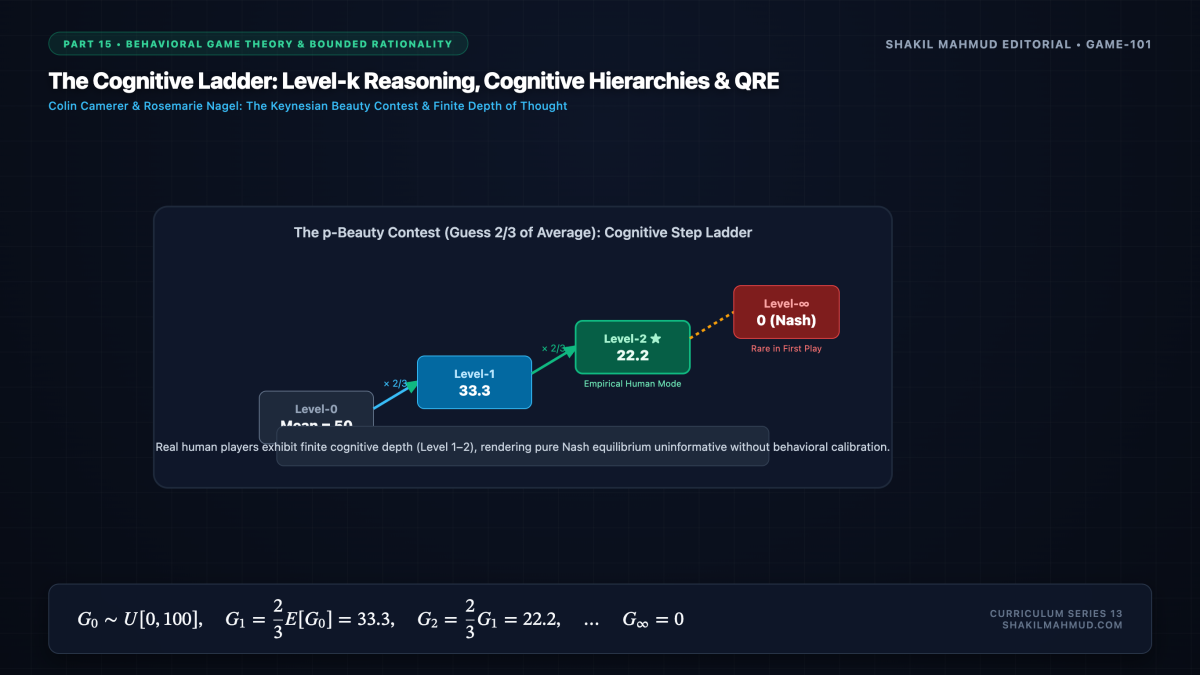
In standard classical game theory, players are presumed to inhabit a realm of hyper-rational omniscience: they possess infinite cognitive depth, compute fixed points instantly, and assume that every other agent is doing the exact same. But bring game theory into an empirical laboratory with real living human beings, and the predictions of pure Nash equilibrium frequently collapse. Real humans have finite attention spans, emotional heuristics, and bounded cognitive faculties. In the late 1990s, behavioral economists led by Colin Camerer, George Loewenstein, and Rosemarie Nagel pioneered Behavioral Game Theory. By marrying mathematics with psychological empirical observation, they mapped the true architecture of human strategic reasoning: the Cognitive Hierarchy.
The Keynesian Beauty Contest ($p$-Beauty Contest)
To demonstrate the chasm between theoretical Nash deduction and empirical reality, consider the famous $p$-Beauty Contest game, inspired by John Maynard Keynes’s observation of 1930s financial markets (where investors buy stocks not based on fundamental value, but based on what they think other investors think everyone else thinks is valuable).
Rules of the Game: Each player in a large group simultaneously chooses an integer between $0$ and $100$. The winner is the person whose number is closest to two-thirds of the average ($2/3 times bar{x}$) of all numbers submitted.
The Pure Nash Deductive Abyss
How does a hyper-rational Nash player reason?
- Even if every person chose the maximum possible number ($100$), the average would be $100$, and $2/3$ of the average would be $66.7$. Therefore, choosing any number strictly above $67$ is strictly dominated.
- Assuming everyone eliminates numbers $> 67$, the maximum average is $67$, and $2/3 times 67 approx 44$. Therefore, numbers $> 44$ are eliminated.
- Iterating this logic: $2/3 times 44 approx 30 implies 20 implies 13 implies 9 implies dots implies 0$.
The unique Nash Equilibrium of the game, reached by iterated elimination of strictly dominated strategies, is for every player to choose exactly $0$!
The Empirical Reality: The Cognitive Step Ladder
When this experiment is conducted with real human populations—undergraduates, corporate CEOs, financial traders, and professional economists—almost nobody chooses $0$. In fact, a player who chooses the mathematically “correct” Nash strategy of $0$ almost guarantees that they will lose the game!
Empirical distributions around the globe consistently reveal sharp clustering around distinct cognitive peaks:
- Level-0 ($L_0$): Non-strategic or naive players. They pick a number uniformly at random from $[0, 100]$. The expected mean is $50$.
- Level-1 ($L_1$): Players who assume everyone else is a naive Level-0 agent. They best-respond to the Level-0 mean:
$$G_1 = frac{2}{3} times 50 approx 33.3$$
Empirically, massive spikes appear around $33$ and $35$. - Level-2 ($L_2$): Players who assume others are Level-1 strategists. They best-respond to the Level-1 guess:
$$G_2 = frac{2}{3} times 33.3 approx 22.2$$
Empirically, the largest human mode in first-time plays occurs precisely around $22$. - Level-3 ($L_3$): Players who calculate $2/3 times 22.2 approx 14.8$. Small spikes appear at $15$.
- Hyper-Rational / Nash Players: A small group of mathematicians guess $0$ or $1$. They are mathematically pristine, but strategically bankrupt: they fail because they fail to model the cognitive limitations of their peers.
The Poisson Cognitive Hierarchy Model
Colin Camerer, Teck-Hua Ho, and Juin-Kuan Chong (2004) codified this into the Cognitive Hierarchy Model. The proportion of the population doing $k$ steps of iterative strategic thinking follows a Poisson distribution with parameter $tau$ (the mean depth of reasoning):
$$f(k) = frac{e^{-tau} tau^k}{k!}$$
Across hundreds of experimental studies in multiple cultures, the empirical mean depth of human strategic reasoning is remarkably stable: $tau approx 1.5$. Human civilization functions on approximately 1.5 steps of recursive thinking.
Quantal Response Equilibrium (QRE)
Richard McKelvey and Thomas Palfrey (1995) developed the continuous statistical generalization: Quantal Response Equilibrium (QRE). Instead of choosing their best response with probability $1$, players choose actions probabilistically via a logit choice rule parameterized by precision $lambda$:
$$sigma_i(a) = frac{exp(lambda cdot mathbb{E}[u_i(a, sigma_{-i})])}{sum_{a’ in A_i} exp(lambda cdot mathbb{E}[u_i(a’, sigma_{-i})])}$$
When $lambda to 0$, play is completely random noise; when $lambda to infty$, QRE converges to the classical Nash equilibrium. QRE bridges the gap between pure mathematics and human frailty, allowing game theory to model actual financial market frenzies, military blunders, and behavioral economics.