In Michael Spence’s signaling model, communication required painful, un-fakeable economic expenditure: thousands of dollars in tuition, years of grueling study, or massive corporate dividend burn. But in the vast theater of human affairs—diplomatic communiqués, central bank forward guidance, military de-escalation hotlines, and corporate boardroom deliberations—communication is completely, indisputably free. Words consume negligible joules of energy. Can costless words (“cheap talk”) convey genuine, actionable mathematical information between self-interested parties whose interests diverge? In 1982, Vincent Crawford and Joel Sobel published an immortal paper in Econometrica proving that even without monetary cost or legal contracts, strategic communication can occur—but it suffers from an unavoidable, quantifiable law of informational coarsening.
The Crawford-Sobel Cheap Talk Architecture
The Crawford-Sobel framework formalizes communication between an informed Sender ($S$) and an empowered Receiver ($R$):
- State of the World: Nature draws a continuous state $theta in [0, 1]$ from a uniform distribution $f(theta) = 1$. The state represents private truth: the severity of an economic crisis, the true revenue of a startup, or the military strength of a fortress.
- Informed Sender: The Sender observes $theta$ perfectly, but cannot execute physical actions. The Sender sends a costless message $m in M$ to the Receiver.
- Empowered Receiver: The Receiver cannot observe $theta$. The Receiver hears message $m$, updates beliefs over $theta$, and executes a consequential physical action $y in mathbb{R}$.
- Payoff Divergence & Bias $b$: The Receiver desires an action that matches the true state:
$$u_R(y, theta) = -(y – theta)^2$$
The Receiver’s ideal action is identically $y_R^*(theta) = theta$.
However, the Sender possesses an inherent ideological or strategic bias $b > 0$:
$$u_S(y, theta, b) = -(y – (theta + b))^2$$
The Sender always desires the Receiver to choose an action that is biased upward by $b$: $y_S^*(theta) = theta + b$.
The Impossibility of Fully Truthful Communication
Could there exist a fully separating equilibrium where the Sender truthfully reveals the exact state $m(theta) = theta$? Suppose the Receiver naively believed this and chose $y(m) = m$. The Sender, observing state $theta$, would immediately have an irresistible incentive to lie and claim $m = theta + b$. Anticipating this exaggeration, the Receiver would discount the message, unraveling perfect transmission. Continuous truth-telling is incentive-incompatible.
Partition Equilibria & Information Coarsening
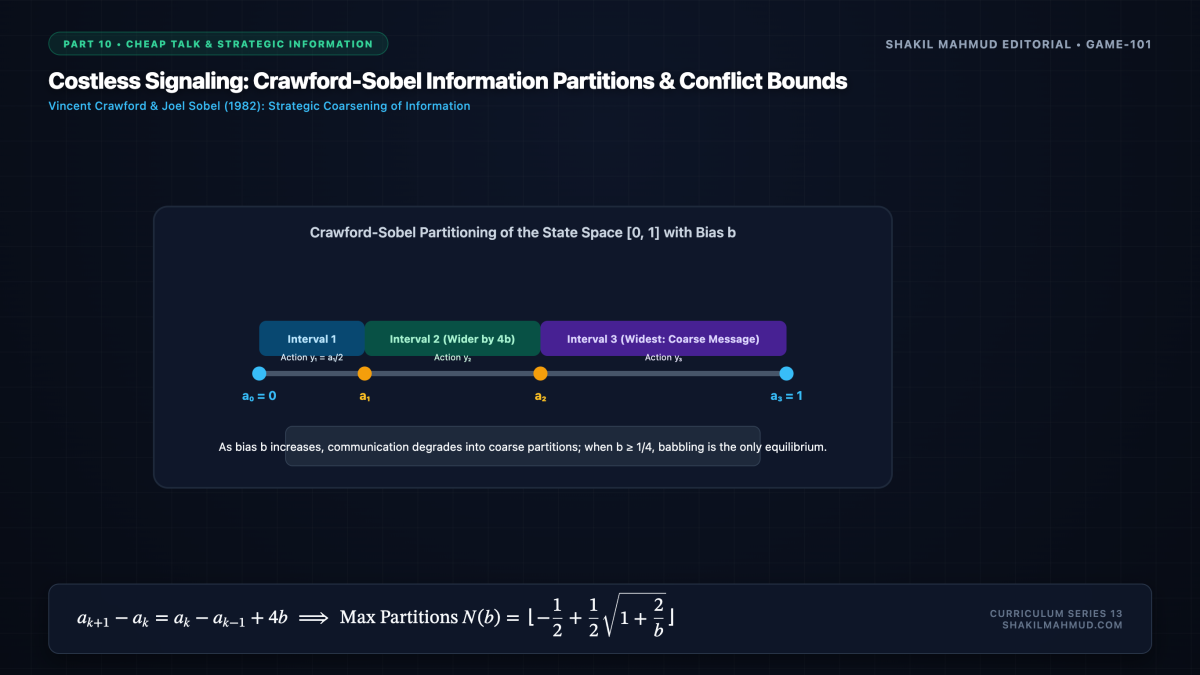
Crawford and Sobel proved that all equilibria in this game take the form of discrete interval partitions. The continuous state space $[0, 1]$ is cleaved into a finite number of segments $0 = a_0 < a_1 < a_2 < dots < a_N = 1$:
- If the true state falls anywhere inside interval $[a_{k-1}, a_k]$, the Sender sends the identical generic message: “The state is somewhere between $a_{k-1}$ and $a_k$.”
- Hearing this imprecise message, the rational Receiver takes an action equal to the conditional expectation of the state within that bucket:
$$y_k = frac{a_{k-1} + a_k}{2}$$
At the boundary $a_k$, the Sender must be completely indifferent between the Receiver taking action $y_k$ and action $y_{k+1}$. Enforcing this indifference condition yields the celebrated second-order difference equation:
$$a_{k+1} – a_k = a_k – a_{k-1} + 4b$$
Notice the extraordinary geometric property: each successive interval is wider than the preceding one by exactly $4b$! Communication becomes coarser, vaguer, and less precise at higher states.
The Conflict Bound on Truth
Because the sum of all interval widths must equal $1$, the maximum number of partitions $N(b)$ that can mathematically exist is strictly bounded by the bias:
$$N(b) = leftlfloor -frac{1}{2} + frac{1}{2}sqrt{1 + frac{2}{b}} rightrfloor$$
- When $b to 0$ (perfect alignment), $N to infty$; communication approaches flawless, continuous fidelity.
- As $b$ grows, $N(b)$ drops rapidly. When $b ge 1/4$, $N(b) = 1$. When $N=1$, babbling is the only equilibrium. The Sender’s words convey zero informational entropy, and the Receiver ignores them entirely.
Crawford and Sobel proved that vague diplomatic phrasing is not an accidental failure of vocabulary; it is a mathematical necessity. In the presence of conflicting interests, precision destroys credibility; strategic ambiguity is the only channel through which any truth can survive.