In 1994, the United States Federal Communications Commission (FCC) auctioned off the nation’s electromagnetic spectrum for billions of dollars using game-theoretic auction architecture, replacing decades of corrupt political cronyism with mathematical efficiency. In Silicon Valley, every millisecond a Google search query or Meta feed load occurs, automated programmatic second-price auctions allocate billions of dollars in advertising real estate. Auctions are the primary market-clearing mechanisms of human civilization. In 1981, Roger Myerson published a paper in Mathematics of Operations Research that won him the 2007 Nobel Prize: “Optimal Auction Design”. Myerson established the twin pillars of modern mechanism design: The Revenue Equivalence Theorem and Virtual Valuations.
The Four Classical Auction Formats
Throughout mercantile history, four standard formats emerged to auction a single indivisible good:
- English (Ascending) Auction: The price ascends publicly until only one bidder remains; the winner pays the final standing price.
- Dutch (Descending) Auction: A high price clock ticks downwards until the first bidder shouts “Mine!”; the winner pays that current price.
- First-Price Sealed-Bid (FPSB): Bidders submit private envelopes; the highest bid wins and pays their own bid ($b_{(1)}$).
- Second-Price Sealed-Bid (SPSB / Vickrey): Bidders submit private envelopes; the highest bid wins but pays the second-highest bid ($b_{(2)}$).
The Revenue Equivalence Theorem
Intuition suggests that a seller should extract different sums of money from different formats. A first-price auction forces bidders to pay their full bids, whereas a second-price auction discounts the winner’s payment. Yet in 1981, building on William Vickrey’s 1961 discovery, Roger Myerson formalized the celebrated Revenue Equivalence Theorem:
Assume $n$ risk-neutral bidders have private valuations $v_i$ drawn independently and identically from a strictly increasing, atomless cumulative distribution $F(v)$ on $[underline{v}, bar{v}]$.
Any auction mechanism that:
- Allocates the item to the bidder with the highest valuation, and
- Yields zero expected surplus to a bidder with the lowest possible valuation $underline{v}$,
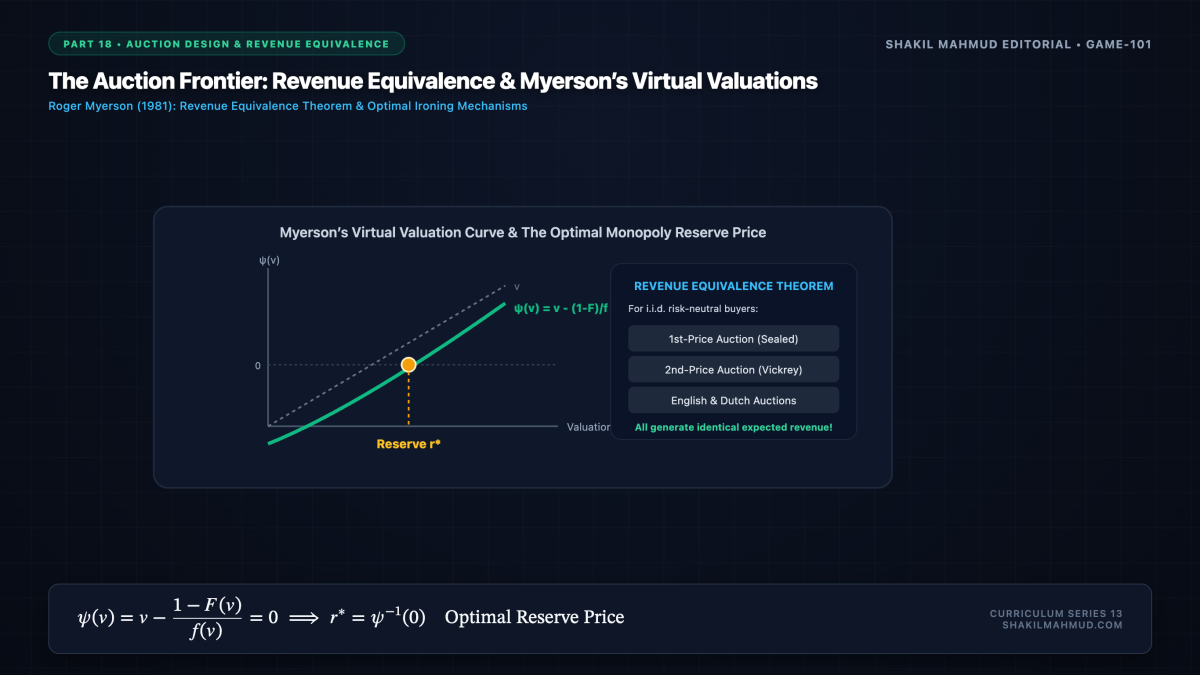
yields the exact same expected revenue for the seller, and every bidder of type $v$ makes the exact same expected interim payment!
In a second-price auction, bidders bid their true valuations truthfully ($b(v) = v$). In a first-price auction, fear of overpaying induces bidders to shade their bids down to the expected value of the next highest rival: $b(v) = mathbb{E}[v_{(2)} mid v_{(1)} = v]$. The strategic bid shading in first-price auctions precisely cancels out the discount granted in second-price auctions. In expected value: English = Dutch = First-Price = Second-Price!
Myerson’s Virtual Valuation & Optimal Reserve Prices
Revenue Equivalence holds for standard, efficient auctions. But what if the seller is a profit-maximizing monopolist who does not care about social efficiency, but wants to extract maximum cash from buyers?
Myerson defined the Virtual Valuation function $psi(v)$:
$$psi(v) = v – frac{1 – F(v)}{f(v)}$$
The term $v$ represents the surplus extracted from selling to a buyer with valuation $v$. The subtracted term $frac{1 – F(v)}{f(v)}$ represents the informational rent that the seller is forced to surrender to all higher-valuation buyers to prevent them from pretending to have lower valuations.
Myerson proved that the seller’s expected revenue is identically equal to the expected virtual valuation of the winning bidder:
$$mathbb{E}[text{Revenue}] = mathbb{E}left[ max_{i} psi(v_i) right]$$
Therefore, to maximize revenue:
- The seller should allocate the item to the bidder with the highest virtual valuation $psi(v_i)$, provided $psi(v_i) ge 0$.
- If the distribution satisfies the standard monotone hazard rate condition ($psi'(v) > 0$), the highest valuation bidder still has the highest virtual valuation.
- The seller must establish an Optimal Reserve Price $r^*$ below which the item will not be sold, even if it goes unallocated:
$$psi(r^*) = 0 implies r^* – frac{1 – F(r^*)}{f(r^*)} = 0$$
Notice an astonishing fact: the optimal reserve price $r^*$ is completely independent of the number of bidders $n$! Whether 2 bidders or 2,000 bidders participate, the threshold $r^*$ remains invariant. Myerson’s theorem forms the automated bidding core of Google AdWords and modern algorithmic high-frequency ad exchanges.