In 1970, an assistant professor at the University of California, Berkeley named George Akerlof submitted a short, unassuming paper to the American Economic Review. The paper was rejected by three prestigious journals in succession; editors insisted that if Akerlof’s logic were correct, modern commercial markets could not exist. When The Quarterly Journal of Economics finally published “The Market for ‘Lemons’: Quality Uncertainty and the Market Mechanism”, it ignited an intellectual revolution. Akerlof demonstrated that when sellers know more about the quality of a product than buyers, Adam Smith’s classical “invisible hand” does not merely stumble—it can systematically cannibalize the entire market until trade completely ceases.
The Mechanics of Adverse Selection
Consider a market for used cars where two types of automobiles exist: high-quality cars (“peaches”) and defective cars (“lemons”).
- Sellers value lemons at $$1,000$ and peaches at $$2,000$.
- Buyers value lemons at $$1,200$ and peaches at $$2,400$.
Notice that for every individual car, the buyer values it strictly more than the seller ($$1,200 > $1,000$ and $$2,400 > $2,000$). Under full information, two distinct markets emerge: lemons trade between $$1,000$ and $$1,200$, and peaches trade between $$2,000$ and $$2,400$. Every asset finds an owner, and total social surplus is maximized.
The Asymmetric Information Catastrophe
Now introduce information asymmetry: the seller knows whether their car is a peach or a lemon, but the buyer can only see the polished exterior. Suppose $50%$ of cars in the population are peaches and $50%$ are lemons.
A rational buyer cannot risk paying $$2,400$ for a car that might be worthless scrap. Instead, the buyer is willing to pay at most the expected value of a car drawn at random:
$$mathbb{E}[V] = 0.5 times $1,200 + 0.5 times $2,400 = $1,800$$
Now look at the seller’s incentives at the market price of $$1,800$:
- A lemon owner is ecstatic: their car is worth $$1,000$, and they can sell it for $$1,800$. All lemons flood into the market.
- A peach owner faces a disaster: their car is worth $$2,000$ to them, but the market only offers $$1,800$. Selling is an irrational loss of $$200$. Every peach owner withdraws their car from the market.
The Unraveling Spiral
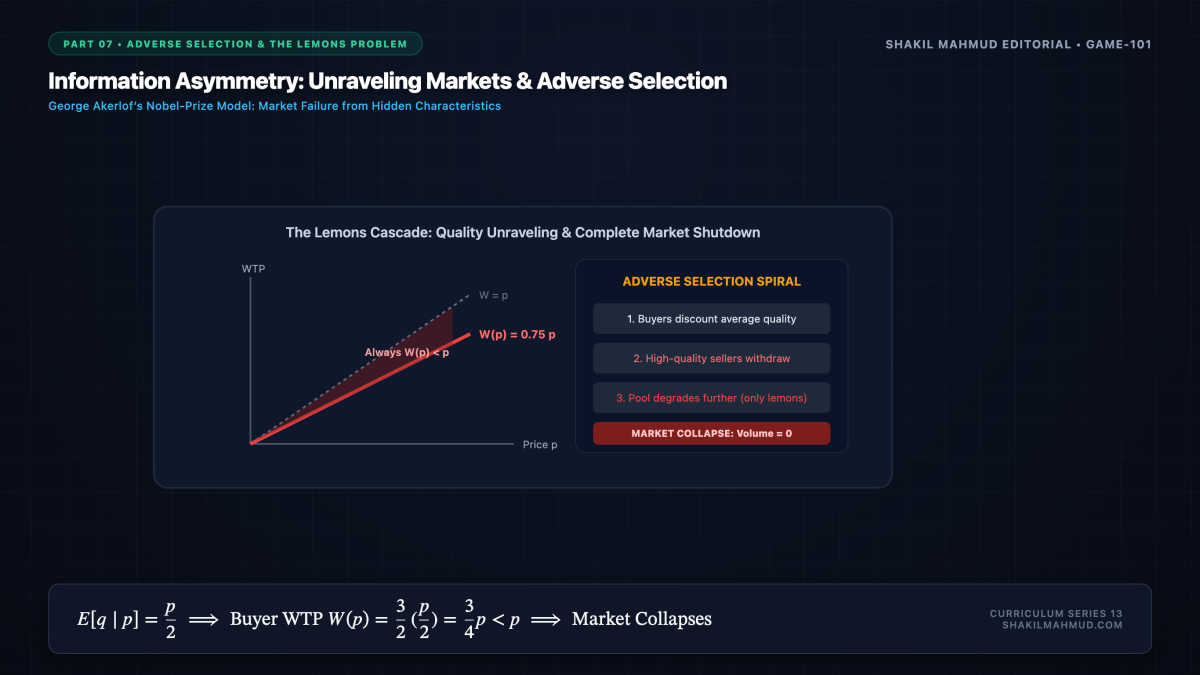
Buyers are not fools; observing that no high-quality cars are for sale, they immediately revise their expectations downwards. The proportion of peaches drops to $0%$. The expected value collapses to $$1,200$. Now only lemons trade. The presence of hidden defective goods has completely driven the high-quality goods out of existence—an economic manifestation of Gresham’s Law (“bad money drives out good”).
In a continuous distribution where quality $q sim U[0, 2]$, if sellers value quality at $q$ and buyers value it at $frac{3}{2}q$, buyers’ willingness to pay for a car priced at $p$ is based on the average quality willing to sell ($q le p$):
$$mathbb{E}[q mid q le p] = frac{p}{2} implies text{Willingness to Pay } W(p) = frac{3}{2} left( frac{p}{2} right) = frac{3}{4} p < p$$
At every positive price, buyers are willing to pay less than the price asked! The market unspools in a recursive death spiral until total trading volume collapses to zero. A market where mutually beneficial trade exists for every single participant is entirely wiped out by hidden information.
Adverse selection explains why private individual health insurance markets collapse without mandates (only the sickest purchase insurance, raising premiums in an explosive spiral), why credit markets experience credit rationing, and why warranties and institutional brand reputations are existential pillars of modern commerce.