The Core is a formidable concept of coalitional stability, but it suffers from two major practical deficiencies: in many games the Core is completely empty, and in others it contains an infinite continuum of outcomes without specifying which one is morally, philosophically, or economically fair. If a consortium of airlines builds an airport runway, how should the construction bill be divided among jumbo jets, regional carriers, and private propeller craft? If a team of researchers patents a life-saving drug, what share of royalties belongs to each scientist? In 1953, twenty-nine-year-old mathematician Lloyd Shapley published a five-page paper that solved the problem of fair allocation forever: The Shapley Value.
The Axioms of Fairness
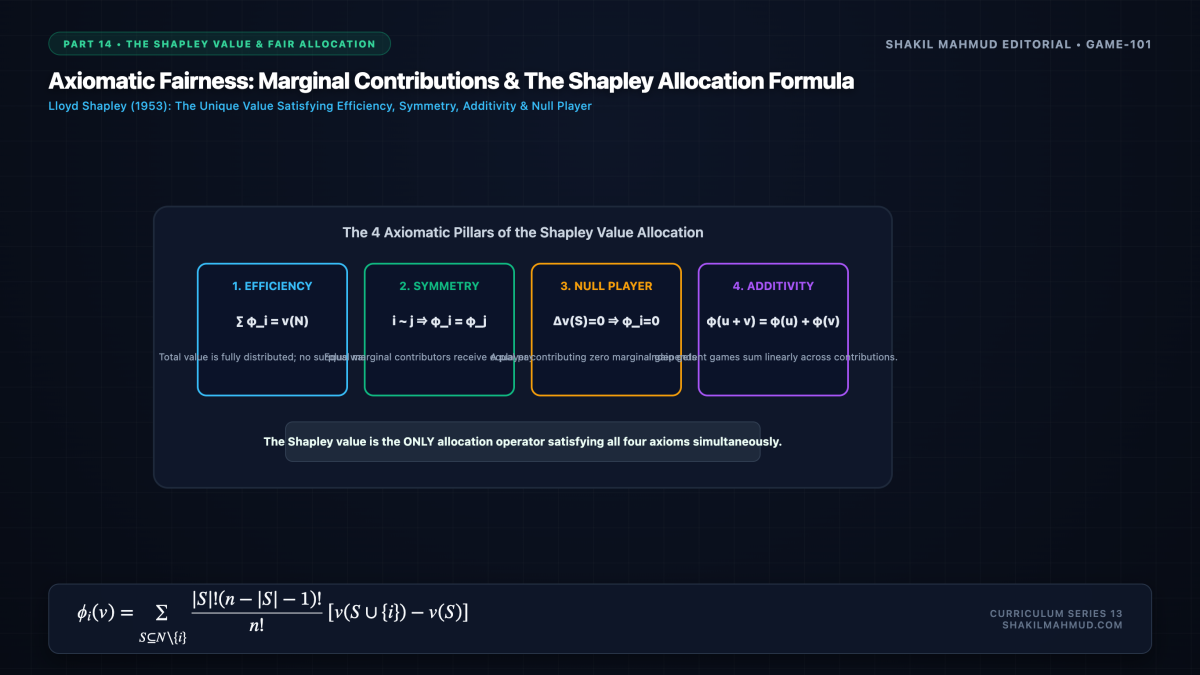
Shapley approached the problem not through bargaining psychology, but through pure, uncompromising axiomatics. He sought an allocation rule $phi: mathcal{G} to mathbb{R}^n$ mapping every cooperative game $(N, v)$ into a unique payoff vector $phi(v) = (phi_1(v), dots, phi_n(v))$ satisfying four self-evident pillars of justice:
- Axiom 1 (Efficiency): $sum_{i in N} phi_i(v) = v(N)$. All wealth created by the grand coalition must be distributed; nothing is wasted, and no phantom wealth is minted.
- Axiom 2 (Symmetry): If two players $i$ and $j$ are substitutes—contributing identical marginal value to every possible coalition ($v(S cup {i}) = v(S cup {j})$ for all $S subseteq N setminus {i, j}$)—then they must receive identical payoffs: $phi_i(v) = phi_j(v)$. Arbitrary discrimination is prohibited.
- Axiom 3 (Null / Dummy Player): If player $i$ contributes zero marginal value to every coalition ($v(S cup {i}) = v(S)$ for all $S subseteq N setminus {i}$), their allocation must be zero: $phi_i(v) = 0$. An agent who adds nothing receives nothing.
- Axiom 4 (Additivity / Linearity): If two independent games $u$ and $w$ are merged into a combined game $v = u + w$, the total allocation must equal the sum of the individual allocations: $phi(u + w) = phi(u) + phi(w)$.
The Master Formula: Marginal Contribution Across Permutations
Shapley proved the breathtaking theorem that there exists exactly one unique mathematical operator that satisfies all four axioms simultaneously. That operator is the expectation of an agent’s marginal contribution across all $n!$ possible arrival orders of the coalition:
$$phi_i(v) = sum_{S subseteq N setminus {i}} frac{|S|! (n – |S| – 1)!}{n!} left[ v(S cup {i}) – v(S) right]$$
Consider the combinatorial elegance of this formula:
- Suppose the $n$ players arrive one by one in a random permutation $pi in S_n$. There are $n!$ equally likely permutations.
- When player $i$ arrives, they join the pre-existing coalition of players $S$ who arrived before them.
- Player $i$’s marginal contribution to that specific subgroup is $v(S cup {i}) – v(S)$.
- There are $|S|!$ ways for the predecessors to arrive, and $(n – |S| – 1)!$ ways for the successors to arrive.
- The Shapley value $phi_i(v)$ is simply the expected marginal contribution of player $i$ under a uniform distribution over all possible evolutionary arrival orders.
Modern Applications: From Airport Runway Pricing to Explainable AI
The Shapley value is one of the most widely applied equations in modern applied mathematics:
- Infrastructure Cost Allocation (Airport Problem): A 3,000-meter runway is built for small planes (needing 1,000m), medium jets (2,000m), and jumbo jets (3,000m). Shapley value proves that all planes share the first 1,000m equally, larger planes share the second 1,000m, and jumbo jets alone pay for the final extension.
- Voting Power (Shapley-Shubik Index): Measuring true political power in legislatures and the UN Security Council by computing how often an actor is the “pivotal” voter turning a losing coalition into a winning one.
- SHAP (SHapley Additive exPlanations) in Machine Learning: How does an artificial intelligence explain a credit denial or medical diagnosis? By treating input features (age, income, biomarker) as players in a cooperative game and computing their Shapley values $phi_i$, yielding the industry-standard framework for Explainable AI (XAI).
In 2012, Lloyd Shapley was awarded the Nobel Memorial Prize in Economic Sciences. His value formula proved that fair allocation is not a subjective moral compromise; it is an invariant mathematical law embedded in the combinatorics of cooperation.