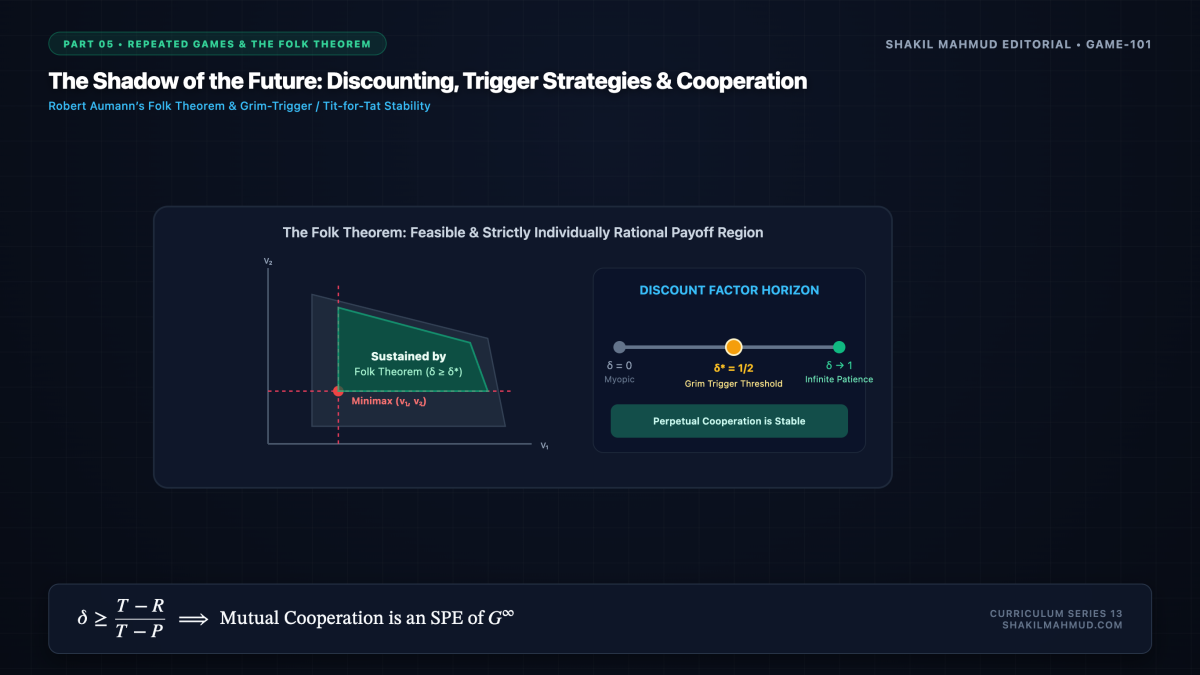
If the Prisoner’s Dilemma proved that one-shot interaction forces rational agents into mutual destruction, real life presents an astonishing paradox: human societies, biological ecosystems, and global trade networks routinely exhibit high levels of trust and cooperation. Why? Because in human existence, interactions are rarely solitary duels. We meet the same colleagues, trade with the same partners, and negotiate with the same rivals day after day. In the late 1950s, game theorists codified this phenomenon in one of mathematics’ most profound results: The Folk Theorem of repeated games.
The Geometry of Infinitely Repeated Games
Consider a stage game $G = (N, (A_i), (u_i))$ that is played repeatedly at discrete time intervals $t = 0, 1, 2, dots, infty$. At each stage, players observe the full history of all previous actions $h^t = (a^0, a^1, dots, a^{t-1})$. Because payoffs received in the future are worth less than immediate payoffs today, players evaluate payoff streams through an exponential discount factor $delta in (0, 1)$:
$$U_i = (1 – delta) sum_{t=0}^infty delta^t u_i(a^t)$$
The factor $(1 – delta)$ normalizes the infinite sum so that receiving payoff $c$ in every period yields an overall utility of exactly $c$. The discount factor $delta$ reflects both time preference (patience) and the probability that the interaction will continue into the next period.
Minimax Threat Points & Individually Rational Payoffs
To understand what can be sustained in repeated play, we must determine the worst punishment that opponents can collectively inflict upon player $i$. This is player $i$’s minimax value (or reservation utility):
$$underline{v}_i = min_{alpha_{-i} in prod_{j neq i} Delta(A_j)} max_{a_i in A_i} u_i(a_i, alpha_{-i})$$
No rational player can ever be forced to accept an average payoff strictly below $underline{v}_i$ in the long run, because player $i$ can always best-respond to any punishment and guarantee at least $underline{v}_i$. A payoff vector $v = (v_1, dots, v_n)$ is called strictly individually rational if $v_i > underline{v}_i$ for all $i in N$.
The Folk Theorem Formulated
Let $text{co}(u(A))$ denote the convex hull of feasible stage-game payoffs (achievable via correlated or alternated actions). The Friedman-Aumann Folk Theorem states:
Let $v in text{co}(u(A))$ be any feasible payoff vector such that $v_i > underline{v}_i$ for all $i in N$. Then there exists a critical discount factor $underline{delta} < 1$ such that for all $delta in (underline{delta}, 1)$, there exists a Subgame Perfect Equilibrium of the infinitely repeated game $G^infty(delta)$ that achieves average payoff vector $v$.
This theorem is breathtaking: any feasible payoff that is strictly better than mutual destruction can be sustained as a self-enforcing, decentralized equilibrium, provided the players are sufficiently patient ($delta to 1$).
Trigger Strategies: Grim Trigger vs Tit-for-Tat
How is such cooperation maintained without a central police force or court of law? Through trigger strategies:
- Grim Trigger (Friedman, 1971): Player 1 plays Cooperate in period 0, and continues cooperating as long as both players have cooperated in every prior period. If Player 2 ever defects even once, Player 1 permanently switches to Defect for all eternity.
A player compares the one-time temptation to defect ($T$) followed by perpetual punishment ($P$), against enduring mutual cooperation ($R$):
$$R + delta R + delta^2 R + dots ge T + delta P + delta^2 P + dots iff frac{R}{1 – delta} ge T + frac{delta P}{1 – delta}$$
Solving for $delta$ yields the universal cooperation threshold:
$$delta ge frac{T – R}{T – P}$$
If patience exceeds this threshold, the threat of future starvation completely deters present crime. - Tit-for-Tat (Axelrod, 1984): In Robert Axelrod’s famous computer tournaments, the simplest program defeated all complex predatory algorithms. Tit-for-Tat begins with cooperation, and thereafter mimics whatever the opponent did in the preceding step. It possesses the four virtues of evolutionary success: it is nice (never defects first), retaliatory (punishes defection instantly), forgiving (restores cooperation as soon as the opponent stops defecting), and clear (transparently predictable).