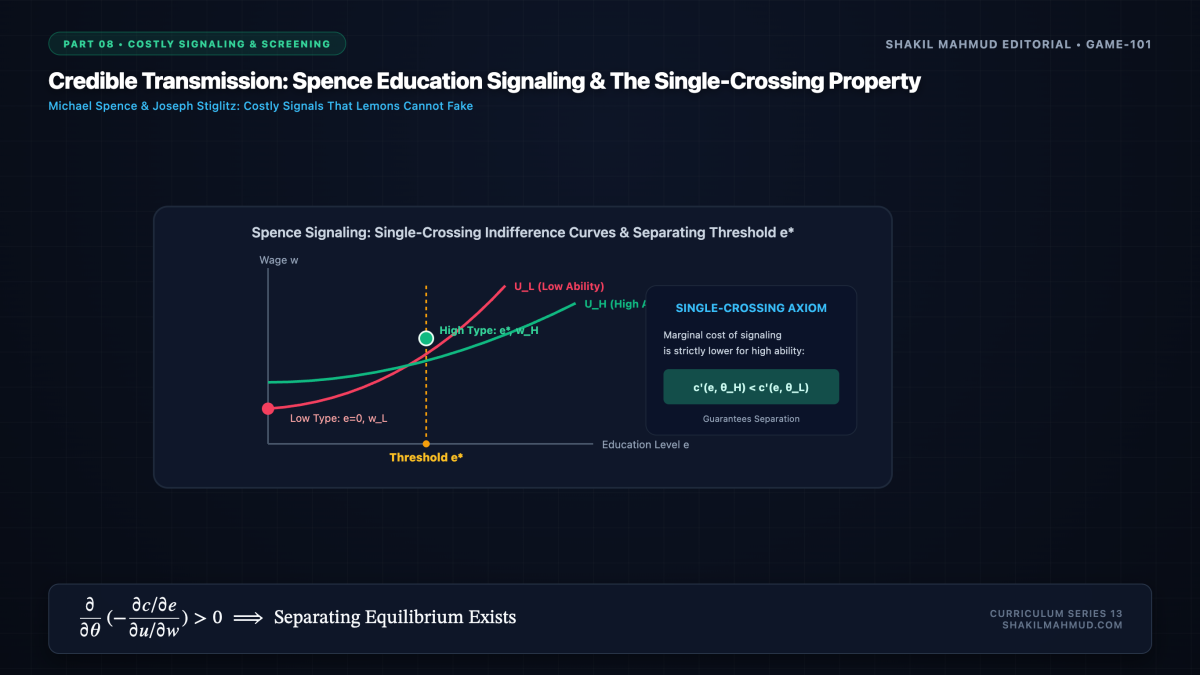
If George Akerlof demonstrated that informational asymmetry can annihilate markets, how does civilization manage to function at all? How does a brilliant software engineer prove their intellect to an employer who cannot read their brain? How does a peacocks convince a peahen of genetic vigor? Talk is cheap; words can be mimicked by any fraudster. In 1973, Michael Spence published a masterpiece that unlocked the answer: “Job Market Signaling”. To communicate truth across an informational chasm, an agent must send a message that is fundamentally costly—and crucially, costlier for frauds than for the genuine article.
The Dilemma of Cheap Talk
Suppose a firm wishes to hire high-ability workers ($theta_H$) worth $$100,000$ in annual output, while low-ability workers ($theta_L$) produce only $$50,000$. If the firm simply asks candidates, “Are you high ability?”, every rational low-ability applicant will instantly claim to be a genius. Because talk costs nothing, words convey zero informational entropy.
The Spence Education Signaling Model
Michael Spence recognized that education serves an extraordinary purpose completely independent of human capital accumulation: even if higher education taught zero practical skills, it could still function as a flawless, rational sorting machine.
Let $e$ denote years of education. Suppose the psychic or monetary cost of acquiring education $e$ depends directly on innate ability $theta$:
$$c(e, theta_L) = frac{e}{theta_L}, quad c(e, theta_H) = frac{e}{theta_H}, quad text{where } theta_H > theta_L$$
Because $theta_H > theta_L$, the marginal cost of studying, solving differential equations, and enduring rigorous examinations is strictly lower for the high-ability individual:
$$frac{partial c}{partial e}(e, theta_H) < frac{partial c}{partial e}(e, theta_L)$$
This is the fundamental Single-Crossing Property (the Spence-Mirrlees condition). In wage-education space $(e, w)$, the indifference curves of the two types cross exactly once.
Separating vs Pooling Equilibria
Two distinct classes of Bayesian Perfect Equilibria can arise:
- Pooling Equilibrium: Both types choose the identical education level ($e = 0$). Employers cannot distinguish them and pay all workers the pooled average wage $bar{w} = p w_H + (1-p)w_L$. Low types free-ride on high types, and adverse selection lurks beneath the surface.
- Separating Equilibrium: The employer sets a threshold: pay $w_H = $100,000$ to anyone with education $e ge e^*$, and pay $w_L = $50,000$ to anyone with $e < e^*$.
For separation to be an equilibrium, two Incentive Compatibility (IC) conditions must be simultaneously satisfied:
- Low Type IC: Low types must prefer their lower wage without education rather than acquiring $e^*$ to mimic the high types:
$$w_L – c(0, theta_L) ge w_H – c(e^*, theta_L) implies 50,000 ge 100,000 – frac{e^*}{theta_L} implies e^* ge theta_L (50,000)$$ - High Type IC: High types must strictly prefer acquiring $e^*$ to receive $w_H$:
$$w_H – c(e^*, theta_H) ge w_L – c(0, theta_H) implies 100,000 – frac{e^*}{theta_H} ge 50,000 implies e^* le theta_H (50,000)$$
Because $theta_H > theta_L$, there always exists a non-empty interval of threshold education levels $[e^*_{min}, e^*_{max}]$ such that:
Low types rationally choose $e = 0$, while high types rationally choose $e = e^*$.
The market successfully separates truth from deception. High types voluntarily endure the grueling ordeal of education not for the curriculum itself, but because it is a barrier that low-ability candidates cannot afford to cross.
Universal Signaling: From Peacock Tails to Proof-of-Work
Spence’s signaling theorem transcends human labor economics; it is an invariant law of strategic nature:
- Amotz Zahavi’s Handicap Principle (1975): In evolutionary biology, the magnificent, heavy tail of the male peacock consumes metabolic energy and attracts predators. It is an un-fakeable handicap signaling: “My genes are so robust that I can thrive even with this massive impediment.”
- Corporate Dividends & Debt: Why do corporations pay taxable cash dividends instead of retaining earnings? Because distributing hard cash proves solvency that a struggling firm cannot mimic without insolvency.
- Bitcoin Proof-of-Work: How does a decentralized pseudonymous node prove block validity? By burning gigawatt-hours of thermodynamic computation. In the digital realm, energy expenditure is the ultimate un-fakeable signal of ledger commitment.