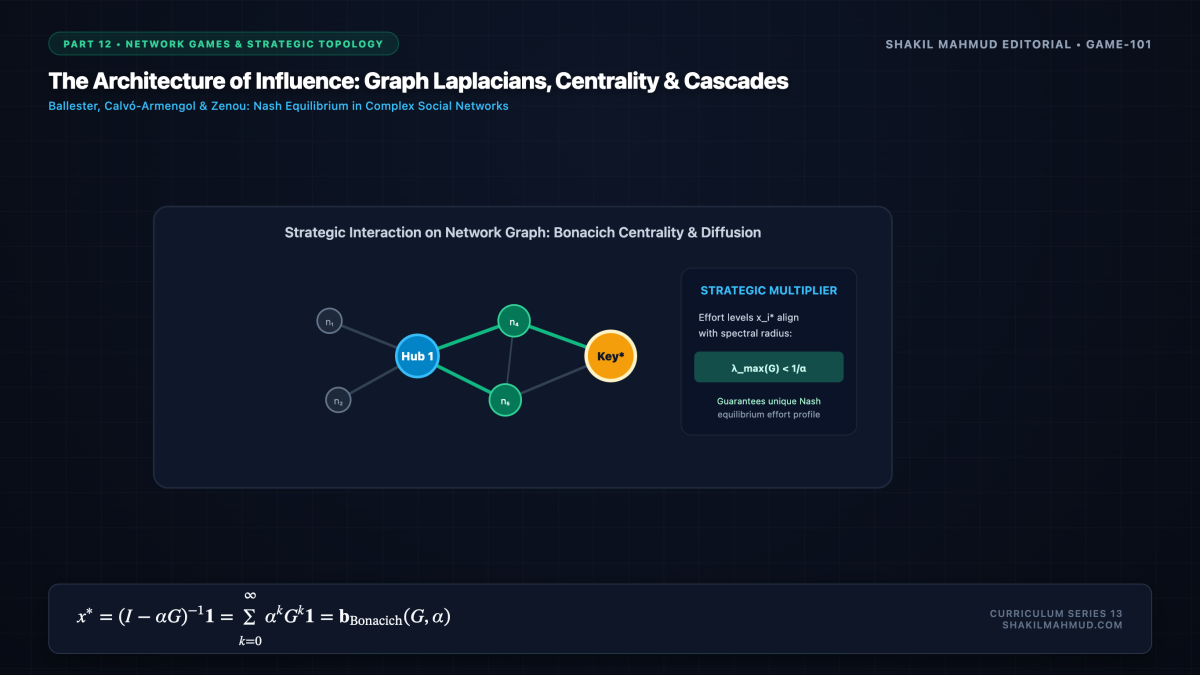
In classical game theory, players interact within a vacuum: either everyone plays against everyone simultaneously, or isolated pairs duel in anonymity. But in human civilization, financial markets, and digital architectures, strategic agents are embedded in complex networks. A bank does not trade with the entire global economy; it is exposed to specific counterparty lending channels. A consumer does not poll the world before adopting an operating system; they are influenced by their immediate social graph. In 2006, Coralio Ballester, Antoni Calvó-Armengol, and Yves Zenou published a seminal breakthrough in Econometrica: “Who’s Who in Networks. Wanted: The Key Player”. They proved that when strategic agents interact across an arbitrary graph, the unique Nash equilibrium aligns mathematically with spectral graph theory and Bonacich Centrality.
The Network Game Architecture
Let $G = (V, E)$ be an unweighted, directed or undirected graph where $V = {1, dots, n}$ is the set of agents. The network topology is encoded in the adjacency matrix $A = [g_{ij}]$, where $g_{ij} = 1$ if an edge connects agent $i$ and agent $j$, and $g_{ij} = 0$ otherwise (with $g_{ii} = 0$).
Each agent $i$ selects a continuous effort level $x_i ge 0$ (such as R&D investment, crime intensity, technology adoption, or academic study). Agent $i$’s payoff exhibits local strategic complementarities (peer effects) combined with quadratic private costs:
$$u_i(x_1, dots, x_n) = alpha_i x_i – frac{1}{2} x_i^2 + beta sum_{j=1}^n g_{ij} x_i x_j$$
The parameter $beta > 0$ governs the strength of strategic complementarity: if agent $i$’s neighbor increases their effort ($x_j uparrow$), agent $i$’s marginal return to effort increases ($frac{partial^2 u_i}{partial x_i partial x_j} = beta g_{ij} > 0$).
Equilibrium & The Inversion of the Graph Matrix
To find the Nash Equilibrium, compute the first-order condition $frac{partial u_i}{partial x_i} = 0$:
$$alpha_i – x_i + beta sum_{j=1}^n g_{ij} x_j = 0 implies x_i = alpha_i + beta sum_{j=1}^n g_{ij} x_j$$
In vector notation across all $n$ agents:
$$mathbf{x} = boldsymbol{alpha} + beta G mathbf{x} implies (I – beta G) mathbf{x} = boldsymbol{alpha}$$
If the spectral radius of the network matrix satisfies $lambda_{max}(G) < frac{1}{beta}$, the matrix $(I – beta G)$ is non-singular and invertible via the Neumann power series:
$$mathbf{x}^* = (I – beta G)^{-1} boldsymbol{alpha} = sum_{k=0}^infty beta^k G^k boldsymbol{alpha}$$
Bonacich Centrality: The Geometry of Paths
Examine the power series expansion: $(G^k)_{ij}$ counts the exact number of walks of length $k$ between agent $i$ and agent $j$ in the network graph! The parameter $beta^k$ exponentially discounts longer, more distant paths. When baseline motivation is uniform ($boldsymbol{alpha} = mathbf{1}$), the equilibrium effort vector $mathbf{x}^*$ is identically the Katz-Bonacich Centrality Vector:
$$mathbf{b}(G, beta) = (I – beta G)^{-1} mathbf{1}$$
An agent’s optimal strategic action does not depend merely on how many direct connections they possess (degree centrality). It depends on how well-connected their neighbors are, how connected their neighbors’ neighbors are, and so forth across all infinite walks across the graph topology.
The “Key Player” Problem: Targeted Interventions
Ballester, Calvó-Armengol, and Zenou tackled an urgent practical problem: if a policymaker wishes to maximize network activity (or an intelligence agency wishes to dismantle a criminal/terrorist network), which single node should be removed to cause the greatest systemic collapse?
They proved that the node whose removal minimizes total network activity is NOT the node with the highest degree, nor the node with the highest betweenness. It is the node maximizing the Key Player Centrality Index:
$$c_i^*(G, beta) = frac{b_i(G, beta)^2}{m_{ii}(G, beta)}$$
where $m_{ii} = [ (I – beta G)^{-1} ]_{ii}$ measures the internal feedback loops returning to node $i$. This result governs modern systemic risk in banking networks (Basel III capital surcharges for Globally Systemically Important Banks), epidemiological quarantine targets, and immunization protocols.