In 1928, a young Hungarian-American polymath named John von Neumann presented a paper to the Göttingen Mathematical Society that would transform the social sciences forever: Zur Theorie der Gesellschaftsspiele (“On the Theory of Games of Strategy”). Before von Neumann, human conflict, warfare, and economic exchange were viewed through the lenses of rhetoric, moral philosophy, or historical contingency. Von Neumann realized that strategic interaction could be codified with the identical mathematical rigor that Isaac Newton brought to mechanics: as an optimization problem where the payoff of every action depends deterministically upon the simultaneous decisions of rational opponents.
The Axiomatization of Utility
To quantify rational choice under uncertainty, von Neumann collaborated with the Austrian economist Oskar Morgenstern at the Institute for Advanced Study in Princeton. In their monumental 1944 treatise, Theory of Games and Economic Behavior, they constructed modern expected utility theory from four pristine axioms: completeness, transitivity, continuity, and independence. If an agent’s preferences satisfy these conditions, there exists a cardinal utility function $u: X to mathbb{R}$ such that the agent chooses between lotteries by maximizing mathematical expectation:
$$mathbb{E}[u(L)] = sum_{x in X} p(x) u(x)$$
With utility formalized as a real-valued scalar, the stage was set to analyze strategic interaction in its purest, most unforgiving manifestation: the zero-sum duel.
The Geometry of Zero-Sum Games & The Minimax Theorem
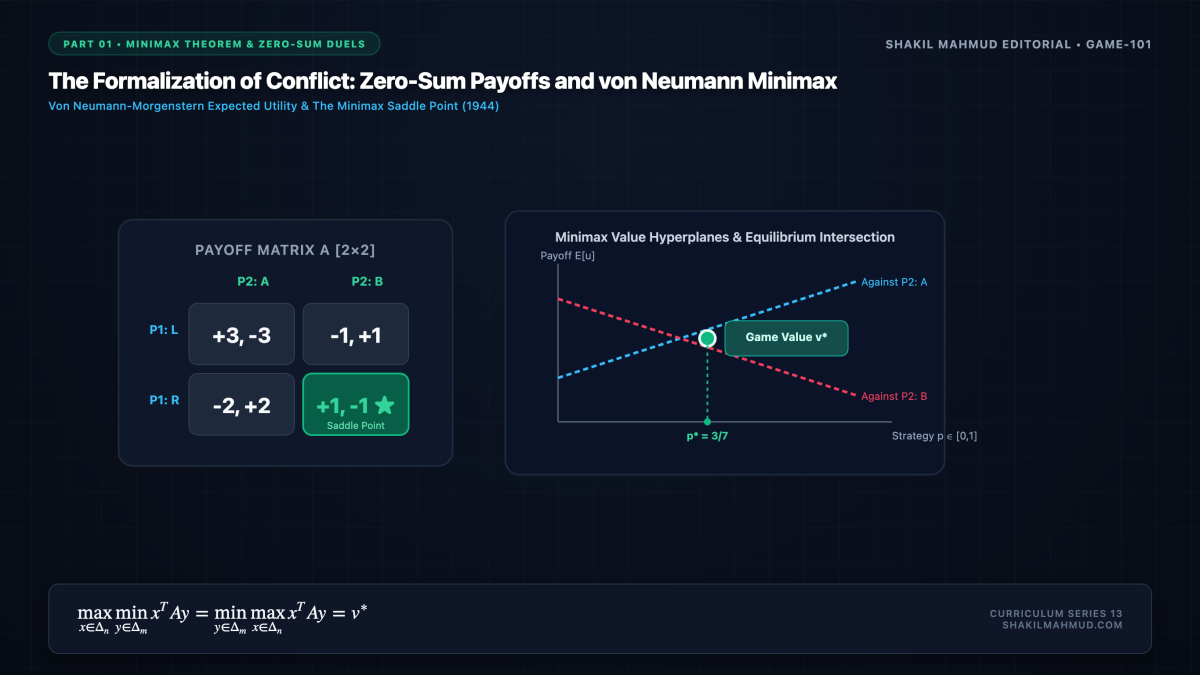
A two-player zero-sum game is defined by a payoff matrix $A in mathbb{R}^{n times m}$. If Player 1 (the row player) chooses pure action $i in {1, dots, n}$ and Player 2 (the column player) chooses action $j in {1, dots, m}$, Player 1 receives $a_{ij}$ while Player 2 loses exactly $a_{ij}$ (payoff $-a_{ij}$). Total societal wealth is strictly conserved; one player’s triumph is identically the other’s catastrophe.
If players are restricted to pure deterministic choices, an equilibrium exists if and only if the matrix contains a saddle point—an entry that is simultaneously the minimum of its row and the maximum of its column:
$$max_{i} min_{j} a_{ij} = min_{j} max_{i} a_{ij} = v^*$$
In most duels (such as Rock-Paper-Scissors or matching pennies), no pure saddle point exists. Any deterministic strategy can be exploited by an adversary. Von Neumann’s revolutionary leap was to expand the strategy space to the continuous probability simplices:
$$Delta_n = left{ x in mathbb{R}^n ;middle|; sum_{i=1}^n x_i = 1, ; x_i ge 0 right}, quad Delta_m = left{ y in mathbb{R}^m ;middle|; sum_{j=1}^m y_j = 1, ; y_j ge 0 right}$$
By randomizing actions according to mixed strategy vectors $x in Delta_n$ and $y in Delta_m$, expected payoff becomes the bilinear form $x^T A y$. Von Neumann proved the immortal Minimax Theorem:
$$max_{x in Delta_n} min_{y in Delta_m} x^T A y = min_{y in Delta_m} max_{x in Delta_n} x^T A y = v^*$$
The scalar $v^*$ is the unique value of the game. Player 1 can guarantee receiving at least $v^*$ regardless of Player 2’s brilliance, while Player 2 can hold Player 1 to at most $v^*$. Strategic uncertainty is eliminated in expectation.
Linear Programming Duality & The Hyperplane Separation
While von Neumann initially proved the Minimax Theorem using topology and Brouwer’s fixed-point theorem, George Dantzig and von Neumann subsequently recognized in 1947 that minimax is mathematically equivalent to the Duality Theorem of Linear Programming. Finding Player 1’s optimal mixed strategy is equivalent to solving the primal linear program:
$$max v quad text{subject to} quad A^T x ge v mathbf{1}, quad mathbf{1}^T x = 1, quad x ge 0$$
Its dual problem yields Player 2’s optimal defensive strategy:
$$min u quad text{subject to} quad A y le u mathbf{1}, quad mathbf{1}^T y = 1, quad y ge 0$$
By strong LP duality, the optimal objective values coincide ($v^* = u^*$). The geometric proof rests on the Hahn-Banach separating hyperplane theorem: in compact convex Euclidean sets, disjoint convex hulls can always be strictly separated by an affine hyperplane, which corresponds precisely to the minimax equilibrium strategy.
The Minimax Theorem proved that rational players need not outguess their opponents’ psychology. By playing the minimax mixed strategy, an agent renders the opponent completely indifferent across their counter-strategies, establishing an unshakeable mathematical fortress.