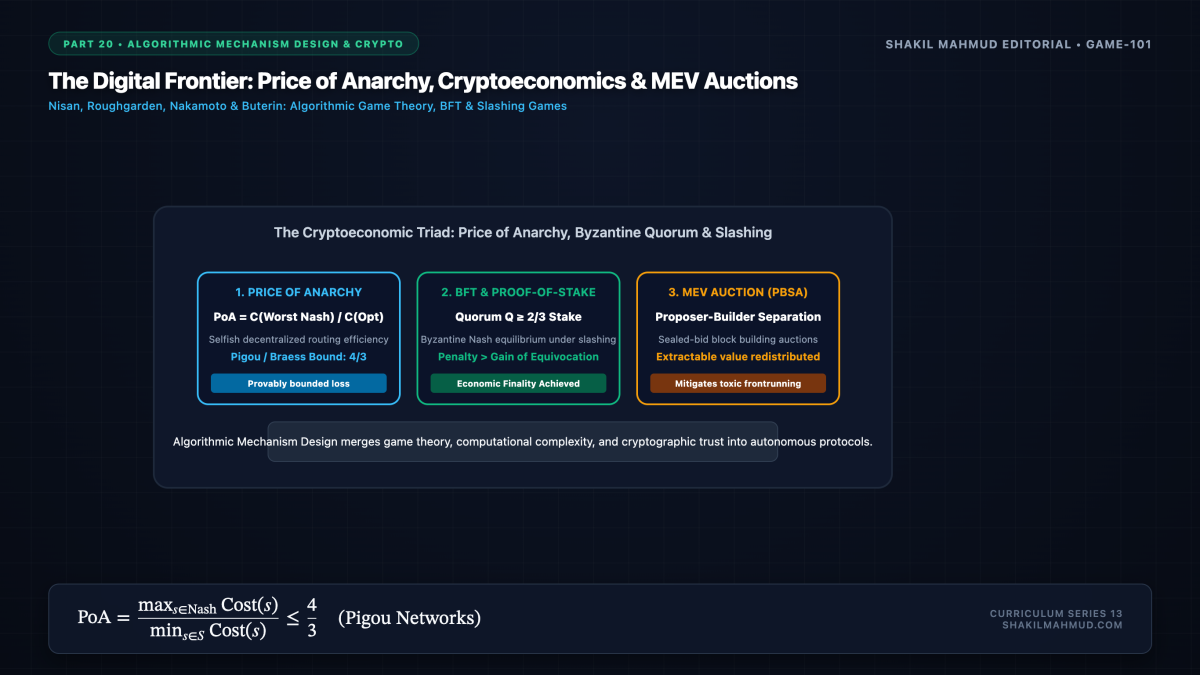
In the twenty-first century, game theory migrated from blackboard economics into the silicon substrate of computer science and decentralized networks. When millions of autonomous agents, automated trading algorithms, and self-interested blockchain validators interact over high-speed networks, classical assumptions of equilibrium meet the unforgiving boundaries of computational complexity and adversarial Byzantine environments. How inefficient is decentralized anarchy compared to a central planner? How do you secure consensus when anonymous nodes profit from double-spending? In the crucible of the digital revolution, Algorithmic Game Theory and Cryptographic Mechanism Design were born.
The Price of Anarchy (PoA)
In 1999, computer scientists Elias Koutsoupias and Christos Papadimitriou formulated a foundational concept that bridges algorithmic efficiency and strategic equilibrium: The Price of Anarchy (PoA).
In any decentralized system (such as internet packet routing, autonomous traffic navigation, or peer-to-peer torrents), selfish agents choose paths that minimize their individual latency, reaching a Wardrop/Nash equilibrium. A benevolent central planner, by contrast, would route traffic to minimize total social latency. The Price of Anarchy quantifies the efficiency penalty of decentralization:
$$text{PoA} = frac{max_{s in text{Nash}} text{Social Cost}(s)}{min_{s in S} text{Social Cost}(s)}$$
Consider the classic Pigou’s Network (1920) and Braess’s Paradox (1968): adding a new zero-cost highway to a congested road network can cause every single driver’s travel time to increase because selfish routing cascades into an inefficient Nash trap! In 2002, Tim Roughgarden proved that in all networks with affine latency functions, the Price of Anarchy is strictly bounded:
$$text{PoA} le frac{4}{3}$$
Selfish decentralization destroys at most $33.3%$ of social welfare compared to a totalitarian central dispatcher. Mathematical anarchy possesses a provable efficiency guarantee.
Cryptoeconomics: Byzantine Fault Tolerance Meets Nash
In 2008, an anonymous cryptographer named Satoshi Nakamoto solved a computer science problem that had stood unresolved for thirty years: the Byzantine Generals Problem in an open, permissionless network.
Traditional distributed systems (Leslie Lamport, 1982) assumed that nodes are either honest or arbitrarily malicious (Byzantine). Nakamoto realized that in open networks, nodes are neither saints nor villains: they are rational economic agents responding to incentives. Nakamoto Consensus merged cryptography (SHA-256 hash chains, elliptic curve digital signatures) with game-theoretic mechanism design:
- Proof-of-Work: Block generation requires burning un-fakeable thermodynamic energy ($O(2^{256})$ search).
- The Incentive Engine: A block proposer receives block subsidies and transaction fees only if subsequent miners build upon their block (the longest-chain rule).
- Nash Equilibrium of Honesty: An attacker with less than $51%$ of hash power maximizes expected economic profit not by attacking the ledger, but by playing honestly. Attacking destroys the market value of the very coins they seek to steal. Honesty is engineered as a subgame perfect equilibrium.
Proof-of-Stake & Slashing Games
Modern blockchains (e.g., Ethereum’s Gasper consensus) transitioned from thermodynamic proof-of-work to Proof-of-Stake (PoS). In PoS, validators lock economic capital (stake) as collateral. Here, mechanism design introduces algorithmic Slashing Penalties:
If a validator signs two conflicting blocks at the same height (equivocation), cryptographic proof of the double-signature is submitted to the chain, and the protocol automatically burns their entire staked collateral. By setting the penalty for treason strictly higher than any conceivable double-spend extraction, Byzantine sabotage becomes game-theoretically irrational.
MEV & The Auction Architecture of Modern Blockchains
On decentralized finance (DeFi) platforms, transaction ordering dictates wealth. If an automated market maker exhibits price divergence, the first transaction to execute arbitrage captures thousands of dollars. This gave rise to Maximal Extractable Value (MEV): specialized algorithmic bots (“searchers”) engaging in toxic gas-price priority wars, clogging the network, and frontrunning retail orders.
To tame this chaos, cryptographers and economists designed Proposer-Builder Separation (PBS) and MEV-Boost auctions: an open, off-chain second-price/first-price auction where specialized block builders compete to pack blocks efficiently and bid payments directly to validators. Toxic mempool warfare is channeled into an orderly, game-theoretic Vickrey-style auction, redistributing value back to network security.
From John von Neumann’s zero-sum matrices in 1944 to Ethereum’s cryptographic slashing mechanisms in 2026, Game Theory has completed its grand historical trajectory: from describing human conflict to mathematically compiling the autonomous economic operating system of reality.