Until the late 1960s, game theory rested upon a colossal, unrealistic idealization: that every player possesses complete information regarding the rules, payoff functions, and strategic motivations of every opponent. In military warfare, generals do not know whether the enemy possesses superior radar or runs low on ammunition; in financial markets, a venture capitalist does not know whether a founder’s technology is genuine breakthrough or fraudulent vaporware. For twenty years, this informational fog rendered game theory practically impotent in real-world economics. In 1967, Hungarian-American economist John Harsanyi published a breathtaking three-part paper in Management Science that resolved the problem entirely, earning him the 1994 Nobel Memorial Prize in Economic Sciences.
The Infinite Regress of Beliefs
Why was incomplete information considered mathematically impossible to model? Because it sparked an intractable epistemological infinite regress: “I wonder what he thinks I think he thinks about my costs, and what he thinks I think he thinks I think about his valuation…” Every tier of uncertainty spawned a higher-order probability distribution over opponent probability distributions, escalating ad infinitum.
The Harsanyi Transformation: Introducing Nature
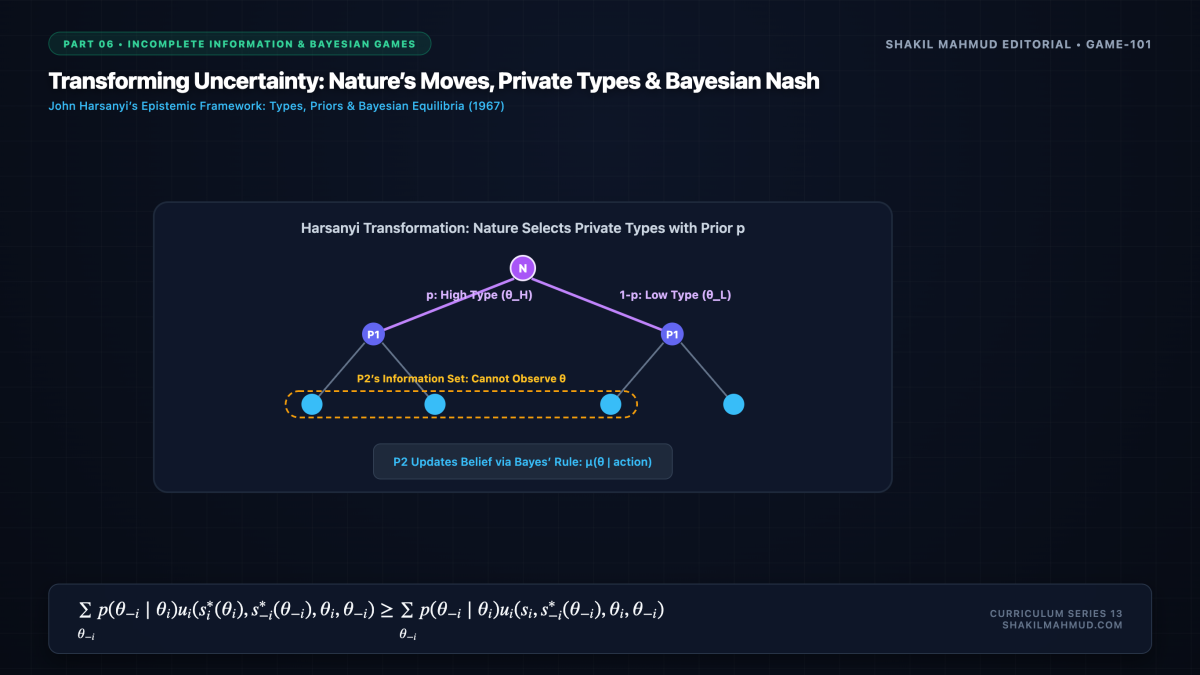
Harsanyi’s stroke of genius was to replace the infinite regress of subjective beliefs with a single, unified probabilistic move by an impartial entity: Nature.
- All private parameters governing an agent’s payoff (their valuation, marginal cost, risk aversion, or technical capability) are summarized into a single random variable called their type, denoted $theta_i in Theta_i$.
- Before the game begins, Nature moves first. Nature draws a joint type profile $theta = (theta_1, dots, theta_n)$ from the type space $Theta = prod_{i=1}^n Theta_i$ according to an objective, common prior probability distribution $p(theta)$.
- Each player $i$ observes exclusively their own private type $theta_i$, remaining ignorant of the realized types $theta_{-i}$ of opponents.
- Using the common prior $p(theta)$ and their observed type $theta_i$, player $i$ computes a posterior subjective belief over opponents’ types using Bayes’ Rule:
$$p(theta_{-i} mid theta_i) = frac{p(theta_i, theta_{-i})}{sum_{theta’_{-i} in Theta_{-i}} p(theta_i, theta’_{-i})}$$
Through this transformation, an intractable game of incomplete information is converted into a standard extensive-form game of complete but imperfect information, where player types are simply unobserved branches of Nature’s opening lottery.
Bayesian Nash Equilibrium (BNE)
In a Bayesian game, a strategy for player $i$ is not merely a single action; it is a complete contingent decision rule $s_i: Theta_i to A_i$ mapping every conceivable type they might embody into an action in the game.
A strategy profile $s^* = (s_1^*, dots, s_n^*)$ is a Bayesian Nash Equilibrium if, for every player $i in N$ and for every possible type $theta_i in Theta_i$, the action $s_i^*(theta_i)$ maximizes expected utility given opponents’ strategies and posterior beliefs:
$$s_i^*(theta_i) in argmax_{a_i in A_i} sum_{theta_{-i} in Theta_{-i}} p(theta_{-i} mid theta_i) u_i(a_i, s_{-i}^*(theta_{-i}), theta_i, theta_{-i})$$
At a Bayesian Nash Equilibrium, each player maximizes their expected utility conditional on their private information, with correct Bayesian expectations about how opponents of various hidden types will strategically respond.
Harsanyi’s transformation unlocked the modern economic universe: without Bayesian games, it is mathematically impossible to formalize auction design, financial market microstructure, insurance contracts, or military intelligence.