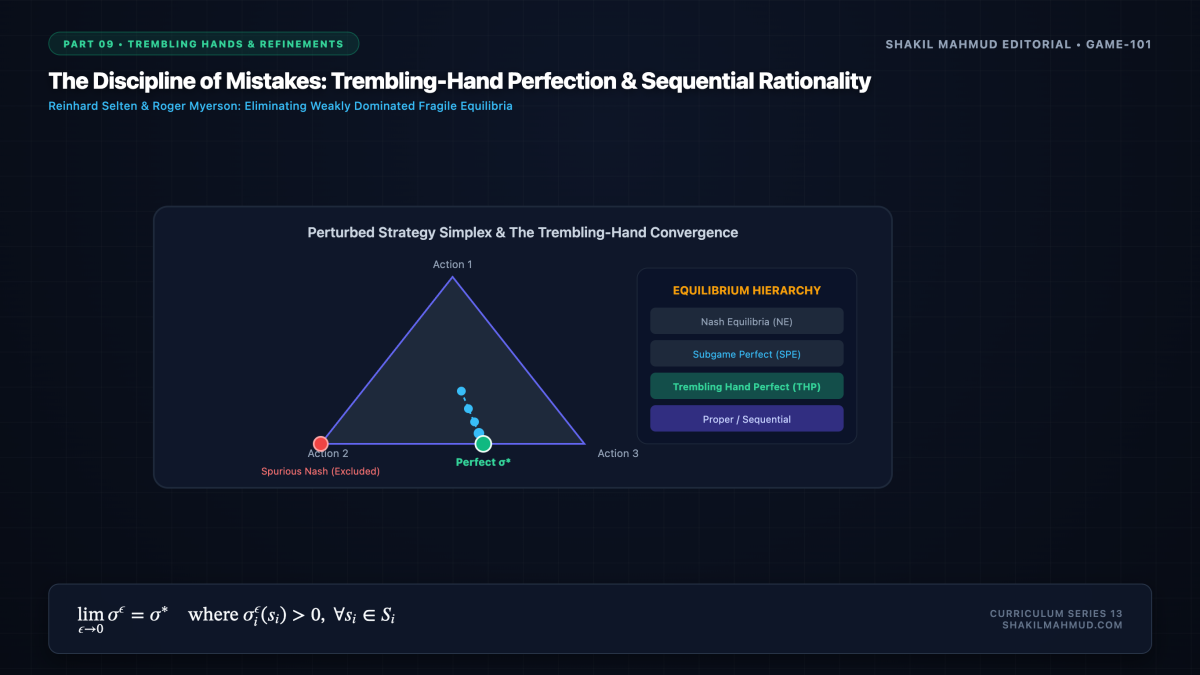
John Nash proved that every finite game has an equilibrium, but he did not prove that every equilibrium makes strategic sense. In many games, multiple Nash equilibria exist, some of which rely on razor-thin razor edges of indifference or the assumption that adversaries never slip. In human combat and machine systems, perfection is a myth: human fingers tremble, software packages suffer cosmic-ray bit flips, and execution errors occur with non-zero probability. In 1975, Reinhard Selten introduced a profound mathematical refinement: Trembling-Hand Perfection. By demanding that an equilibrium survive the introduction of infinitesimal mistakes, Selten purified game theory of its most fragile mathematical phantoms.
The Pathology of Weak Dominance
Consider a simple 2×2 game between Player 1 and Player 2:
- If Player 1 chooses Top ($T$) and Player 2 chooses Left ($L$), payoffs are $(1, 1)$.
- If $(T, R)$, payoffs are $(0, 0)$.
- If Player 1 chooses Bottom ($B$) and Player 2 chooses $L$, payoffs are $(0, 0)$.
- If $(B, R)$, payoffs are $(0, 0)$.
Notice that for Player 1, choosing $T$ weakly dominates $B$: $T$ yields $1 ge 0$ against $L$, and $0 ge 0$ against $R$. Under no circumstances is $B$ strictly superior to $T$. Yet, examine the strategy profile $(B, R)$. If Player 2 plays $R$, Player 1 compares $0$ against $0$ and is completely indifferent. If Player 1 plays $B$, Player 2 compares $0$ against $0$ and is completely indifferent. Therefore, $(B, R)$ is technically a legitimate Nash equilibrium!
Yet $(B, R)$ is deeply unnatural. Player 1 is choosing an action that can never win and can easily lose if Player 2 makes even a 1-in-a-million slip and plays $L$. Why would any rational agent rest their fate on an equilibrium supported exclusively by weakly dominated strategies?
Selten’s Perturbed Games & Trembles
To eliminate these spurious solutions, Selten considered a perturbed game $G(epsilon)$ where players intend to choose pure strategies, but their hands “tremble” with some small probability $epsilon > 0$. Every pure action must be played with at least probability $epsilon_{ia} > 0$:
$$sigma_i(a) ge epsilon_{ia} > 0, quad sum_{a in A_i} sigma_i(a) = 1$$
Because every action is played with strictly positive probability, the interior of the strategy simplex is fully explored. No information set can ever be reached with probability zero. A strategy profile $sigma^*$ in the original unperturbed game is Trembling-Hand Perfect if there exists a sequence of perturbed games $G(epsilon^k)$ with error bounds $epsilon^k to 0$ and an associated sequence of equilibria $sigma^k$ of $G(epsilon^k)$ such that:
$$lim_{k to infty} sigma^k = sigma^*$$
In our example, if Player 2 trembles and plays $L$ with even probability $epsilon > 0$, Player 1’s expected payoff for $T$ is $epsilon times 1 + (1-epsilon) times 0 = epsilon > 0$, while $B$ yields exactly $0$. Top strictly defeats Bottom for every $epsilon > 0$. The spurious equilibrium $(B, R)$ evaporates under the slightest perturbation, leaving $(T, L)$ as the unique trembling-hand perfect equilibrium.
Equilibrium Refinements Hierarchy
Trembling-hand perfection inaugurated the great era of equilibrium refinements:
- Subgame Perfection (Selten, 1965): Eliminates incredible threats in proper subgames.
- Trembling-Hand Perfection (Selten, 1975): Eliminates weakly dominated strategies by testing against full-support mistakes.
- Proper Equilibrium (Myerson, 1978): Requires players to tremble more toward less costly mistakes (mistakes are rationalized according to their relative damage).
- Sequential Equilibrium (Kreps & Wilson, 1982): Fully specifies consistent belief assessments $(mu, sigma)$ at every unreached information set in extensive games.